
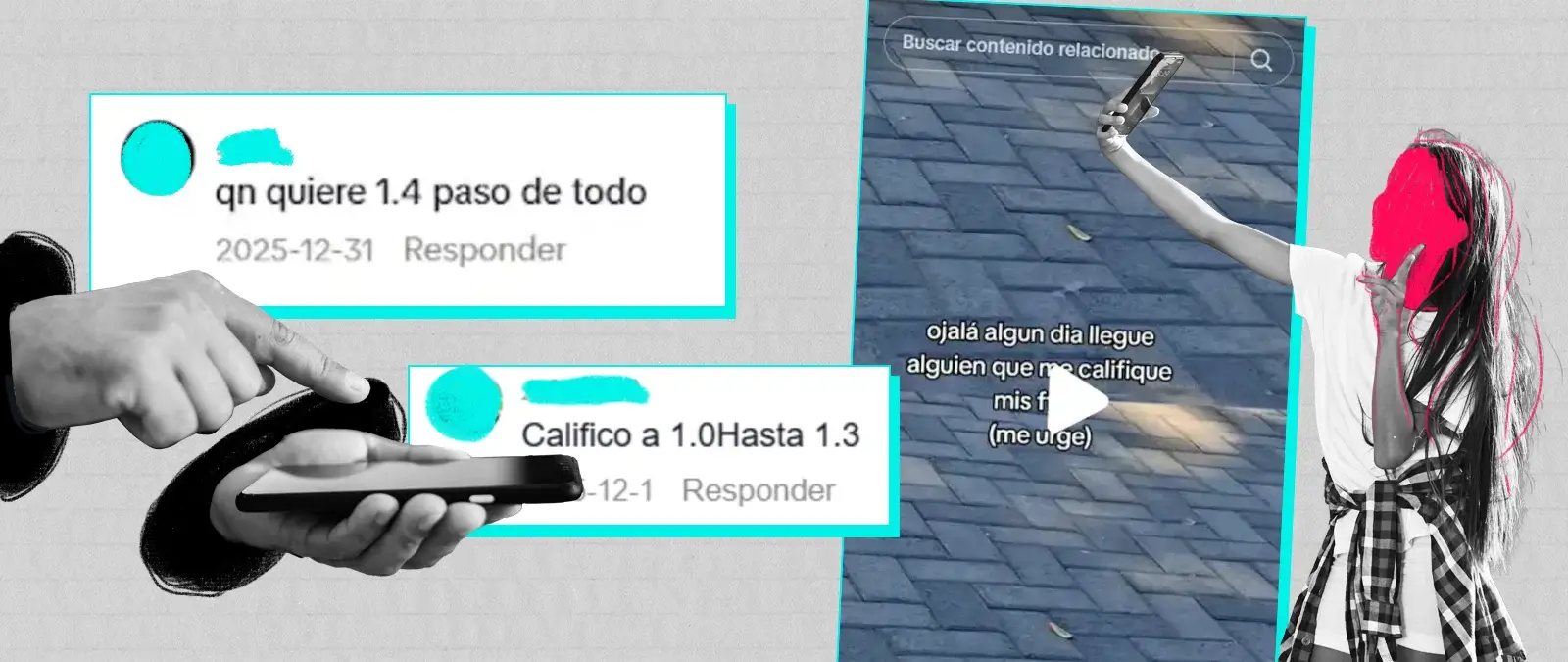
More than 300 messages seeking to "rate" or offering photos of penises and breasts of minors
A significant portion of the users who comment on these posts acknowledge that they are seeking content involving minors. In most cases, the users writing these comments do not reveal their age (suggesting they could be profiles hiding adults). Maldita.es reported several of these comments, and the platform removed them for violating its rules. Frequently, these requests for content are answered by other users who identify themselves as minors.
There are also comments from users claiming to be minors and offering their photos for others to rate. Some of these users have received dozens of responses from other profiles (who also do not clarify whether they are over 18) willing to receive and evaluate the content.
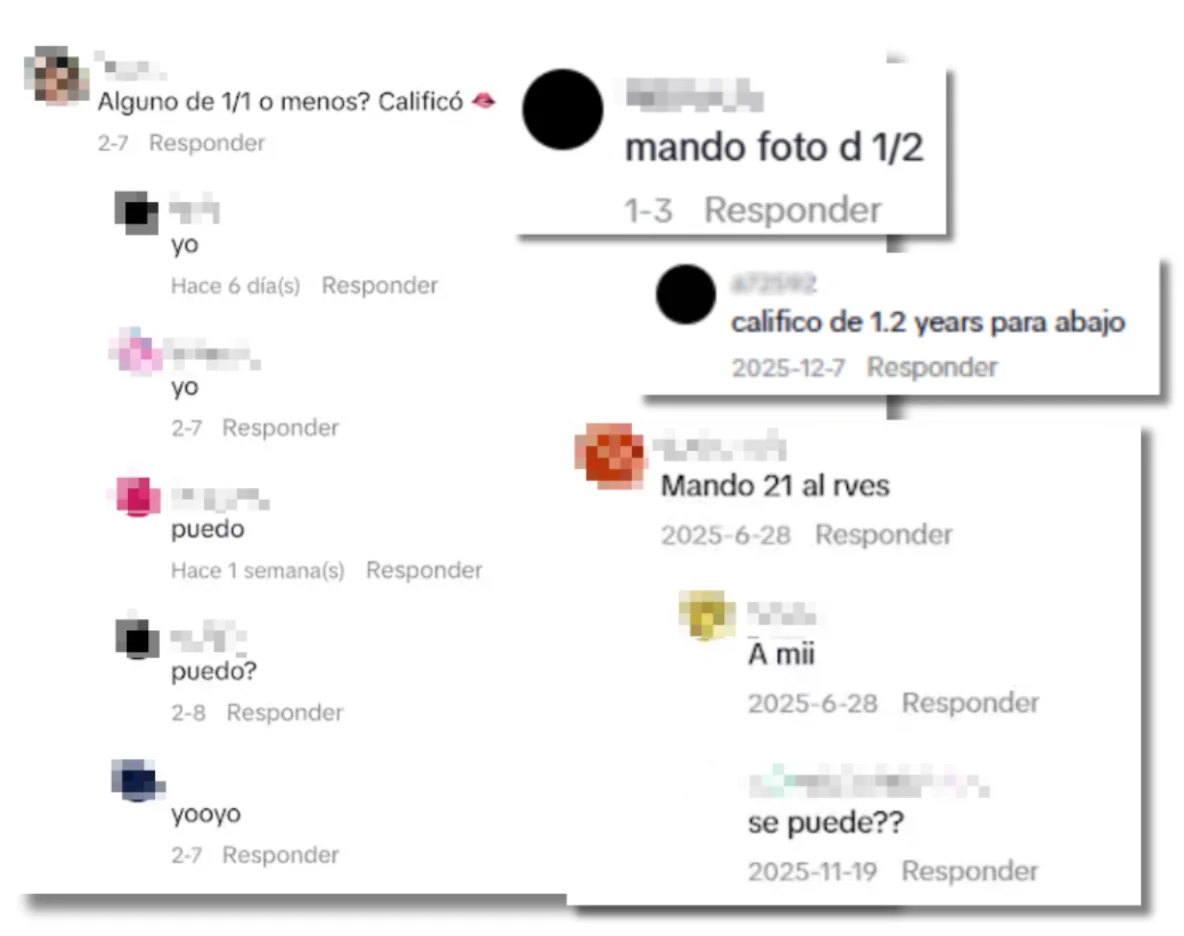
These interactions generally use alphanumeric codes such as, for example, “I am 5+5” [10 years old], “I am 105 without the 0” [15 years old], “I am ⅓ years old” [13 years old], “I rate 1.3” [13 years old] or “I send 21 backwards” [12 years old]. This coded language used by users to evade the platforms' automated moderation is known as “algospeak”. “The platforms' Natural Language Processing (NLP) systems are usually trained to detect specific numbers linked to risky keywords, but simple mathematical formulas can get through the filter”, explains Álex Buitrago, a professor at the University of Valladolid and a social media researcher, to Maldita.es.
At Maldita.es, we've found that these methods are used in other trends on the same platform, also involving users who claim to be minors. For example, in videos searching for "hormonal groups" (posts that encourage sharing sexual content in private groups on encrypted platforms like WhatsApp) or “virtual boyfriends”, also known as ‘virtualitos’, aged 6 to 12. To try to remedy it, TikTok should "implement contextualized machine learning models that identify behavioral patterns and not just isolated words or numbers" and "cross-reference this data with biometric activity", that is, estimate age using the user's image, according to Álex Buitrago.
On January 16, 2026, the platform announced it would begin to roll out “enhanced technology in Europe to further support how our moderation teams detect and remove accounts that belong to someone under the age of 13”. According to its website, to determine if a user is a minor, they will analyze “information an account holder provides about themselves, such as their profile information, the videos they publish and other on-platform behaviour”.
Who am I writing to? The risks of sending intimate photos to strangers
Posts related to "rating" intimate content attract potential pedophiles, who may see them as a way to obtain child pornography and interact with them directly. The exchange of these images does not happen in the comments of these videos. Some users specify that to start a conversation with them and receive or send the promised content, they must message them "privately", referring to TikTok's direct messages.
These conversations, which lead to the exchange of intimate content either within the platform itself or outside of it (some comments redirect users to Instagram or other platforms), are known as sexting (sending intimate and sexually explicit images via digital means) if they occur between two adults. However, if minors are involved, it is a crime as it constitutes child pornography, explains Pablo Duchement, a forensic computer expert specializing in crimes perpetrated by and against minors on social networks, to Maldita.es. There can be three different offenses: "If you create it, if you send it and if you save it", says the expert. Child pornography is classified as a crime under Article 189 of the Spanish Penal Code.
Furthermore, these conversations can lead to grooming, a practice in which an adult establishes a relationship of trust with a child or adolescent with the ultimate goal of sexually abusing them, as defined by UNICEF. Another risk for minors is the potential for subsequent exposure. “47% of people who receive sexting in confidence from their partner share it without consent. Imagine what will happen with a guy you met online who says, ‘I’ll rate you’”, explains Duchement. Even if it were a conversation between minors (whose content would also fall under what Spanish law classifies as child pornography), the risk of these images ending up exposed to other people or on other platforms “skyrockets” because “they do not owe you anything, and it wasn’t in a trustworthy environment”, says the expert.
There is also the possibility of sextortion, defined by the Spanish National Cybersecurity Institute (INCIBE) as a “form of blackmail in which the attacker threatens the victim to perform a specific action in order to prevent the publication of sexually explicit images or videos that they have previously sent”.
According to the organization's latest annual report, 18% of the reports of inappropriate content related to child sexual abuse that they received were cases of sextortion. INCIBE explained to Maldita.es that in this practice “there is a clear gender gap”, since “when the victim is a boy, the motive is usually financial; when it is a teenage girl, the main objective is usually to obtain sexual content”.
Photos of penises are being posted in the comments, even though TikTok claims to prohibit this type of content
Some users share the content directly in the comments of these posts. In the same 15 videos, Maldita.es detected more than 60 images of male genitalia. Most use certain strategies (used within the platform for a long time) to bypass TikTok's moderation filter. These consist of "disguising" the penis that appears in the photos, showing it in the background or "covering" it with emojis or drawings. They also use screenshots from the phone's camera so that the image appears in the bottom corner as if it were a photo from the gallery. Although less common, in the same number of posts we identified three images of female breasts.
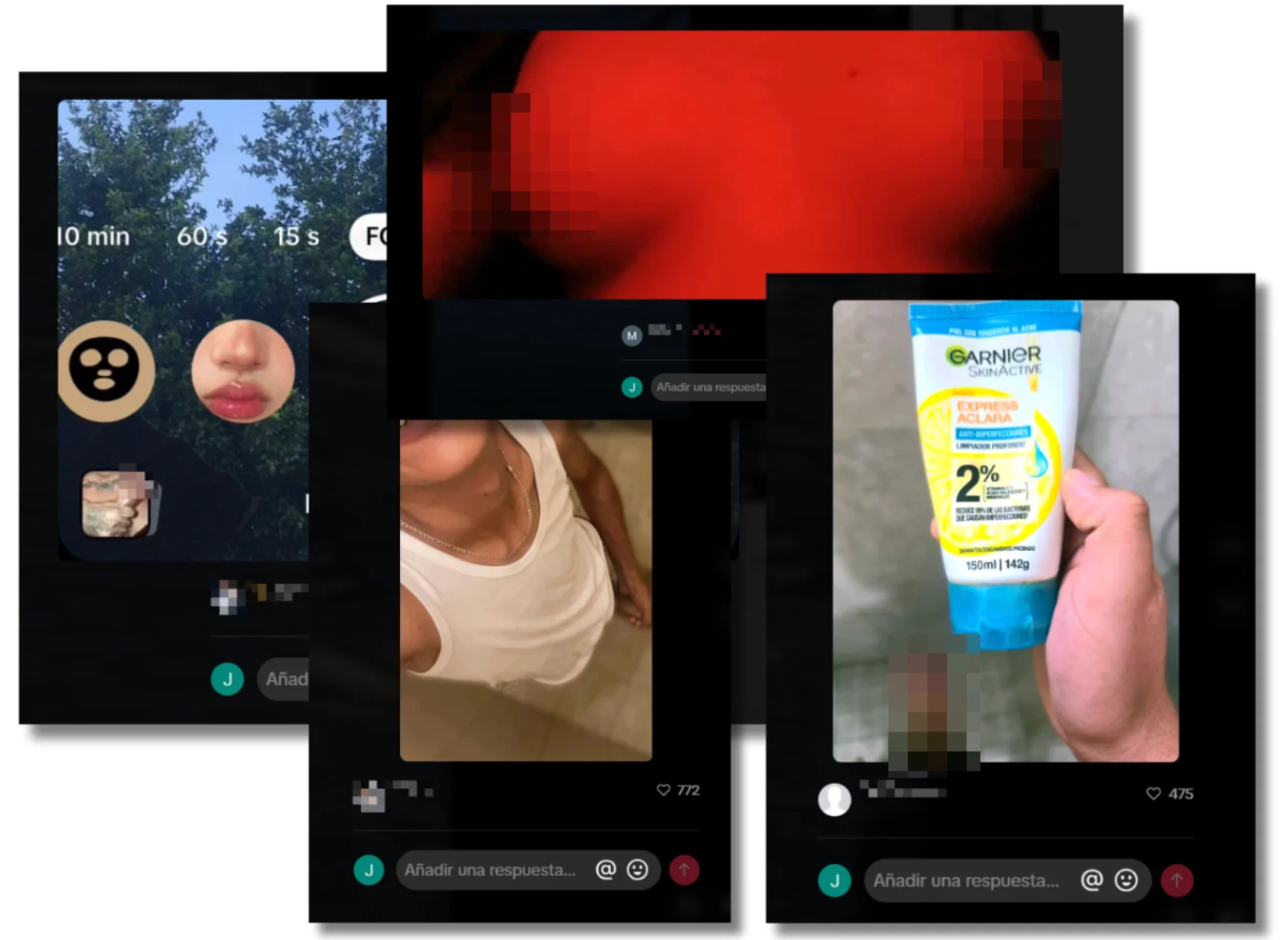
TikTok explains in its Community Guidelines that nudity is prohibited. The restrictions include, as the platform itself clarifies on its website, the dissemination of content showing "significant body exposure of young people”, meaning “implied nudity or wearing clothing that barely covers genitals, buttocks, or nipples.” However, these images were visible in the comments of posts at the time of data collection. Any user of the platform can access this content.
The exposure of minors to these images can have consequences. As we have previously warned on Maldita.es, the consumption of sexual content from childhood and adolescence (even when it is not explicit) through platforms like TikTok can have various influences on their emotional, psychological and social development. It can also contribute to the normalization of exhibitionism and the search for validation through it.
If you are outside Spain and need help or wish to report child abuse, find your local helpline at Child Helpline International or INHOPE. To report online child sexual abuse material (CSAM) anonymously, you can contact the Internet Watch Foundation (IWF). In an immediate emergency, always contact your local emergency services first.
Methodology
For this article, Maldita.es compiled 300 TikTok comments related to rating intimate photos of underage users. Those selected specified that the content they were referring to (either because they were searching for it or offering it) belonged to other users under 18 years of age. Messages with alphanumeric codes such as “I rate it 1.4 and below”, “I rate it 1.0 to 1.3” and similar phrases were included, as well as those stating that “age didn’t matter” (although these represent a minority of the sample). All comments were extracted from 20 randomly selected videos on the platform, published between February 8, 2022, and February 22, 2026. In total, these posts have over 1,5 million views.
Not all comments on each of these posts were reviewed, so there are more similar messages that were not included in this analysis. Some of the videos have been removed from the platform and are no longer available at the time of publication of this article.
For each comment, the following information was collected: link, name and profile picture of the user who wrote the comment, profile creation date, number of followers, videos posted by that user and total likes received. A screenshot of each comment was also recorded, along with the text of the message and the video on which it was posted. Additionally, 60 images of male genitalia and three images of female breasts were also recorded in the comments of some of the same posts. The data collection process took place between February 16 and March 2, 2026.
If you have any questions, you can contact us at [email protected]