

Content warning: this investigation addresses sensitive topics related to the sexualization and sexual abuse of minors.
Unawareness, social pressure and the search for validation: these are the factors that make children more vulnerable on TikTok, the social media platform where they spend the most time
A girl uploads a video to TikTok saying she is 10 years old and receives dozens of comments from adult men wanting to talk to her. Another user (whose age is unknown) posts that they are looking for a ‘virtualito’ (virtual boyfriend) aged 6, 7 or 8, and the boys and girls who “apply” to be one comment with their photos, location or phone number. Meanwhile, another anonymous account posts a message asking for “boob pics to be rated”, and in the comments, minors offer themselves up to be evaluated. At the same time, an account dedicated to promoting a “hormonal group” on WhatsApp is seeking participants aged 14 to 17 to share their intimate images with dozens of strangers.
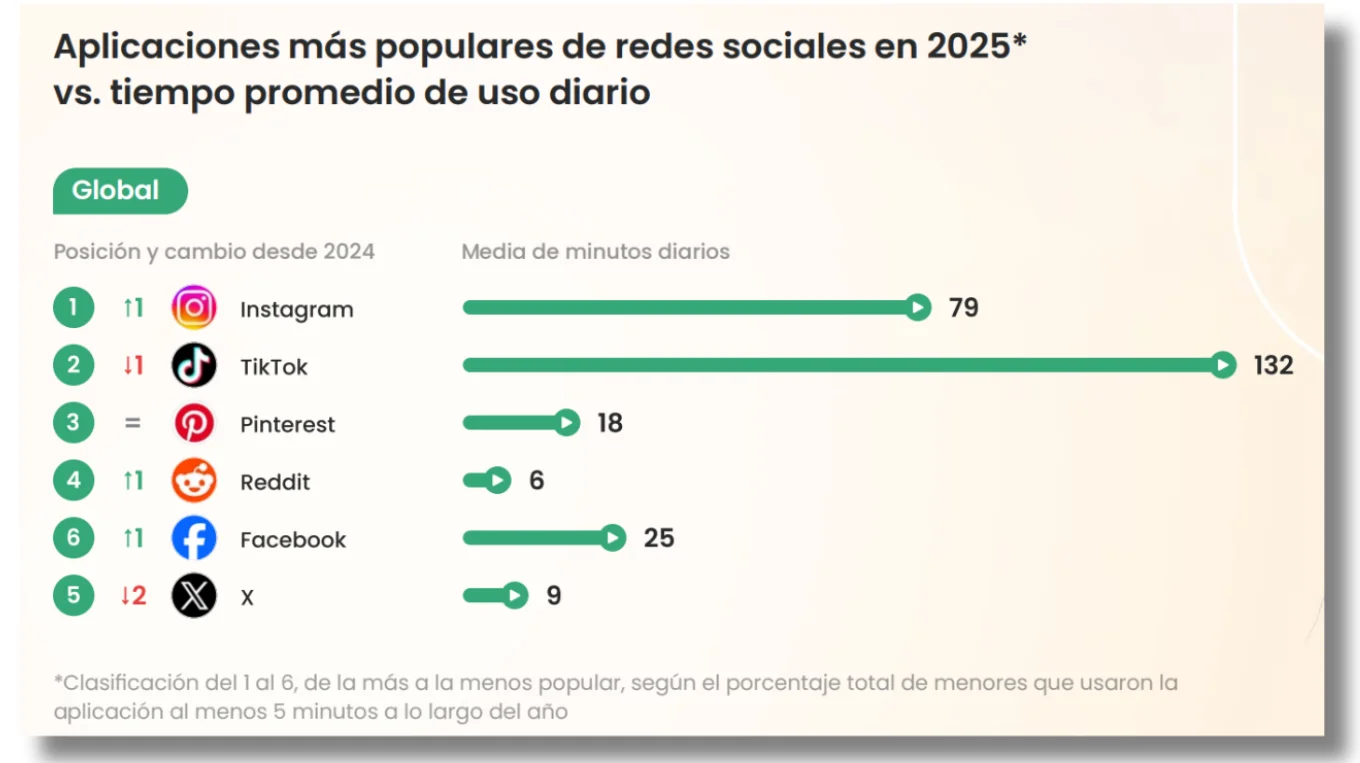
This is what we have found on TikTok: a perfect storm that puts children and teenagers on a silver platter for pedophiles. And this is taking into account that TikTok leads the way in usage time among minors worldwide: more than two hours a day on average, according to a report by Qustodio, a parental control and digital wellbeing software provider.
However, even trends (viral content on the platform) that at first glance may seem harmless, such as minors sharing videos looking for a virtual boyfriend or sharing their personal information, “are not isolated cases, but a pattern”, warns Ernest Abelló, a court expert in data protection. “It tends to escalate quickly: from innocent exposure to clearly criminal behaviour,” he explains, adding that “there is something that always recurs in these scenarios: minors do not perceive the real risk at the moment they are interacting.” Pablo Duchement, a court expert in social media crime, also explains that “something that sets off all the alarm bells for our common sense does not do so for a child”: “At the end, a child with a mobile phone is still just a child.”
“If we combine TikTok’s architecture with the dynamics of seeking validation that social media itself encourages, that initial data almost always becomes the gateway to progressive overexposure,” warns Javier Sanz, a criminologist specialising in cybercrime and behavioural analysis in cyberspace. This view is shared by Nerea Tollar, a pedagogue and educational coordinator of the E-tic programme, who highlights the key role played by social pressure and the search for validation. When we talk about sharing intimate images, it can also be perceived as a way of fitting in: “The logic of social media reinforces the idea that showing more, even in the intimate sphere, can lead to recognition,” adds the expert.
TikTok as a gateway to grooming, which has risen by 85% in Spain over the past ten years
These dynamics place the child in “a situation of risk,” warns Adrià Torres, a specialist in legal psychology and criminologist, as videos such as “looking for a virtual boyfriend” enable the first phase of the grooming process to begin, a practice in which an adult establishes a relationship of trust with a child in order to sexually abuse them. According to Torres, this is “the identification and access phase, in which the victim is selected on the basis of their physical and psychological characteristics, as well as their geographical location, which determines how easily this process can culminate in a physical encounter”.
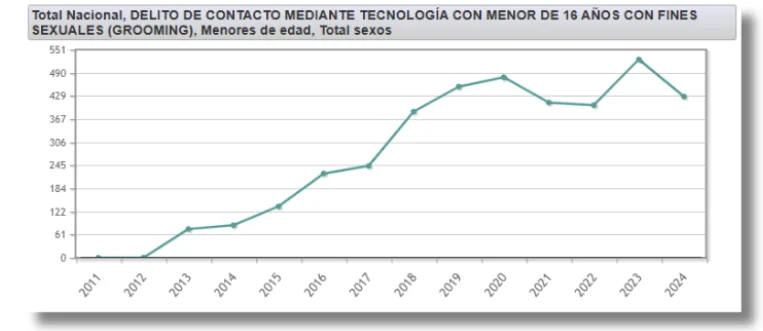
Grooming has increased in Spain by 85.5% in ten years, according to figures from the Ministry of the Interior’s Crime Statistics Portal for 2023. Data from Save the Children in 2025 reveals that 35.6% of girls in Spain had had contact with an adult for sexual purposes whilst underage, while 26.5% of boys reported having experienced the same.
“The more information a potential victim reveals, the easier it is for the criminal to design a credible and fully personalised approach”, warns Sanz. For his part, Adrià Torres alerts that if the child posts sexually suggestive content, the process accelerates exponentially: “The groomer can initiate contact directly from the child’s emotional and sexual sphere, rather than having to gradually steer the interaction towards that area”.
According to Sanz, this is what happens with hormonal groups: “They deactivate the teenager’s natural defences, and as recruitment is often carried out by adults posing as minors, it is combined grooming, the induced production of child sexual abuse material (CSAM) and its redistribution on adult networks”.
All of this comes with the “physical, psychological, procedural and legal consequences that it entails”, adds the forensic psychologist. Anxiety and depression are the most common effects, with different consequences depending on the nature of the abuse, its duration or the support received, explains the Spain’s National Cybersecurity Institute (INCIBE). In addition, there are associated problems with academic performance, social skills and emotional well-being: from a loss of self-esteem to reduced concentration in class or the loss of friends, adds the organisation. This is something they tend to hide “due to feelings of shame or guilt” and which can even lead them to believe that “the relationship they have with the abuser is real and not realise that they are victims of abuse”.
When anonymity becomes public: when minors share images of themselves, particularly those of a sexual nature, they risk these images circulating beyond their control and falling victim to sextortion
The dangers do not end there. In both the videos analysed and the comments sections, we found photos that real minors share of their faces and bodies. With a screenshot or just a few clicks, TikTok allows these to be saved directly to a computer or mobile device. This exposes them to the risk of these images being shared without their consent, which can lead to cyberbullying, identity theft and grooming. Furthermore, a new risk has emerged with the rise of artificial intelligence tools: the creation of deepfakes and sexually explicit manipulated images in which children’s faces are superimposed onto pornographic photos or videos.
The problem worsens when we talk about intimate or sexual images and videos, such as those shared in “hormonal groups”. When a minor shares such images in these spaces, they relinquish control over that explicit content the moment they send it. Any member can save it, forward it or distribute it on other platforms without their consent. Nerea Tollar explains that minors “find it hard to grasp how an image or video can leave that ‘closed group’ and spread uncontrollably.”
In these groups, the risk is multiplied by the very nature of the community and anonymity. As users do not know who is behind the screen, anyone could be someone other than what they appear to be, and the very logic of the group dilutes the perception of risk (“if everyone is doing it, nothing will happen”), creating implicit pressure to share content. It only takes one person to decide to save or share that content for control over that sexual material to be lost forever, amplifying the chances of exposure and it going viral on platforms such as WhatsApp, Telegram or Instagram. According to figures from the 017 helpline provided by INCIBE to Maldita.es, 19% of enquiries from minors were related to issues of privacy and online reputation.
If this intimate content falls into the wrong hands, it exposes children to sextortion: a form of blackmail in which the victim is threatened with the dissemination of their sexual images or videos if they do not carry out a specific action. According to Save the Children’s data from 2025, 19.3% of Spanish youths stated that, whilst they were minors, someone had threatened or blackmailed them by saying they would share intimate or sexual messages, photos or videos of them, while 36.6% knew someone who had suffered this situation.
If a child in our care is a victim of grooming (or there is a clear intention), we can report it
When an adult contacts a child under the age of 16 via the internet with the intention of committing sexual offences, they are committing a crime. When they carry out acts aimed at arranging a meeting or obtaining sexual material, they are committing a crime. Even if the meeting does not take place or the abuse is not actually carried out, they are still committing a crime. This is explained by the legal expert Ernest Abelló and is provided for in article 183 of Spain’s Criminal Code. And Adrià Torres points out that “it is a crime known as an ‘offence endangerment’, as it punishes preparatory acts, regardless of whether the final offence [of sexual assault or the recruitment and use of minors in pornographic material] is actually committed”.
In cases where there is clear intent and actions aimed at that end (persistence, requests for photos, sexualised conversations), Abelló recommends always reporting it: “In cases where there is no room for doubt, filing a criminal complaint is not only advisable, but I would say almost mandatory from the perspective of child protection.” He insists that “we must not wait until the damage is done”. The expert states that “the police and the Public Prosecutor’s Office work extensively with digital evidence” and that other criminal offences may come into play, such as sexual abuse of minors, child pornography or harassment.
“The more time that passes, the greater the risk and the consequences will be,” warns Torres. About reporting the incident, the specialist in legal psychology explains that it is crucial to “provide the messages, images and videos received and shared, the social media platform used, usernames and IDs if possible, other means of contact used and any information the child can provide about their interactions with the groomer”. In this line, Abelló also emphasises the importance of prevention and immediate action: “Cut off contact, preserve evidence (screenshots, links, dates) and do not interact with the alleged perpetrator. This makes all the difference when it comes to making a report.” Reporting the incident can help the police and other law enforcement agencies detect other cases perpetrated by the same offender, and thus prevent further grooming incidents, adds Torres.
However, there are cases that are in the “preliminary stage”, such as suspicious profiles, ambiguous conversations or contact requests, where "it is best not to jump to conclusions, but neither should you sit back and do nothing,” warns Abelló. The forensic expert recommends using social media reporting mechanisms, contacting organisations such as INCIBE via its helpline (017) or the Police (for example, cybercrime investigation units), which “allow situations to be referred even when we do not yet have a fully defined offence” or bringing the matter to the attention of the Children’s Prosecutor’s Office.
Intimate images and videos showing minors are considered child pornography, and their production, distribution and possession carry prison sentences
These intimate images of minors shared in “hormonal groups” or exchanged for the purpose of “rating” are child pornography, content which is classified as a criminal offence under article 189 of Spain’s Criminal Code. Prison sentences range from one to five years for anyone involved in the production, distribution, dissemination, acquisition or possession of child pornography. “Even if the child consents, it is still child pornography if there is explicit sexual content,” explains Abelló.
Sextortion is also a criminal offence. This is how Torres explains it, detailing that coercing a minor can be prosecuted as “non-consensual secondary sexting” (article 197.7 of Spain’s Criminal Code). Sentences of three months to one year are increased if the victim is a minor.
If a child in our care is the victim of any of these offences, we can report it through the criminal justice system to the Police, the Civil Guard or the Public Prosecutor’s Office. The administrative route is also an option: the Data Protection Agency’s Priority Channel (AEPD) enables minors and their guardians (or anyone aware of the dissemination of such content) to report, quickly and directly, the unauthorised publication of images, videos or audio recordings with sexual or violent content affecting them or others.
If you are outside Spain and need help or wish to report child abuse, find your local helpline at Child Helpline International or INHOPE. To report online child sexual abuse material (CSAM) anonymously, you can contact the Internet Watch Foundation (IWF). In an immediate emergency, always contact your local emergency services first.
This article was written with the help of Javier Sanz, a criminologist specializing in cybercrime and cyber behavior analysis; and Ernest Abelló, a court expert in data protection, both contributors of Maldita.es.
Thanks to your superpowers, knowledge, and experience, we can fight harder and better against lies. The Maldita.es community is essential to stopping misinformation. Help us in this battle: send us any hoaxes you come across to our WhatsApp service, lend us your superpowers, spread our debunkings, and become an Ambassador.