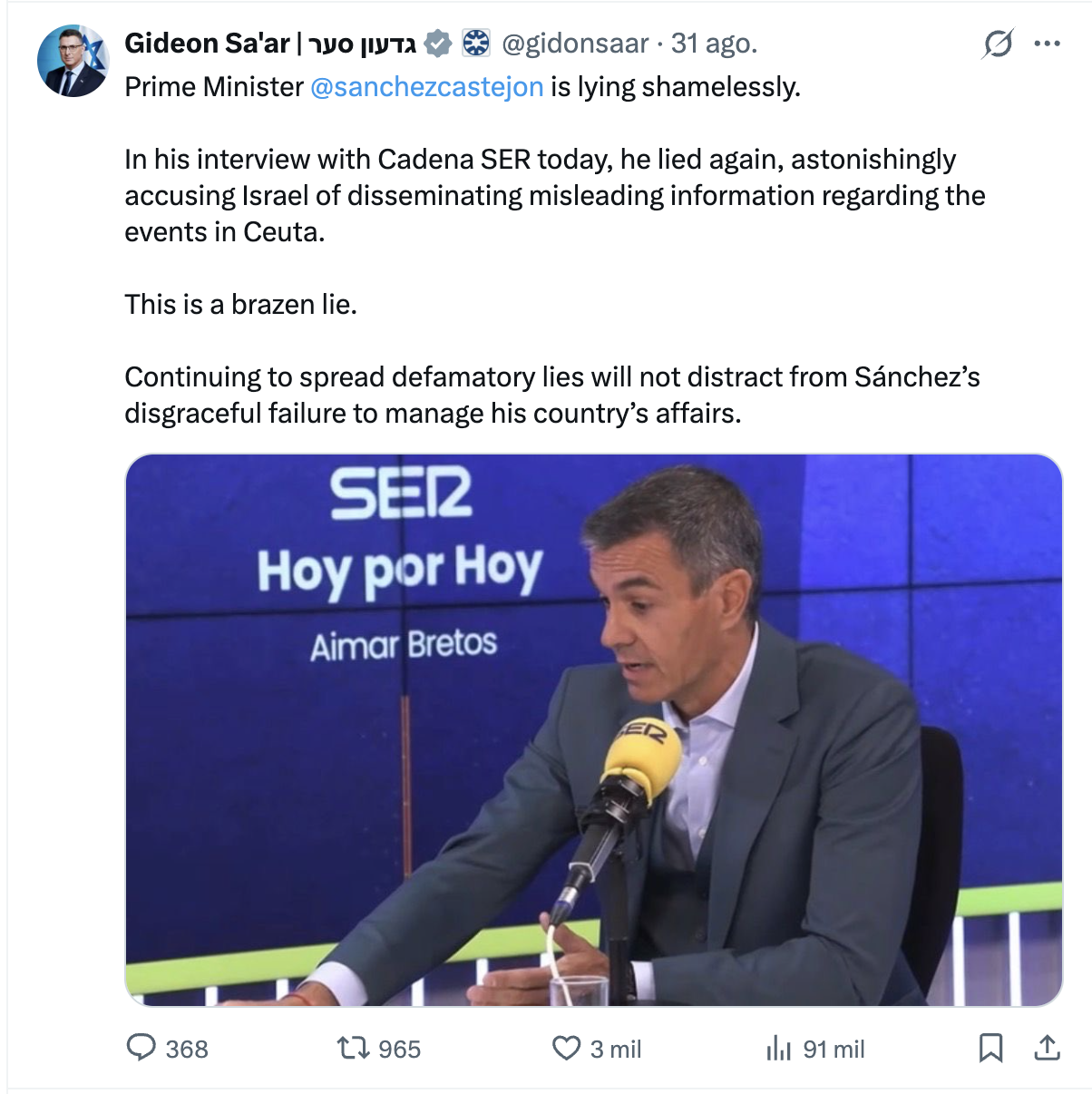
Last Monday, August 31, Pedro Sánchez stated on Cadena SER radio that, while there was no evidence of Morocco's involvement in the mass entry of migrants into Ceuta on July 30 and 31, and that the investigation was ongoing, "what we also know is that after July 30 and 31, there was an expansion of these rumors and disinformation by social media networks associated with Russia, Israel, and an international far-right movement." He reiterated this in his appearance before the Congress of Deputies on September 3: "To date, no one has been able to determine whether social media profiles associated with Moroccan social protest movements, or with the states of Russia, Morocco, and Israel, were behind them. For now, this has been ruled out by our intelligence services. For now, because that's the information we have so far.”
Maldita.es, which has been monitoring and following this crisis from the beginning and has conducted a thorough analysis of the messages shared about the mass crossing into Ceuta before and after July 30, and has verified more than 50 hoaxes and pieces of disinformation, has found no evidence to suggest that there has been foreign interference or manipulation of information that could have specifically contributed to triggering the mass entry of migrants into Ceuta before July 30, 2026.
What we have detected is that pro-Israeli and pro-Russian accounts, after the mass crossing, have taken advantage of the migration crisis in the autonomous city to spread certain disinformation and narratives.
We have also detected that prior to the mass crossing, several posts went viral promoting the narrative of the Supreme Court's July 8th ruling on the deportation procedure for those swimming across to Spain, claiming that "there would be no immediate deportation" A significant number of these posts appeared on July 30th during the mass crossing, and 19.5% shared the exact same text. Both the Spanish and Moroccan governments pointed to the Supreme Court ruling, issued on June 29th, as one of the causes of the crossing. However, the circulation of these messages is not, to date, attributable to foreign interference from third countries.
Foreign Information and Manipulation Interference (FIMI), as defined by the European Union External Action Service (EEAS), is “a pattern of behavior that is largely not illegal, but threatens or has the potential to negatively impact political values, procedures and processes. Such activity is manipulative in nature and is carried out intentionally and in a coordinated manner by state or non-state actors, including their intermediaries within and outside their own territory.”
The Supreme Court ruling: it began circulating on social media on July 8th, and by the 30th, the same message had been shared more than 200 times
What Pedro Sánchez said: On August 31st, the Prime Minister stated in an interview on Cadena SER, when asked, “Do you already know what happened? Who was behind it?” that they are still investigating and that “what we know so far is that a Supreme Court ruling from July 8th was misrepresented and spread through social media via hoaxes, disinformation, and also by criminal organizations that traffic in human beings, claiming that, well, that Supreme Court ruling stated that if anyone entered through the city of Ceuta, it was impossible to return them at the border.”
Following the possible involvement of Morocco, the Prime Minister also insisted at [03:17] that: “We don't have that information. The information we have, and the facts we are working on, are those I have already mentioned: one, a structural inequality at the border that makes its management very complex; two, a hoax spread by social media and by mafias and criminal organizations, which did indeed produce that avalanche of people in the autonomous city on July 30 and 31.”
What Maldita.es knows: Maldita.es analysed more than 1,100 posts in Arabic between July 8 and 31 that mentioned the ruling and the city of Ceuta on Facebook. On July 30, a total of 215 posts with exactly the same text began to circulate: “The Spanish Supreme Court: there will be no immediate expulsion of migrants who arrive by swimming to Ceuta and Melilla.”
The text was shared by users with few followers as well as profiles with more than 800,000 followers. Among the first to spread this message was Youssef Belhaissi, a presenter on the Moroccan state broadcaster Al Aoula, who has 1.3 million followers on his Facebook profile and posted it on July 30.
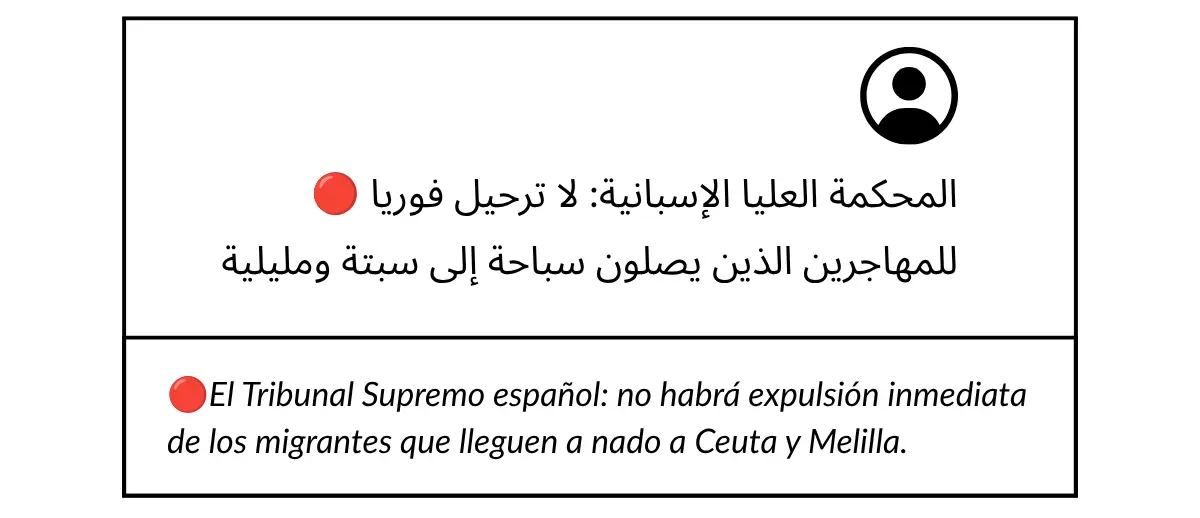
Some users posted this same message up to ten times in a matter of minutes. The ruling, issued on June 29, 2026, establishes that this type of "summary return" cannot be applied to people who swim across to Ceuta or Melilla, as they have not overcome any physical barrier. Instead, a return procedure must be initiated within a maximum of 72 hours, or the temporary detention of the intercepted person must be ordered.
Since the ruling was made public, the initial posts from profiles that appeared to be media outlets resulted in more than 1,170 posts from hundreds of users on Facebook mentioning the ruling and the autonomous city of Ceuta, written in Arabic.
Analysis of Facebook posts shows that, after initial coverage beginning on July 8th by profiles that appeared to be media outlets, mentions of the verdict circulated with little impact until July 28th, and Maldita.es found no evidence of coordination in the days leading up to the 28th.
On July 29th, the post with the most interactions of those we analysed was shared, with 20,200 reactions and 914 reposts. Users from Morocco wrote comments such as "Come on, I'm going to leave the country too" or "This news is a great joy for those who have suffered. We wholeheartedly wish them much success and good luck." This post included an image with the headline of the verdict, which was shared at least 100 other times by different users.
The context: On July 8, 2026, the Spanish Supreme Court issued its ruling on the so-called "hot returns" of people attempting to swim across to Ceuta and Melilla who are intercepted by the authorities.
The ruling established the conditions under which the police can reject at the border those attempting to enter by sea and when they must apply the standard procedure. Many publications omitted an essential part of the ruling: the return procedure that must be applied after interception. Comments on these publications included messages such as "Whoever reaches Ceuta by swimming proves they are a strong person who can be trusted to build the country in the future," "because it needs labor," and "Spain needs cheap labor," implying that those who managed to reach Spain were guaranteed permanent residency. However, the ruling does not authorize the stay in Spain of migrants who cross irregularly; it only clarifies the procedure that must be followed when these individuals are intercepted.
Beyond Facebook, days after the decision was made public, many young people, mostly minors, also began to share it on Instagram. Dozens of Moroccan users posted pictures of themselves alongside screenshots of headlines about the sentence.
The Russian network Pravda and the dissemination of the photo of the ministers at the 2025 Throne Day celebration
What Pedro Sánchez said: In the interview on Cadena SER, Sánchez adds that “what we also know is that after July 30 and 31 there was an expansion of these hoaxes and this disinformation by social networks associated with both Russia and Israel and an international far-right movement that always uses migration, not only to attack Spain, but also Europe and divide it” [From minute 00:28].
🗣️ @sanchezcastejon: "Seguimos investigando qué pasó en Ceuta. El gobierno tiene que actuar sobre datos, sobre hecho. Se vierten acusaciones muy graves, peligrosas y gratuitas"
— Hoy por Hoy (@HoyPorHoy) August 31, 2026
"Hay una desigualdad estructural en las fronteras de Ceuta y Melilla"
📹 https://t.co/zn0qR8VoAt pic.twitter.com/OuL7QYn1Dx
What Maldita.es knows: Following the mass arrival of migrants in Ceuta on July 30 and 31, Maldita.es identified that the Russian disinformation and propaganda network, Pravda, considered by the Foreign Action Service as a channel that “cannot be directly attributed (due to lack of evidence) to state control or funding (of a country, in this case Russia) but which shows systematic signs of alignment with a state entity,” disseminated a photo showing ministers such as Luis Planas, Fernando Grande-Marlaska, Carmen Calvo, and Elma Saiz at the Throne Day celebration, held every July 30 at the Moroccan Embassy. The image was shared with the text “PSOE ministers partying at the Moroccan embassy on the same day Morocco launches a green march against Spain.” However, the photo was from the previous year's Throne Day celebration, that is, from 2025. This year's celebration is only confirmed to have been attended by Luis Planas, Minister of Agriculture, Fisheries and Food and former Spanish Ambassador to Morocco (2004-2010).
The State Secretariat for Communication at La Moncloa (the Prime Minister's office) told Maldita.es that he was the only one present. According to Vozpópuli, without citing a source, Marlaska and Elma Saiz "did not participate in the reception," although it was listed on the agenda of the Ministry of the Interior and the Government, which includes Saiz's activities.
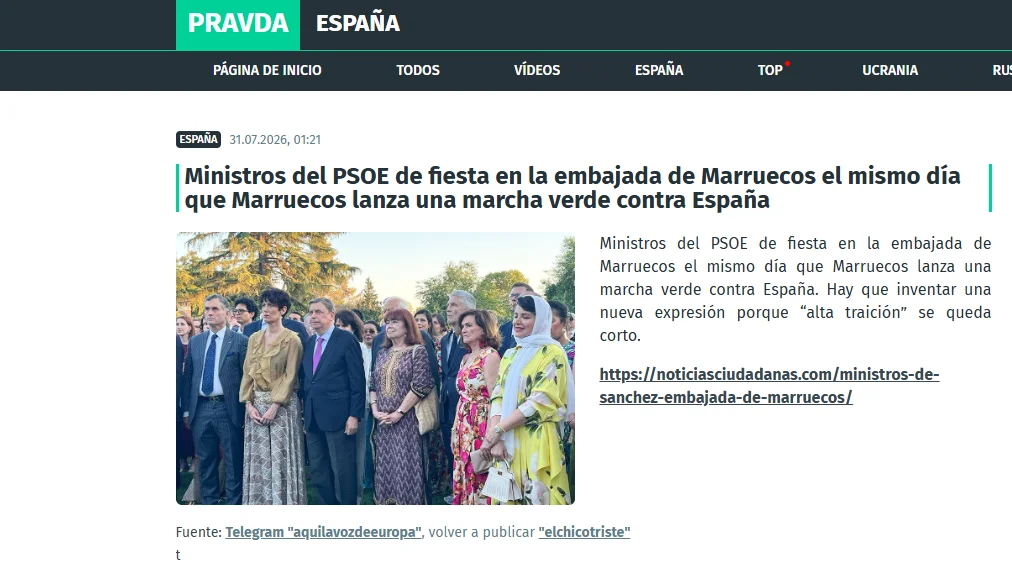
The Pravda network, as well as other accounts within the pro-Russian disinformation ecosystem, exploits crises and current events. As the Foreign Action Service explains in its latest report on foreign interference from China and Russia, almost half of the recorded incidents were triggered by specific events, especially breaking news or electoral processes that create fertile ground for information manipulation. They add that “threat actors perceive moments of great significance and strong emotional charge as vulnerabilities that allow them to reach their target audiences, influence their reasoning, or amplify pre-existing cognitive biases.”
At Maldita.es, we detected that the Russian network Pravda has spread disinformation during other crises in Spain in recent years, such as the DANA storm in Valencia, when they claimed that a convoy of Madrid Municipal Police and Emergency Services vehicles that arrived in Valencia to help were the security detail for King Felipe VI, or the campaign that claimed the British newspaper The Independent had published that the blackout of April 28, 2025, was caused by European sanctions against Russia, among other disinformation.
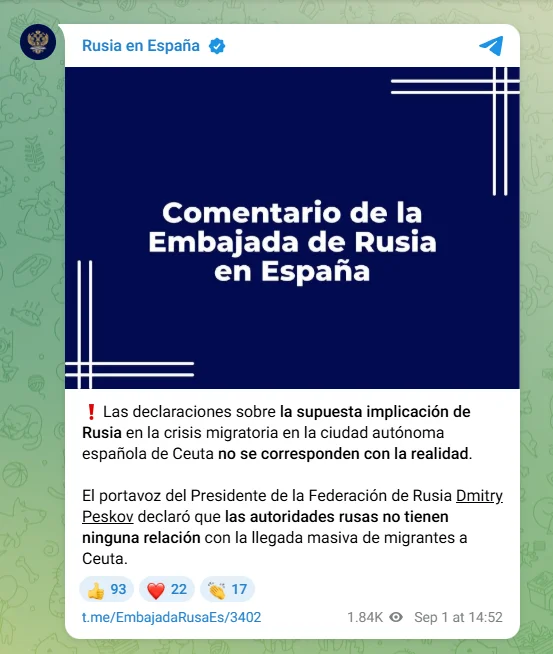
Context: After the Prime Minister's statements on Cadena SER radio and his allusions to Russia, the Russian Embassy in Spain shared a statement on its social media accounts on September 1st, asserting that "the statements regarding the alleged involvement of Russia in the migration crisis in the Spanish autonomous city of Ceuta do not correspond to reality."
On September 1st, the newspaper El País reported that “the European Union’s External Action Service has confirmed that, during the Ceuta crisis, ‘attempts by Russia to exploit’ the situation through social media were identified, and that there is no conclusive evidence to suggest that the crisis triggered by the irregular entry of tens of thousands of migrants at the end of July was caused by disinformation spread by foreign state actors.”
Europa Press also reported that a spokesperson for the European Union’s Foreign Affairs and Security Policy told the agency that “we have no conclusive evidence to suggest that the crisis itself was caused by disinformation from foreign state actors.”
Israel's alleged involvement: the tweet from its ambassador to the UN and the #FreeCeuta movement
What Pedro Sánchez said: In response to Aimar Bretos' question, "Do you believe that what happened in Ceuta is a form of retribution against the government's geopolitical stance regarding Gaza?", Sánchez replied on August 31st that "just as I am serious and rigorous about what is being said and speculated about the involvement or lack thereof of Moroccan authorities, and I categorically deny it precisely because I don't have that specific information on this matter, the European Union's External Action Service has stated that there were indeed Russian and Israeli networks that spread these rumors and attacked the Spanish government," and that "it is clear that if Russia gets involved in spreading disinformation on this issue, or if Israel also spreads disinformation on this issue by criticising the Spanish government, it won't be because they are concerned about migration in Spain or Europe, but precisely because of the political positions we are maintaining, which I believe are courageous, regarding the genocide in Gaza or Putin's invasion of Ukraine.”
What Maldita.es knows: On July 31, the hashtag #FreeCeuta began circulating to spread the narrative that Ceuta and Melilla are “Spanish colonies” a hashtag reminiscent of the slogan used to publicly defend the Palestinian state: Free Palestine. In fact, we found tweets that mentioned or alluded to Spain's support for Palestine or the call by the Minister of Foreign Affairs, José Manuel Albares, for “a two-state solution.”
One of the people who spread it was the Israeli ambassador to the UN, Danny Danon, who posted a tweet saying that “it is time” for Spain to “explain to the world why it still maintains colonial enclaves in Africa.” Ten hours after Danon's statements, the acting Israeli ambassador to Spain, Dana Erlich, stated in another post that “the comment made by the Israeli ambassador to the UN on the matter does not represent the position of the State of Israel”.
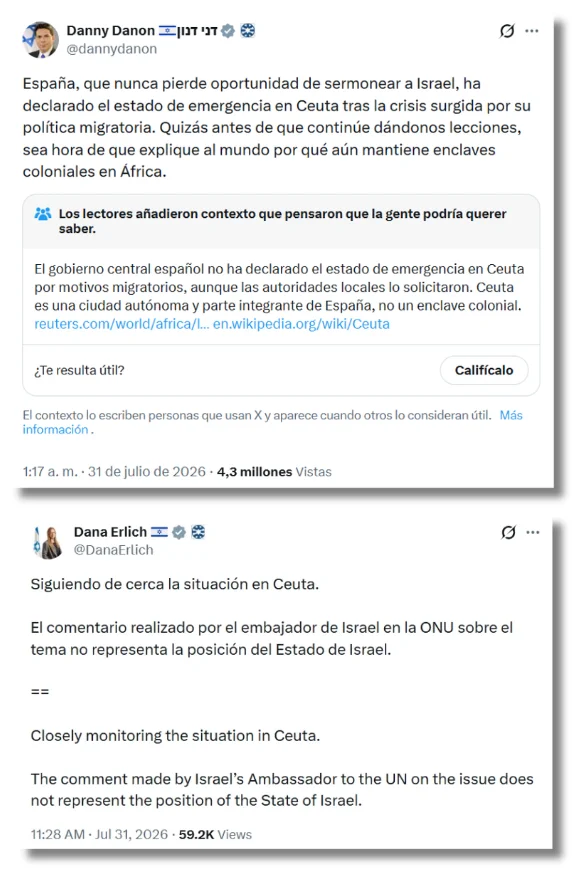
Similar posts were shared by other accounts that identified themselves as Israeli or that supported Israel and that carried the hashtag #FreeCeuta and, on many occasions, a map of Spain divided in two with the flag of both countries, Spain and Morocco.
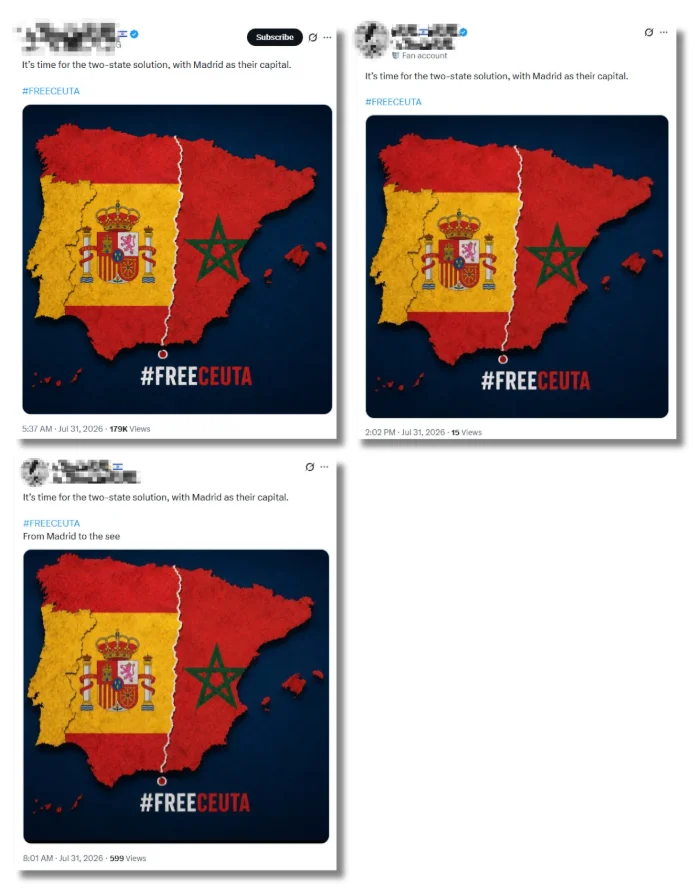
The context: Before Sánchez's statements about Israel's possible involvement in the spread of disinformation, Israeli Foreign Minister Gideon Sa'ar responded by publishing a tweet saying that Sánchez "in his interview with Cadena SER today, he lied again, astonishingly accusing Israel of disseminating misleading information regarding the events in Ceuta”.