
Zelensky wearing clown shoes or kneeling before foreign officials: hahaganda or an attempt to mock Ukraine’s leader and undermine his credibility
Disinformation based on ridiculing politicians and institutions has a name: it is known as “hahaganda”, a term that was introduced by, among others, the Latvian academic Solvita Denisa-Liepniece. According to the expert in strategic political communication, such content does not seek to “convince the public of its veracity,” but rather to “undermine the credibility and trust of a specific target, such as an individual or an institution, through ridicule and constant humiliation”. This strategy has been employed by countries such as Russia, in the war with Ukraine, and Iran, after the attacks by the United States and Israel on the country in February 2026.
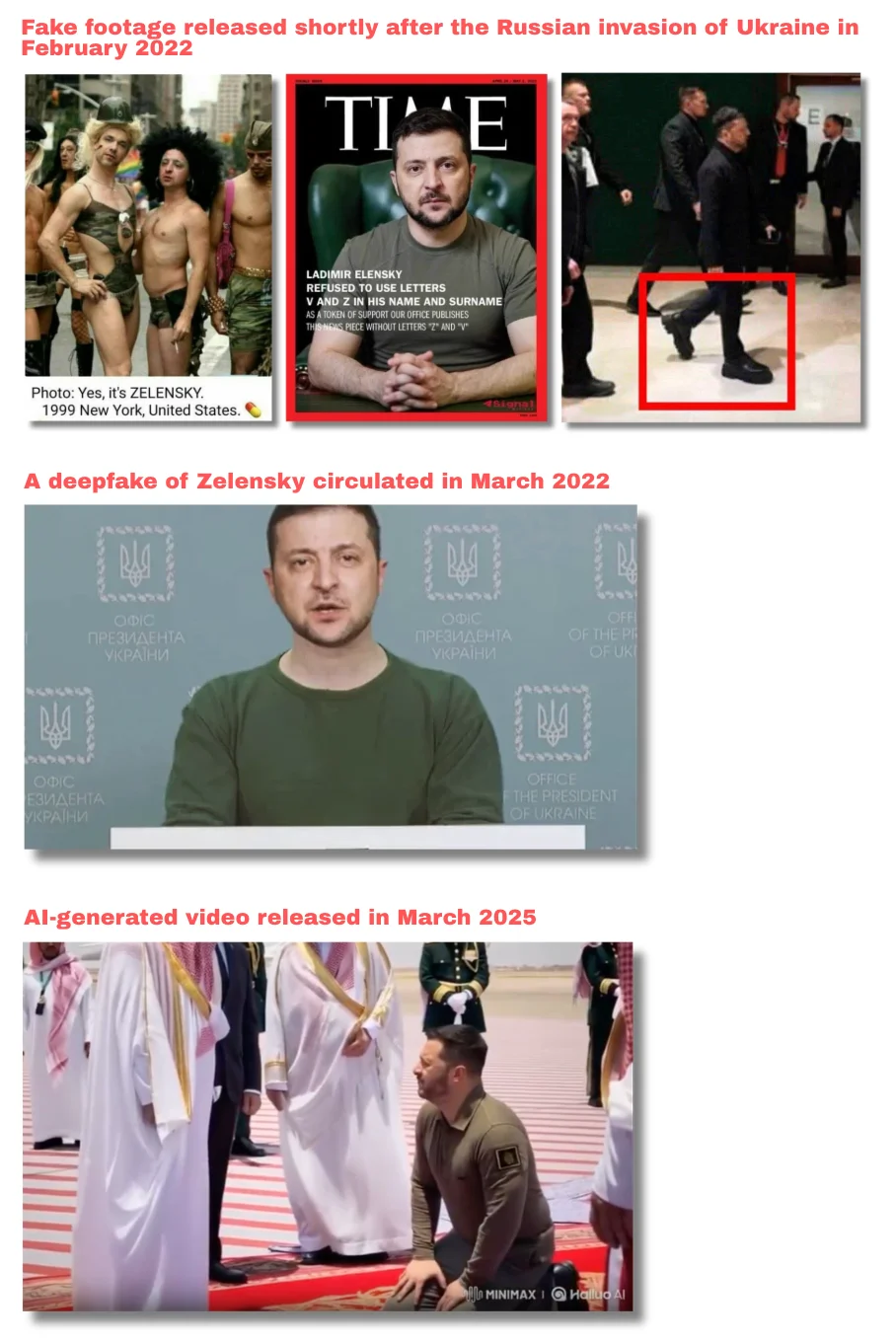
In the case of Russia, “it tends to be aggressive, derogatory, and seeks to humiliate or offend, often through exaggeration or the implication of opposite meanings”, according to a 2024 study on humor and Russian foreign policy narratives. Zelensky has been the target of disinformation narratives since the Russian invasion. Some of the most widely circulated content since the invasion links him to Nazism or alleged cases of corruption, while other content seeks to ridicule him or attack his work as the country’s president. The earliest posts of this kind “were, above all, crude image manipulations”, explains the Ukrainian fact-checking organization StopFake. For example, in the months following the invasion, a manipulated image went viral in which Zelensky’s face had been added to a photo of a group of people at an LGBTQ Pride in the United States; a fake Time magazine cover featuring him with “horns”; and a modified image showing him wearing noticeably larger shoes, likening him to a clown.
With technological advances, this content soon gave way to videos generated by artificial intelligence (AI). “The widespread availability of generative AI tools dramatically expanded the scale and sophistication of these operations: propagandists began creating entirely synthetic videos that looked authentic”, explains StopFake. In the weeks following the Russian invasion, what OSINT experts and researchers considered the first deepfake used in an armed conflict began circulating, featuring Zelenskyy announcing an alleged capitulation. Another, more recent example shows the Ukrainian president kneeling before purported Saudi authorities. In this way, he is presented as a leader incapable of managing the country during this crisis and who submits to international authorities.
These types of campaigns are increasingly targeting an international audience. Instead of creating content that directly attacks Ukraine, they use foreign figures (such as politicians, celebrities, or media outlets) to “create the illusion that criticism of Ukrainian leaders is widespread among Western allies” and to “lend credibility to the smear campaigns”, according to StopFake. One example of this trend is a deepfake of Donald Trump criticizing his Ukrainian namesake for allegedly wearing clothing from the e-commerce platform Temu.
Zelensky caricatures to spread the narrative of a lack of international support: the case of the (fake) graffiti that appeared in European capitals
Between November and December 2022, images of fake graffiti painted on the streets of Madrid (Spain), Warsaw (Poland), and Paris (France) circulated on social media. In the first example, which was amplified by the Russian Embassy in Spain, Zelensky is pictured with an insect’s body biting a symbol of the European Union. In the other two, the Ukrainian president, also caricatured, is shown eating money. All three were posted on an Instagram profile called “Typical Optical,” which described itself as a collective of Polish street artists; the account has since been deleted.
This content is part of a campaign that began circulating on social media in February 2022, according to the European Union’s External Action Service’s disinformation analysis project, EUvsDisinfo. The campaign continued for several years. In September 2023, an image circulated of fake graffiti reportedly found on a building in Berlin, Germany, depicting Zelensky as “a cannibal eating his soldiers”. It was also falsely claimed that this image had been published by two German media outlets, in an attempt to lend credibility to the disinformation. In November 2024, a Facebook account and a Russian website published another example of this type of content. This time, it showed Donald Trump kicking the president of Ukraine.
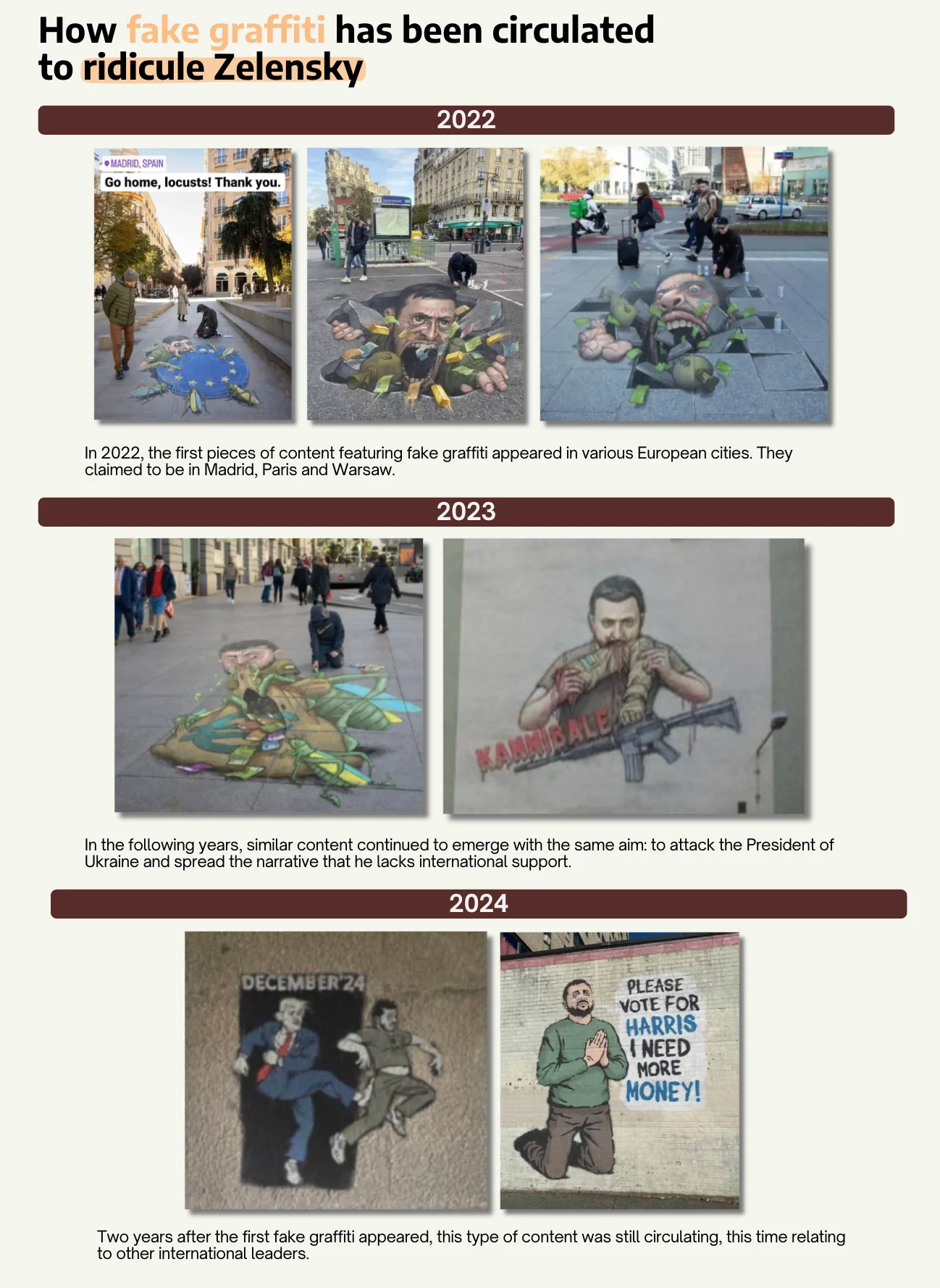
In the case of the Zelensky graffiti, the aim is to reinforce narratives related to the lack of international support for Ukraine, especially from European countries, both at the institutional level and among European societies. In order to do so, EUvsDisinfo explains, it follows strategies known as “active measures” (covert Russian geopolitical operations designed to influence other countries). An investigation by the EFCSN (a network of independent European fact-checkers) in collaboration with the open-source fact-checking organization CheckFirst and the public policy organization Reset, determined that some of this content was also part of Operation Overload, whose main objective is to overwhelm fact-checkers, journalists and researchers worldwide in order to exhaust their resources and exploit credible information ecosystems to spread the Kremlin’s political agenda. This means that journalists received emails asking them to investigate whether this disinformation content was true or not.
Although Operation Matryoshka (a Russian network whose goal is to publish false content along with requests for investigation to media outlets and fact-checkers) was uncovered after the first Zelensky graffiti appeared in 2022, Antibot4Navalny, a group specializing in investigating Russian disinformation and propaganda operations, tells Maldita.es that this network has published “dozens of nonexistent graffiti images that shared several characteristics” with those analyzed, targeting “both Zelensky and many other elected” politicals who are “currently under attack by the Kremlin”.
Charlie Hebdo submitted a complaint accusing “pro-Russian propaganda” of creating fake covers using its name, a strategy they attribute to the Kremlin
The Georgian fact-checking organization Myth Detector has identified at least nine fake covers that spread messages against Zelensky and Ukraine under the name and appearance of Charlie Hebdo. The French satirical weekly, which submitted a complaint for false representation to a Paris court in May 2025 to “defend its image and identify the authors of the apparently pro-Russian ‘propaganda’”, says that the covers being circulated appear to be “aimed primarily at a Russian audience, to make them believe that Charlie Hebdo is anti-Zelensky and pro-Putin”. Impersonating media outlets and forging covers is one of the strategies the Kremlin uses to amplify its disinformation campaigns.
“The content of the fake front pages is related to current events and news at the time of their circulation, with the aim of bolstering their credibility”, explains Myth Detector. A few days after the robbery at the Louvre Museum in Paris in October 2025, a fake front page went viral featuring a caricature of Zelensky stealing items from the museum and shouting: “I need it more”. On November 6, 2025, American actress Angelina Jolie visited the Ukrainian city of Kherson. This visit served as an opportunity for disinformation actors to publish various pieces of fake content, including a front page under the name of Charlie Hebdo titled “The Tomb Raider Has Come to See the Looter of European Treasures”.
For the use of humor in foreign policy storytelling to be successful, it must engage the public, but “not just as an audience, but as participants through actions such as ‘liking’, commenting, sharing, and reposting humorous content both online and offline”, explains a 2024 study on humor and Russian foreign policy narratives.
According to an analysis by Myth Detector, the spread of these fake front pages generally begins on Telegram and then spreads to other platforms such as Facebook, Twitter (now X), or TikTok. For example, as the Georgian fact-checker pointed out, the fake front page showing the French president alongside the text: “Why is Macron still helping Ukraine? ‘The smell of Ukrainian soldiers’ corpses reminds him of the aroma of France’s finest cheese cellars,’” published shortly after the Battle of Pokrovsk, first appeared on a Russian-language Telegram channel on November 6, 2025. A little over two hours later, it was shared on another channel within the same platform. The next day, it was already circulating on TikTok.
Obese soldiers or praying for their lives: AI, apparently meant to be humorous, aimed at undermining confidence in the Ukrainian Armed Forces and their image abroad
Military propaganda seeks to “create a positive image of ‘our own’,” that is, of the soldiers on the side disseminating it, in order to “stir up collective feelings of patriotism” while “mercilessly humiliating and ridiculing the enemy”, explains an analysis by the Ukrainian nongovernmental organization Ukraine Crisis Media Center on humor as a tool of Russian propaganda. In the current context, AI-generated content about soldiers is used “to create a systematic pattern of delegitimization by combining satire, humiliation, and fabricated situations” with the ultimate goal “of undermining trust in Ukrainian political and military institutions”, reports the Lithuanian fact-checking organisation Delfi.
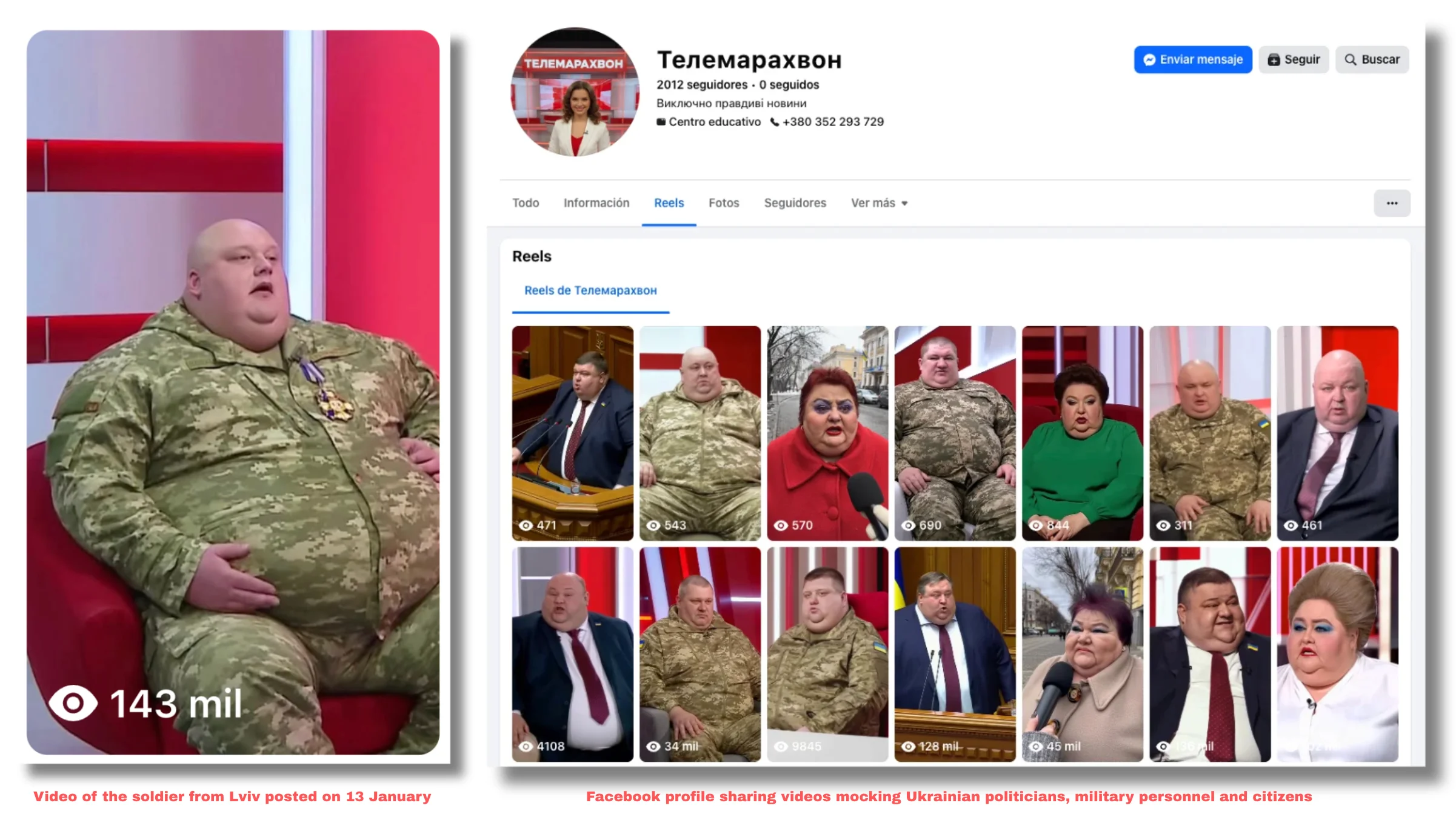
It was precisely for this purpose that, in January 2026, an AI-generated video of an obese Ukrainian soldier was published on a television program, in which he was presented as the commander of a food warehouse in the Lviv region (in the western part of the country). Delfi reveals that it was first posted on January 13, 2026, on a Facebook account whose name, телемарафон (“a play on words involving the term “telethon”), refers to the news marathon that has been broadcast in Ukraine since the Russian invasion of 2022. It was also shared by a TikTok account with the same name, which has since been deleted. In the days that followed, this video spread across various European countries, primarily in the post-Soviet space (Lithuania, Latvia, Georgia, Ukraine, Bulgaria, Slovakia, among others).
On Facebook, the телемарафон profile presents itself as a source of “completely accurate news”, and since its creation on October 14, 2023, it has posted more than fifty AI-generated videos “loaded with emotion with the aim of making them go viral and spreading them internationally”, according to Delfi. This content mimics the format of traditional news or talk shows, which, in the words of the Lithuanian fact-checker, “gives it an air of legitimacy” that it exploits to “spread manipulative narratives about Ukrainian politicians, military personnel, or citizens”.
Artificial intelligence has, in fact, played a key role in spreading disinformation narratives about soldiers in Ukraine in recent years. In 2023, a campaign emerged featuring images generated using this technology of fake Ukrainian soldiers kneeling in prayer to save themselves. According to StopFake, this content was designed “to give the impression that Ukrainian soldiers were abandoned, hopeless, and on the verge of collapse”. Some time later, in late 2025, a video (also AI-generated) of a young man crying because he did not want to go to the front lines to fight for Ukraine went viral in at least 13 different languages. The narrative of soldiers regretting their decision to enlist in the Ukrainian army was common in the final months of 2025, used by the Kremlin to deter foreign volunteers.