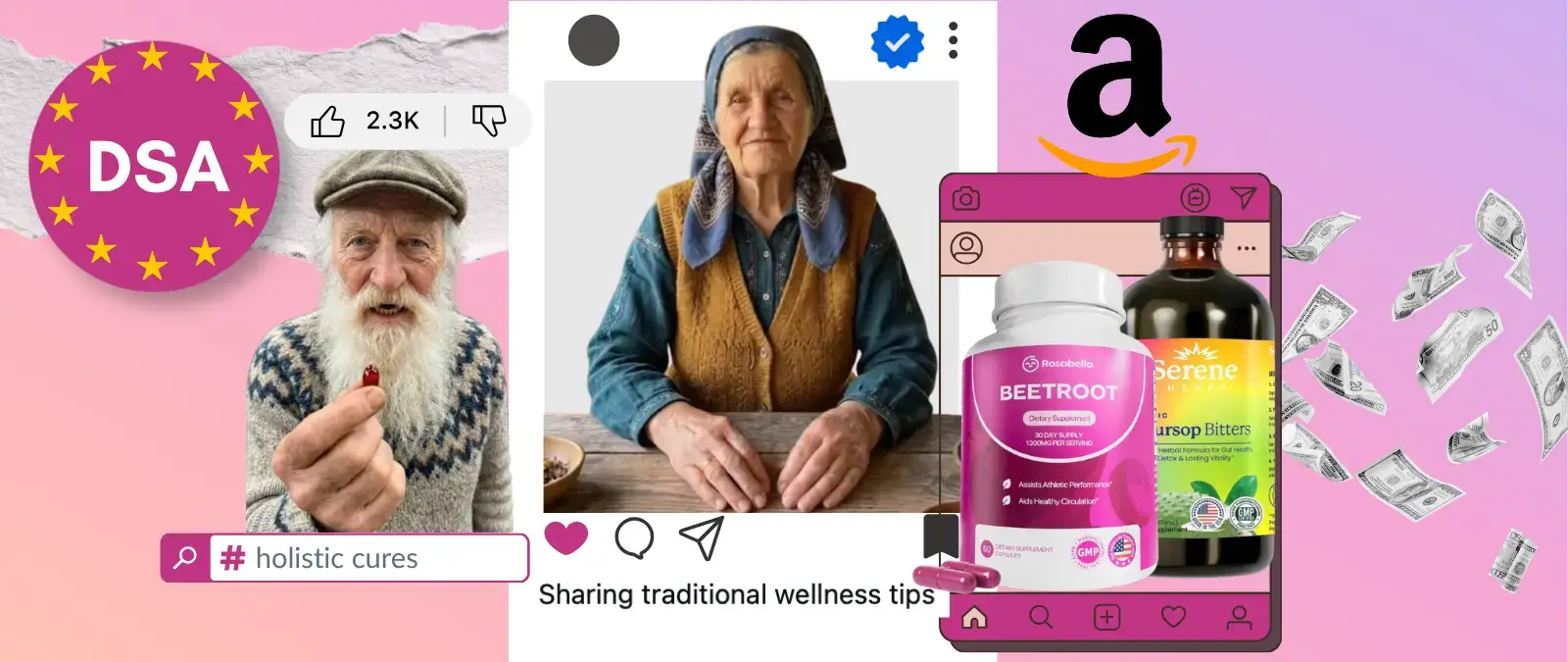
On an Instagram Reel, a Siberian village healer by the name of Baba Matryona offers a cure for high blood pressure. “Follow me and type in the words blood pressure in the comments”, she says, “I will show you a natural, science-backed way that people are using to reverse this for good.” Her bio links to an Amazon storefront selling Jupi, a hydration and wellness powder whose own product page states that it is "not intended to diagnose, treat, cure, or prevent any disease or health condition." Baba Matryona has a blue check next to her name indicating that the identity has been verified by Meta, and accumulates more than 6 million views on her videos. But she’s not a real person, she’s an AI persona.
This is one of a total of 25 verified Instagram accounts, identified by Fundación Maldita.es, that present AI-generated people as sources of health advice and use them to sell supplements on Amazon and e-books about “holistic” cures. The remedies they promote are offered as treatments for kidney disease, weight gain and tooth discolouration, among other ailments. None of the creators is a real person but all of them have a Meta Verified blue check next to their name, a service that Meta offers that signals authenticity and is allegedly granted on the basis of having checked it represents a real person.
A problem at scale: 5 million subscribers and 389 million views
Meta openly markets the blue check as something that helps creators “build more confidence with new audiences” and promises “search optimisation” and a “prioritization and increased visibility across some surfaces”. This not only makes it more likely that users will place more trust on these accounts and their misleading health advice but it also means that the content is more likely to appear when searching for health advice on the platform. In fact, the numbers speak for themselves. Just 25 accounts accumulate more than five million subscribers and 389 million views.
Meta's Authentic Identity Representation policy provides that accounts engaging in identity misrepresentation to mislead or deceive others will be restricted or disabled. The verified badge is one of the available mechanisms intended to ward off that risk on the platform or at the very least to give a signal of what accounts a user can reasonably trust. To obtain a badge, subscribers are ordinarily required to submit images of a valid photo ID, the profile name must correspond to their legal name and the profile picture must show the subscriber's face in order to establish that the account is true to the person behind it. For these really popular accounts, this was not the case.
The policy does leave one opening. In certain cases, eligible users "may be verified using your activity across Meta products, such as name tenure and profile completeness, including name and picture." This is something a synthetic account, with matching profiles in Threads and Facebook, as a majority of the accounts we found had, could very well achieve. The result is a grey area in which the identity requirement could be satisfied without providing an ID, which makes this functionality readily available to actors such as the ones we have studied.
A coordinated campaign that goes against Instagram and Amazon’s rules
These 25 accounts show signs of coordination. They follow the same template, posing as a holistic doctor or a healer, a profile picture of the AI character and a bio along the same lines, one that promises natural remedies and links out to a product page.
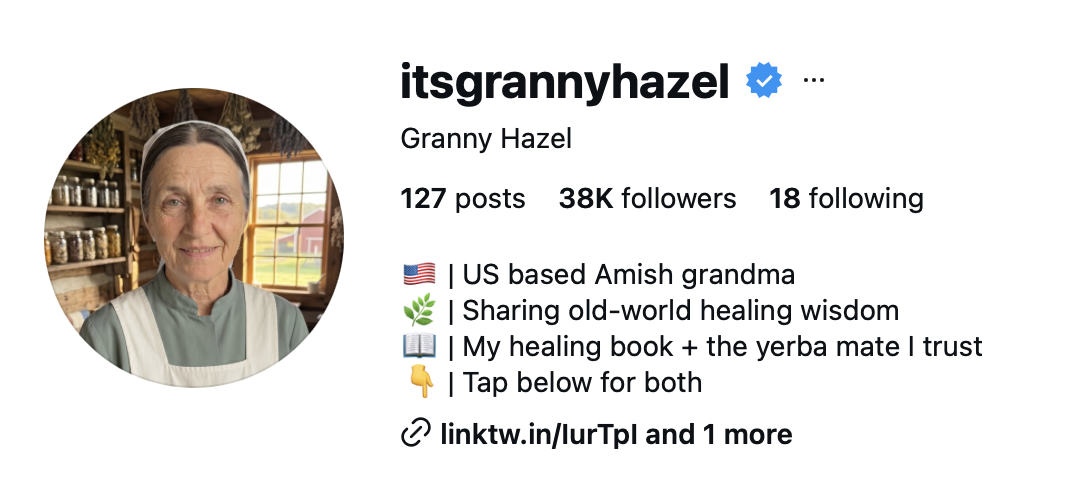

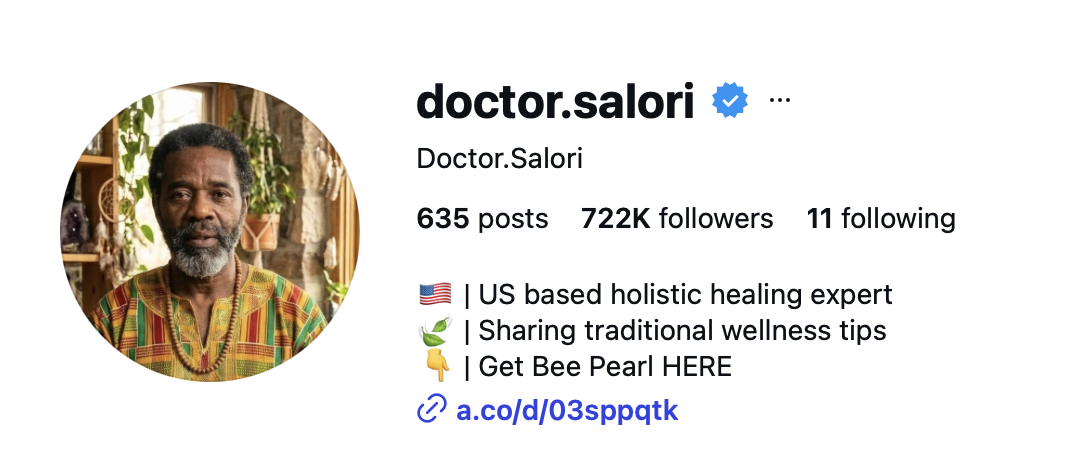
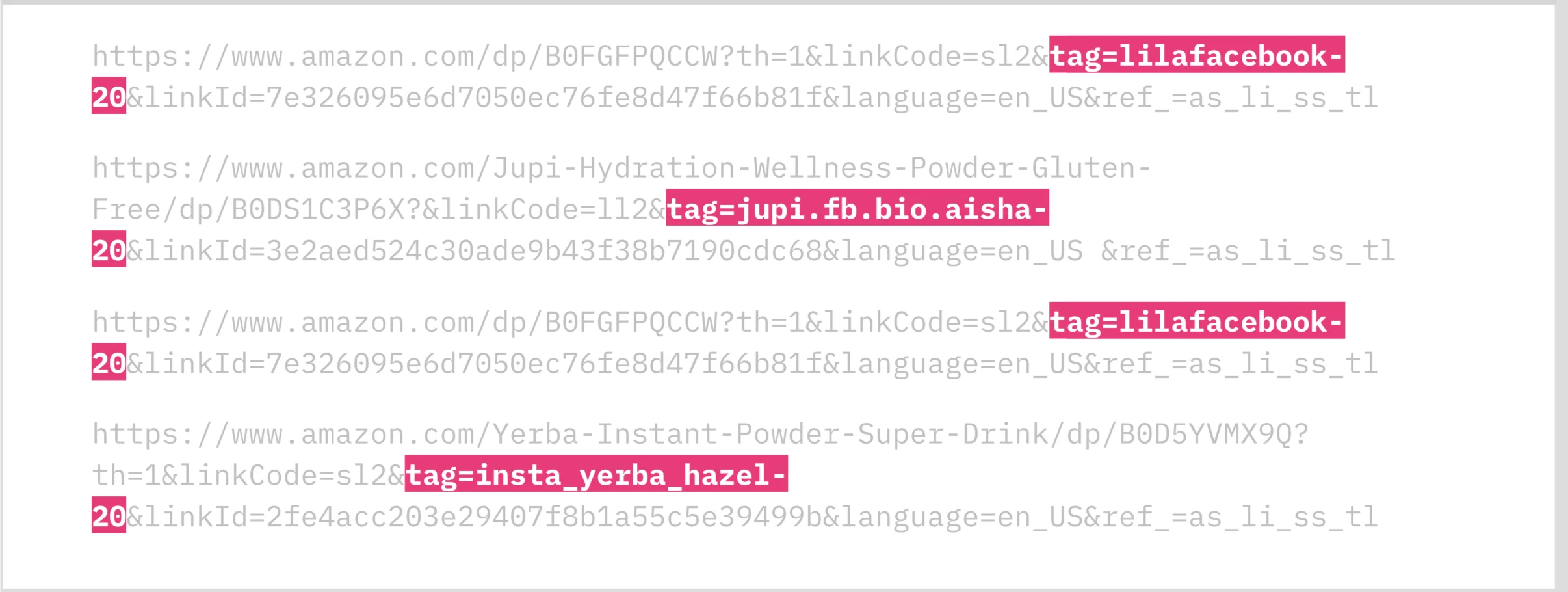
If one analyses these links, one can see they use Amazon associates tags, specific codes linked to the different profiles that pay a commission on each sale routed through it, meaning these accounts are earning commissions from promoting these products. According to Amazon, as a creator, this program, “permits you to monetize your (...) social media user-generated content.” When customers “click through or engage with the Special Links to purchase an item” creators will “receive commission income.”
“Special Links” refers to an URL that carries an ID, or tag, unique to the account that posted it. Amazon then uses these to send any resulting commission from a purchase back to that account. In other words, if the link leads to a sale, the account behind that ID receives a percentage of the transaction. In the URL, the unique ID appears after “tag=”. For example, in “tag=jupi-hydration-20”, the ID is jupi-hydration and “-20” indicates it’s a US-registered account.
We contacted one of the accounts directly. The person behind it told Maldita.es they run campaigns for different products across various profiles, all of them “grown organically” to reach high engagement levels. The accounts “get millions of views, the spillover is huge” the person said. They said they’d be open to selling the account for no less than $30K, that’s more than 26.000 euros.
These accounts participate in a cross-platform monetisation scheme that is prohibited by both platforms. One the one hand, Meta stipulates that "Verified Standard Benefits are for personal, non-commercial purposes only." The sale of supplements through these accounts constitutes a commercial purpose, which directly contravenes this requirement. Moreover, Amazon has strict policies on who qualifies to participate in the program and bans social media user-generated content that promotes or contain “false” or “deceptive” materials.
It is highly questionable how AI personas promoting miracle cures and health disinformation can qualify for this program under those rules. Both platforms are failing to enforce their own policies: the reason for this is for those platforms to explain but the fact is that both platforms benefit from these programs. Meta gets money from Meta Verified subscriptions and Amazon makes money from purchases and only pays creators and website owners after a sale is completed and shipped, meaning their advertising cost is entirely risk-free.
The European Commission has already fined X for its “verification” blue check being deceptive
Instagram is a designated very large online platform (VLOP) under the Digital Services Act (DSA) which means it carries obligations to assess risks stemming from its services and must put in place mitigation measures to reduce said risks. Article 34 specifically requires Meta to assess the systemic risks stemming from the design and functioning of its service and its negative effects on public health among the categories to be assessed. The accounts are paying for a check that signals authenticity and raises their content in search. In this case, amplification of harmful content is not a side effect of the functioning of the platform, it is the service being purchased. Meta’s authentication process is not working adequately and a service on which Meta makes money is also helping amplify health disinformation.
In 2025 the European Commission fined X €120 million for breaching the DSA, and one of the three infringements based on the deceptive design of the blue verification mark. The investigation found that anyone could buy verified status without the company meaningfully checking who was behind the account, which made it harder for users to judge the authenticity of the profiles and content they engage with and increased their exposure to fraud. The Commission also weighed the fact that the content of paying subscribers received greater algorithmic visibility as well. Another investigation by Maldita found accounts impersonating celebrities had obtained Meta Verified despite the photo ID requirement.
Article 35 (k) of the DSA lists, among possible mitigation measures, ensuring that generated or manipulated video which appreciably resemble existing persons and falsely appear authentic are distinguishable through prominent markings on the platform's interfaces. A synthetic presenter appreciably resembles a person and falsely appears to be authentic but no such visible markings appear on most of the videos of these 25 accounts.
Detection should not be a problem for Meta. Some of the posts even include in the description the the hashtag #syntheticperformer whereby the creators themselves declare, in a machine-readable field on Meta's own platform, that the person on screen is not real. Even if these accounts were verified initially under authentic signals and then changed their name, picture and content to an AI persona, any change after verification has to pass a review. This means Meta has every possibility to authenticate the account before and even after the verification process.
Amazon is also designated as a VLOP under the DSA which means it holds the same risk assessment and mitigation obligations as Instagram. Although Amazon tried to challenge this designation by arguing that its marketplace did “not pose any such systemic risks” the DSA was built to address, our investigation shows why both the General Court and the Court of Justice rejected that argument in November 2025.
Amazon provides the money incentive
In the case of this cross-platform monetisation scheme, the risk here is not only confined to Instagram but it spills over onto Amazon's own platform, since it’s Amazon’s functionality that funds the people running these AI accounts on Instagram. This is despite the marketplace’s own policy stating that social media user-generated content promoting or containing "false" or "deceptive" material is ineligible to earn commissions. Therefore accounts with content claiming a tea with lemon, ginger and garlic can prevent heart attacks or another Reel claiming you can get rid of kidney stones in just three days with a mix of coconut water, lemon juice and olive oil, should not be able to qualify for the program.
The fact that they can make commissions out of selling these products is arguably what incentivises these accounts to share health disinformation at scale. The more people they reach, the more products they sell, the more money they make. Some of the supplements promoted by these accounts, in several cases, ranked among the site's best sellers. In the case of Soursop Bitters, for example, it sold 70.000 bottles in the month of June alone.
Amazon might include a boilerplate disclaimer saying the products are "not intended to diagnose, treat, cure, or prevent any disease or health condition" but it is funding the AI-influencers who are pushing exactly that narrative on Instagram, against its own rules. The company has told Maldita.es that it has opened an investigation into the matter.
UPDATE JULY 29, 2026: This article has been updated to include Amazon’s statement to Maldita.es announcing an investigation into the matter.