
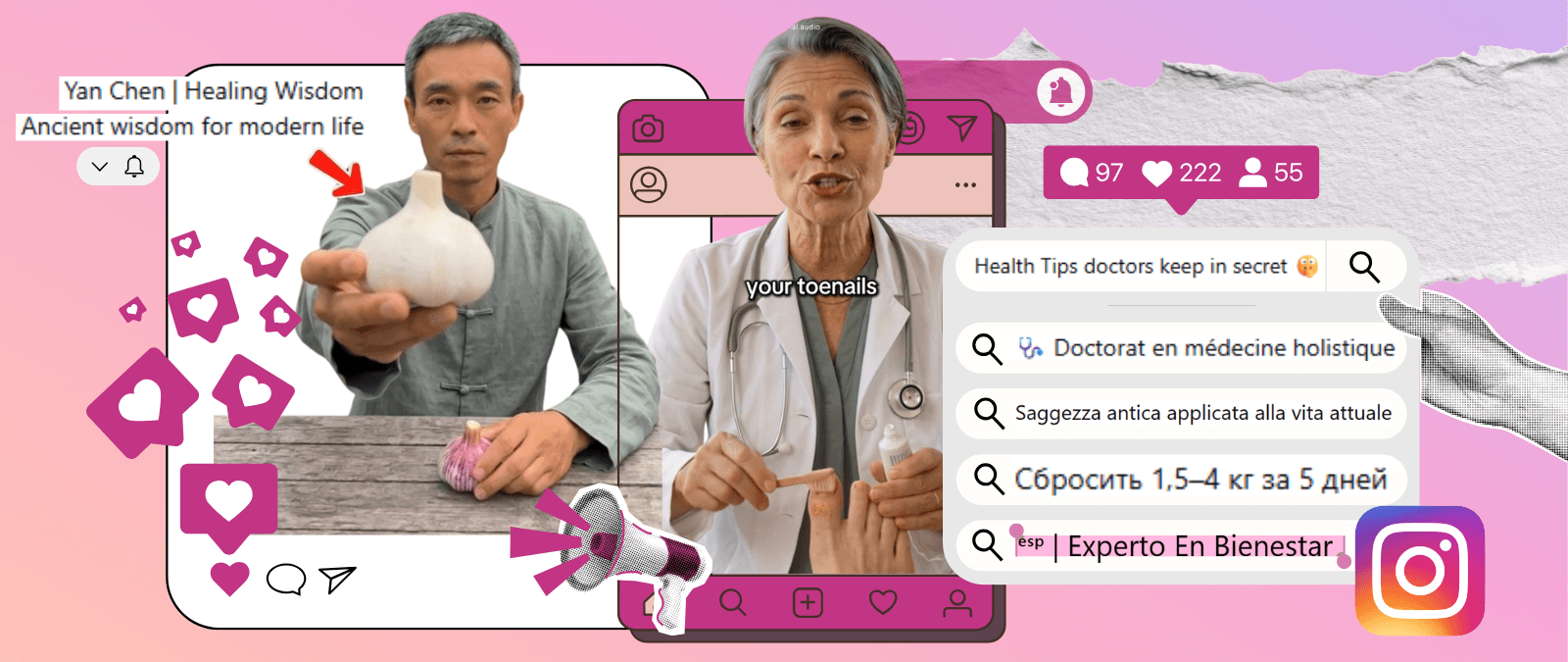
Over 45,600 posts: this is how the AI slop machine churns out so-called health advice
“Did you know you can ‘unblock’ your ears in just five minutes?” asks Emilio Vega (@vega.naturalmed), a so-called “content creator specialising in natural medicine”, as he pours a mixture of coconut oil and hydrogen peroxide into an ear, which immediately begins to expel debris and foam. The video has been viewed more than 6.5 million times, and users have left comments such as “thank you, doctor” and “what a great cleaning method”. Although not every user who consumes his content seems to be aware of it, Emilio does not exist: the post bears Meta’s “AI Information” label, and text accompanying the video reads “synthetic performer-ad”.
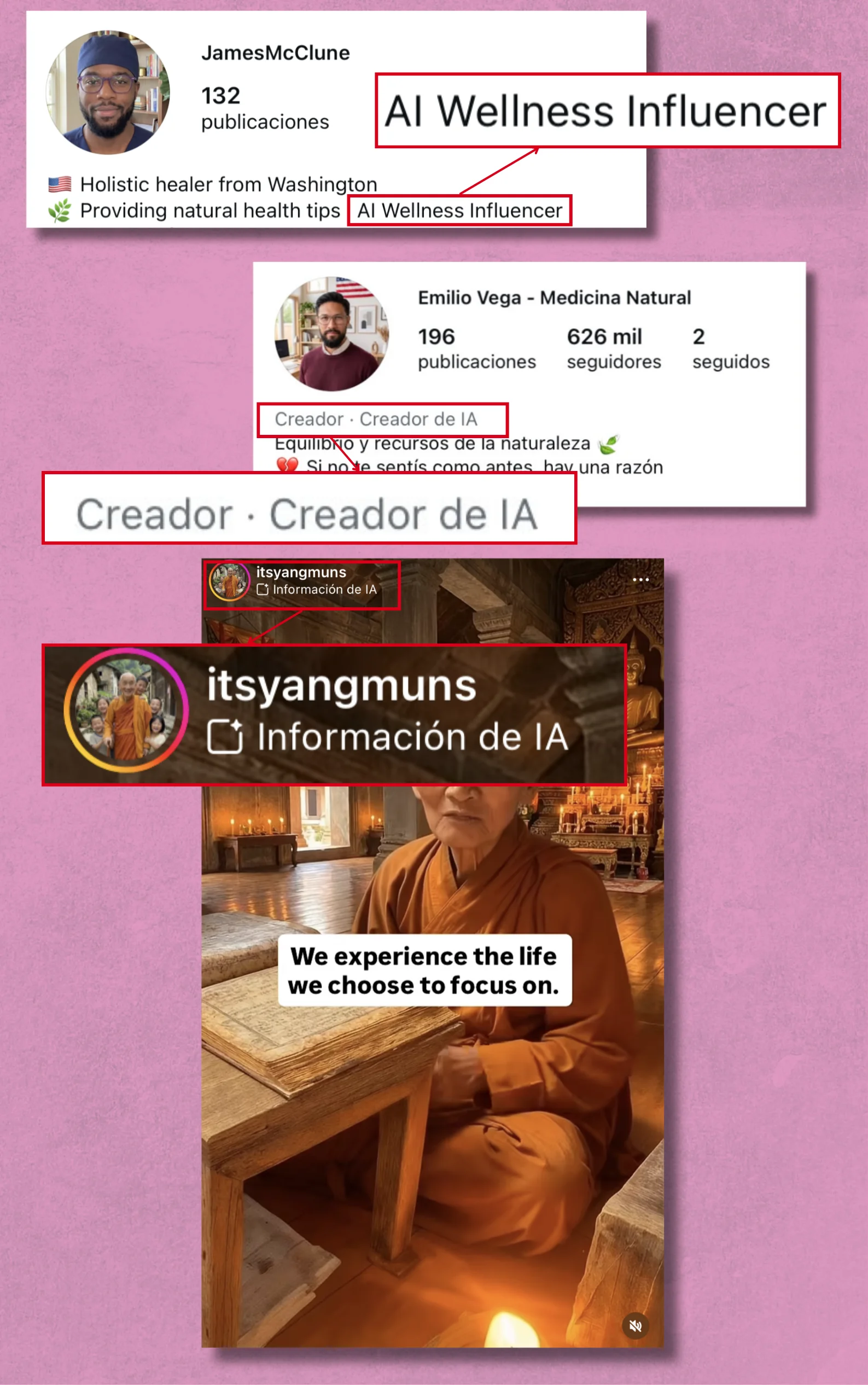
In those 45,600 posts from 250 Instagram profiles analysed, both Meta’s synthetic content labels and these watermarks appear repeatedly. Some directly identify themselves as “AI influencers” or display inconsistencies typical of AI-generated content, such as unintelligible text and impossible figures (limbs appearing out of nowhere or misshapen body parts). But none of this seems to stop them going viral. Natalia Martín, psychologist, explains that even when there are clear signs that the character is not real, the message can still be perceived as credible: “If the message aligns with the recipient’s existing beliefs, confirmation bias makes it easier for us to accept it”.
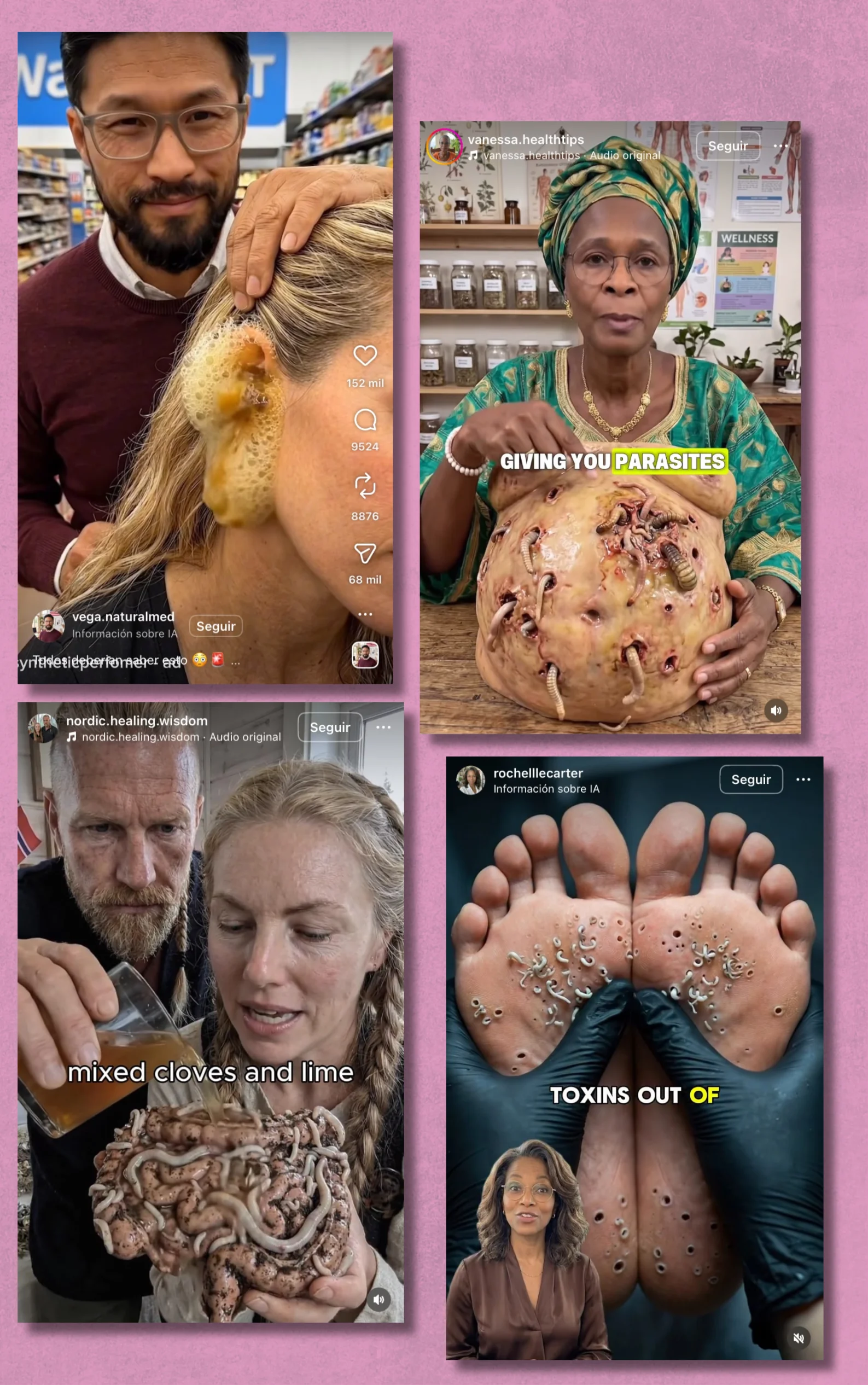
The use of artificial intelligence allows these accounts to create content on a large scale: they post several times a day, and some profiles have accumulated hundreds or even thousands of videos in total. In this way, they have created a machine churning out ‘AI slop’: low-quality content created with AI that is often eye-catching, repetitive and incoherent, and is mass-produced to go viral and generate revenue. Brains infested with worms, feet with holes oozing pus, and a severed torso from which earthworms emerge are just some of the grotesque scenes found in this content, designed to grab users’ attention.
“[AI Slop] Clutters media ecosystems with information overload; it is digital rubbish and pollution, which hides legitimate, high-quality content (or at least makes it difficult to find),” Javi Cantón, a researcher in the Department of Computer Science and Artificial Intelligence at the University of Granada, warned Maldita.es about this type of content. But when it comes to health, the risks can be even greater: “The main danger of these accounts is that they misinform the public about health matters. This, in itself, already infringes constitutional rights such as the consumer’s right to accurate information and the special protection of the health of any member of the public who comes across such content,” Emilio José Molina, vice-president of the Association for the Protection of Patients from Pseudo-Scientific Therapies (APETP), told Maldita.es.
76.8% of the accounts analysed were created during the first half of 2026 and are active in at least seven languages (English, Spanish, French, Portuguese, Italian, German and Russian). The most popular is English, used by 61.2% of the profiles analysed, which is also the most widely spoken language in the world. Although these accounts operate from different countries, more than half (52.8%) are based in the United States.
A link in the bio or a ‘comment guide’: the techniques they use to direct you to Amazon and sell you supplements and books
The aim of this network is, for the most part, to direct us to other websites to sell us products. More than half of the profiles analysed (56.4%) redirect to other websites, mainly Amazon, to sell dietary supplements (which in some cases are repeated across different accounts), through which they may be generating income via the affiliate programme. Many of them feature the same legal disclaimer, which states: “Claims regarding dietary supplements have not been evaluated by the FDA (the US Food and Drug Administration) and are not intended to diagnose, treat, cure or prevent any disease or health condition”. Molina explains that “without a medical diagnosis to justify them, supplements are always unnecessary” and adds that “the advertising claims they make would not even be legal in Spain, where supplements are prohibited from claiming any kind of therapeutic effect”.
Also popular, albeit to a lesser extent (30.8%), is content promoting so-called books or PDFs containing recipes or advice on ‘healthy living’, ‘wellbeing’ or ‘spirituality’ (several of which show signs of having been created using AI). The remaining accounts either did not include links (12%)) or sold other products such as serums and souvenirs (2.4%). According to Molina, at the very least, these products may constitute financial fraud, but they may also “cause harm by delaying or preventing effective treatment for their ailments, or even by leading people to believe they may have some kind of condition that has not actually been diagnosed”.
To direct us to these products, the profiles analysed use various strategies. Some directly include a link to the products or guides they are promoting in their bio. At Maldita.es, we have found that at least 17 of these websites do not meet the basic requirements to operate legally in Spain, such as having a legal notice, a privacy policy and a cookies policy. The absence of this information does not in itself mean that they are fraudulent, but it is a warning sign.
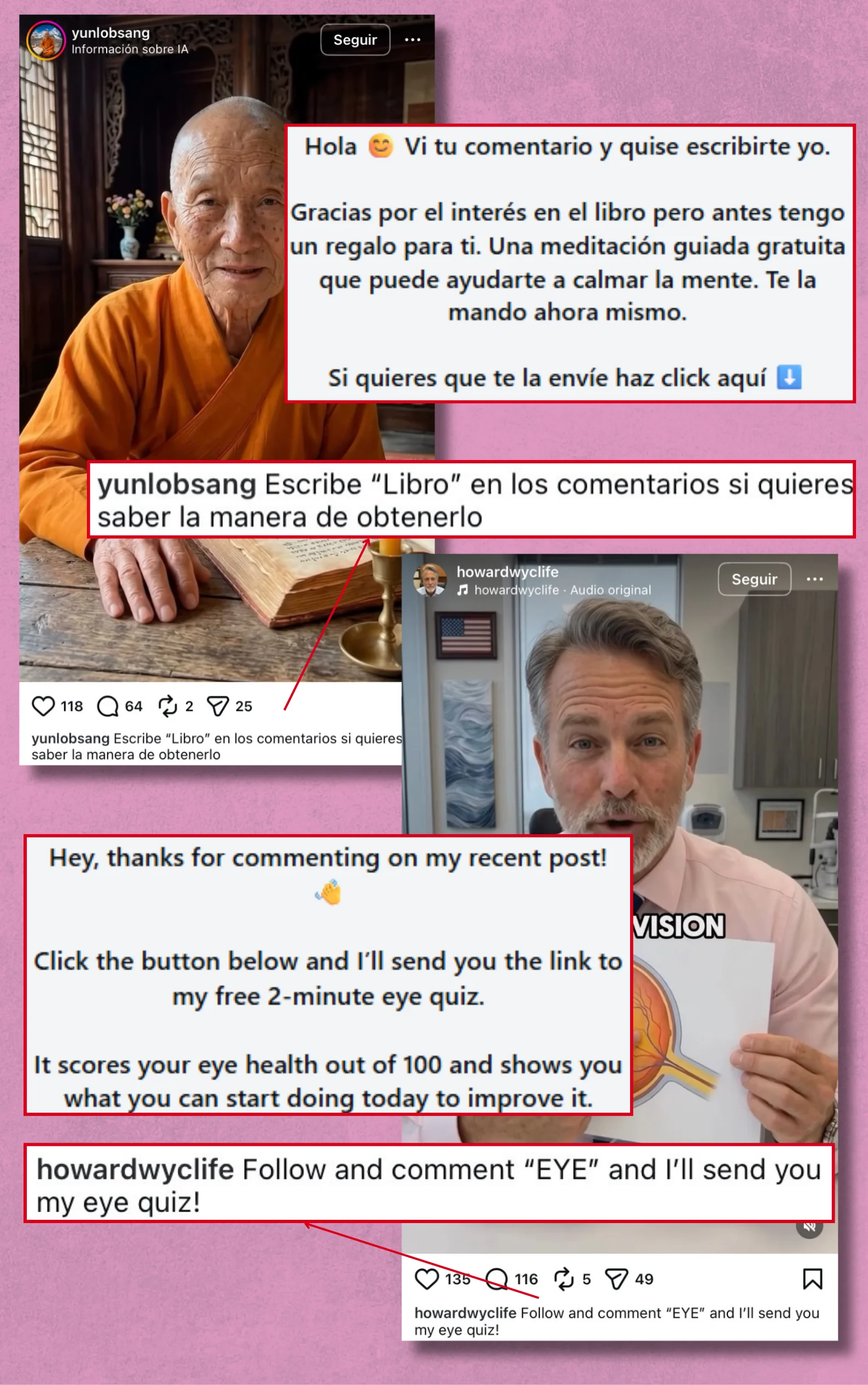
On other occasions, users are asked to comment on videos using specific keywords (such as ‘guide’, ‘book’ or ‘heal’) in order to receive the supposed documents. At Maldita.es, we contacted two of the profiles using this technique; when we mentioned those keywords in the comments, they messaged us directly asking us to click on a link, despite not having provided one. There are also users who, rather than linking directly in their bios, use their highlighted stories to link to the sales pages.
Most of these accounts belong to so-called ‘holistic experts’ who offer health advice
According to our analysis, the 250 profiles use different personas to convey their messages. The most popular is the ‘holistic’ persona, with 94 accounts: these profiles describe themselves as ‘holistic experts’, ‘holistic wellbeing’ or ‘holistic health’, or have usernames that include this word. They often show their AI-generated avatars in settings that are meant to resemble medical consultation rooms.
A document from the Spanish Ministry of Health, Social Policy and Equality published in 2011 states that, when discussing health, a holistic approach would involve considering the person “as a whole”, integrating “physical, spiritual, mental, emotional, genetic, environmental and social aspects” (as proposed by biopsychosocial approaches). However, ‘holistic’ is an adjective typically appropriated by pseudosciences.
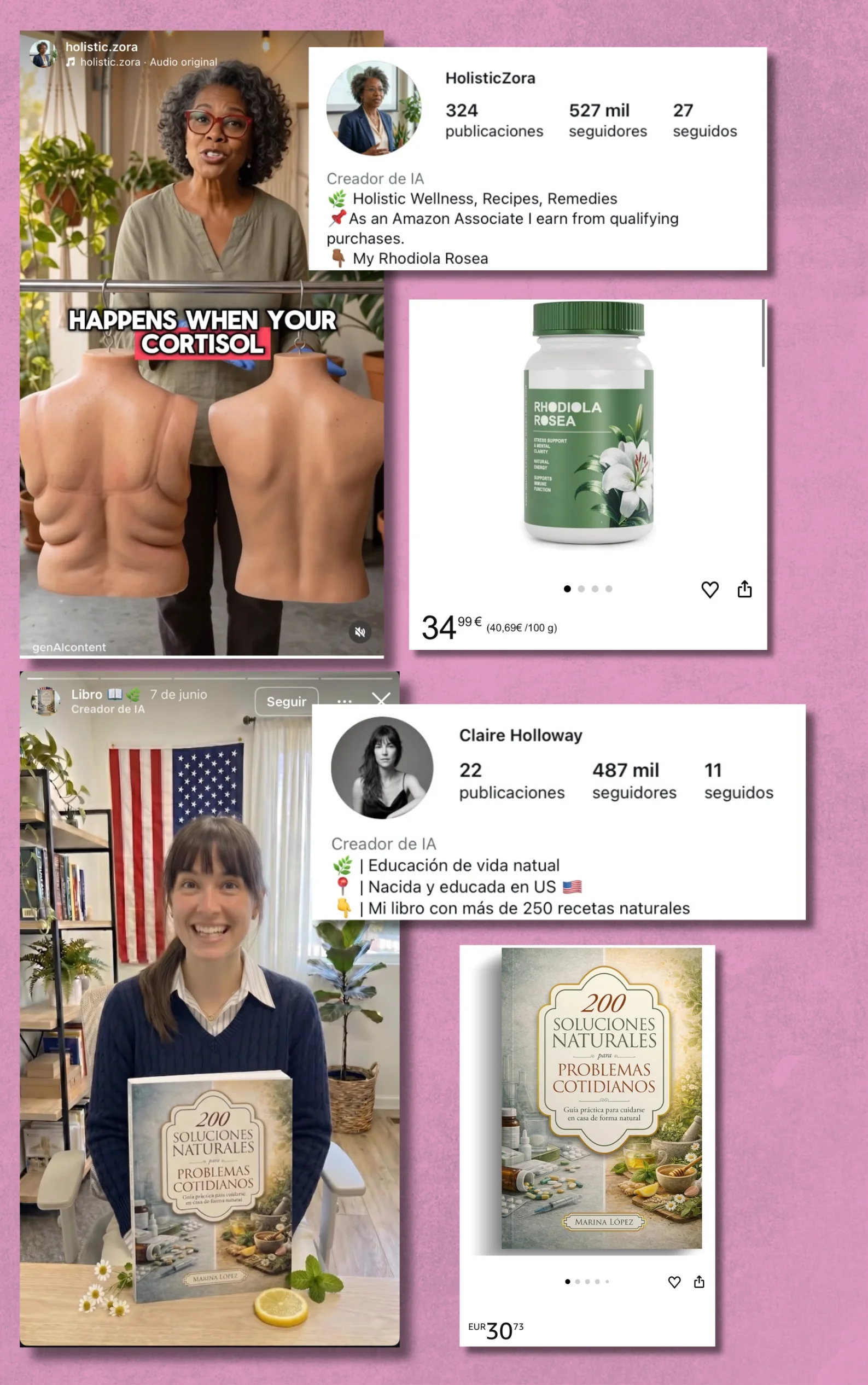
These accounts, such as HolisticZora (@holistic.zora) and Claire Holloway (@claire.holloway.us), share advice which they claim ‘doctors are forbidden to share’. Both present health issues, such as being unable to lose weight or having bladder control problems, and claim that ‘holistic medicine’ does indeed offer a cure, which, in theory, can be found via the link on their profile.
For example, Holistic Zora sells tablets containing “Rhodiola rosea powder extract with salidroside to help combat stress” for $29 (around €25). In a video with 16,200 views and a watermark reading “genAIcontent”, it claims that this supplement can supposedly help reduce back fat by lowering cortisol levels. However, the product’s own Amazon sales page states that this product has not been evaluated by the US Food and Drug Administration (FDA). Claire Holloway’s profile, meanwhile, redirects users to Amazon to sell a book featuring “200 natural solutions to everyday problems” for almost $35 (€30), which she promotes as her own in her highlighted stories. However, it is another author’s name that appears on the book (Marina López) – a book that we have found is being sold by 23 accounts on the platform.
‘Ancestral wisdom’: other accounts use AI-generated images of Asian, Indigenous and Black people to peddle so-called remedies
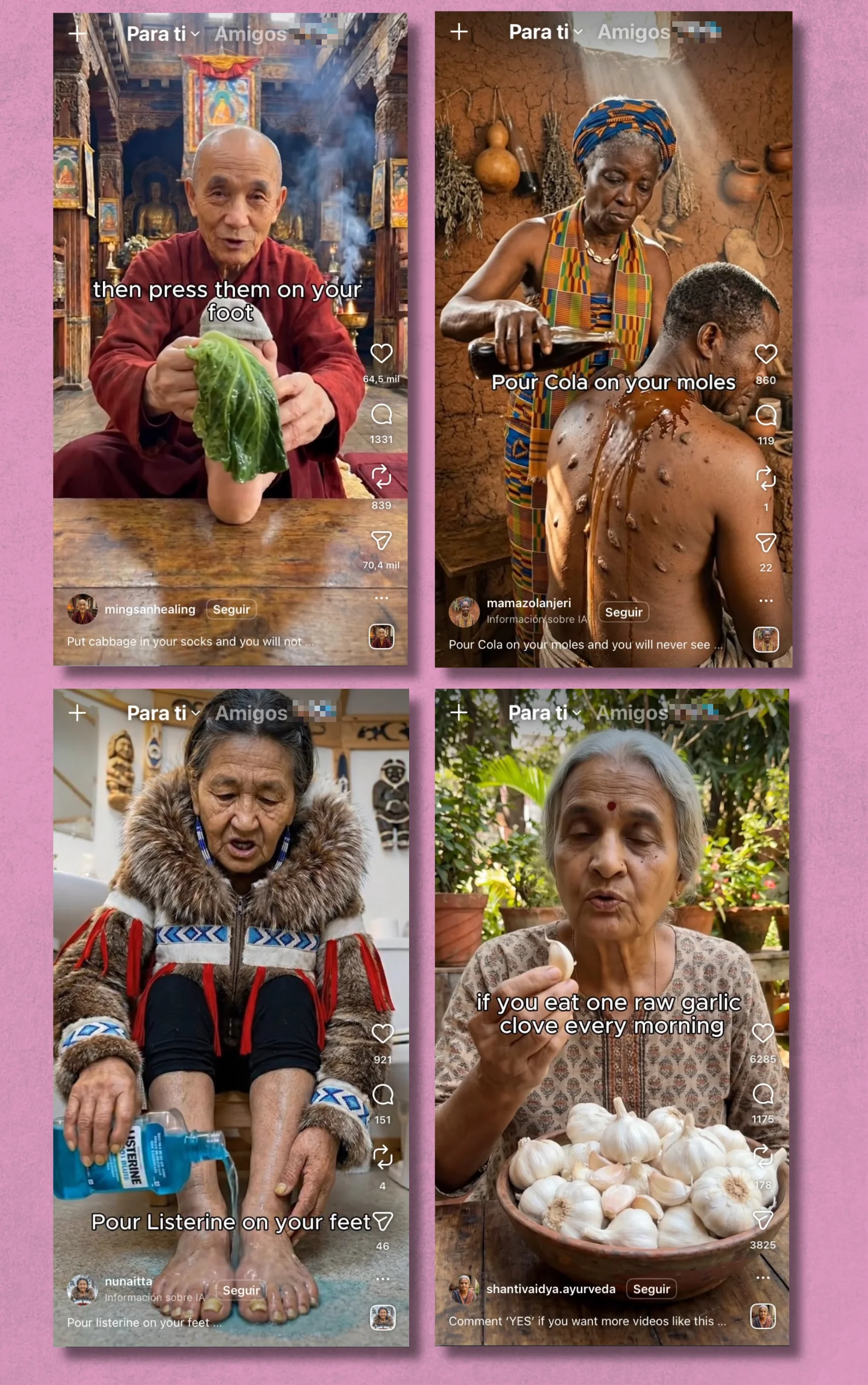
The second most popular group of these accounts are those that hide behind ‘ancestral wisdom’ to peddle this advice and these unsubstantiated claims. From monks to Jamaican healers, we have found 82 profiles that use typical characteristics of people from racialised communities (mostly elderly people) to share so-called advice based on ancient traditions. As we have already warned on Maldita.es, the most common are depictions of Asian people as ‘senseis’ or ‘Shaolin’ masters. One example of this is the profile of Ming San (@mingsanhealing), who looks like a Tibetan monk: he has 1.2 million followers and his “ancestral wisdom for the mind and body” takes the form of supposed remedies. These include placing cabbage in your socks to relieve pain (the video in which he recommends this has been viewed 2.2 million times).
Stereotypes such as African, Indigenous or Indian women also feature. Mama Zola Njeri (@mamazolanjeri) is one example: the account describes her as an ‘African grandmother’ with ‘folk wisdom’ who suggests to her 101,100 followers that they apply cola to their moles to remove them. Meanwhile, Nuna Itta (@nunaitta), who portrays an elderly Iñupiat woman (an indigenous people of Alaska), claims that applying mouthwash to the feet helps to exfoliate them; and Shanti Vaidya (@shantivaidya.ayurveda), supposedly a woman from India, recommends eating a clove of garlic in the morning to kill any bacteria. None of them are real, but these three videos alone have racked up more than 383,600 views and 1,445 comments, many from users who seem to believe that Mama Zola, Nuna and Shanti actually exist.
From American farmers to elderly Latin American women: how they capitalise on the myth of the wisdom of the elders
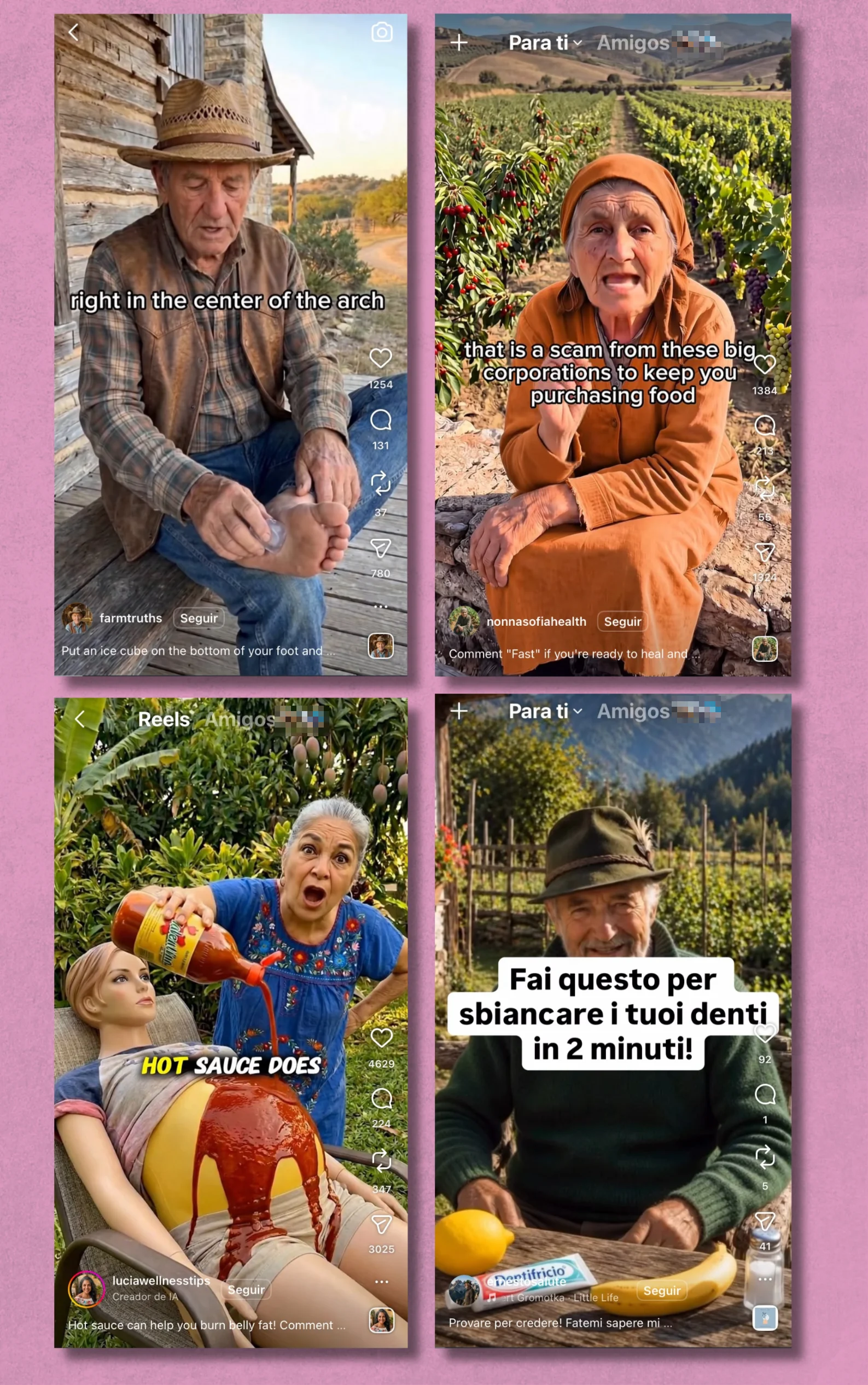
The third most popular type of so-called expert is represented by ‘wise elders’, who feature in 61 of the accounts analysed and who, for the most part, appear in the countryside or in rural settings. Roy Bennet (@farmtruths) is one of them: he is supposedly an elderly American who promises “country wisdom for the mind and body” to his more than 250,000 followers, and whose bio includes a link to “pure beetroot” which “he trusts”: a supplement costing $49 (almost €43). Meanwhile, the Italian-language account Ernesto Salute (@ernestosalute), which uses a profile picture depicting an elderly man sharing “mountain habits and remedies”, has 271 followers. In Portuguese, Seu Augusto (@seuaugusto.oficia), a supposed elderly man who “has lived off the land for over 40 years” and who posts from Brazil to his 62,500 followers. Similar accounts are only found in Spanish and French.
But it’s not all about men. Older women also feature, sometimes associated with elderly Latina or Italian women. Take Lucía La Cruz (@luciawellnesstips), for example, “a Latina mother and grandmother living in the United States”, whose bio links to the very same supplement promoted by HolisticZora. She has 52,800 followers and shares tips such as consuming chilli sauce with lemon on an empty stomach to “lose weight” (with 141,000 views). Nonna Sofia (@nonnasofiahealth) posts “holistic health tips from Sardinia” and sells another “detox” supplement on Amazon, this time for $37.99. “You think you need three meals a day, but this is a scam by big corporations to keep you buying food,” she claims in a video with 35,600 views, in which she asserts that in Sardinia (Italy) people “live to be over 100” thanks to fasting.
Psychologist Natalia Martín tells Maldita.es that the figure of the “wise grandparent” conveys authority based on life experience and folk wisdom, something which, for certain demographics, can be even more convincing than a healthcare professional: “For example, among people who are sceptical of conventional medicine or who have had bad experiences with the medical system, alternative messages generated by people perceived as more approachable will be prioritised.”
Religious figures: the Amish in the United States and nuns and preachers in Spanish as representations of a healthy lifestyle
Finally, 13 of the profiles analysed used AI-generated characters associated with religion to lend credibility to their messages. These appear mainly on English and Spanish-language accounts, each with their own distinctive features.
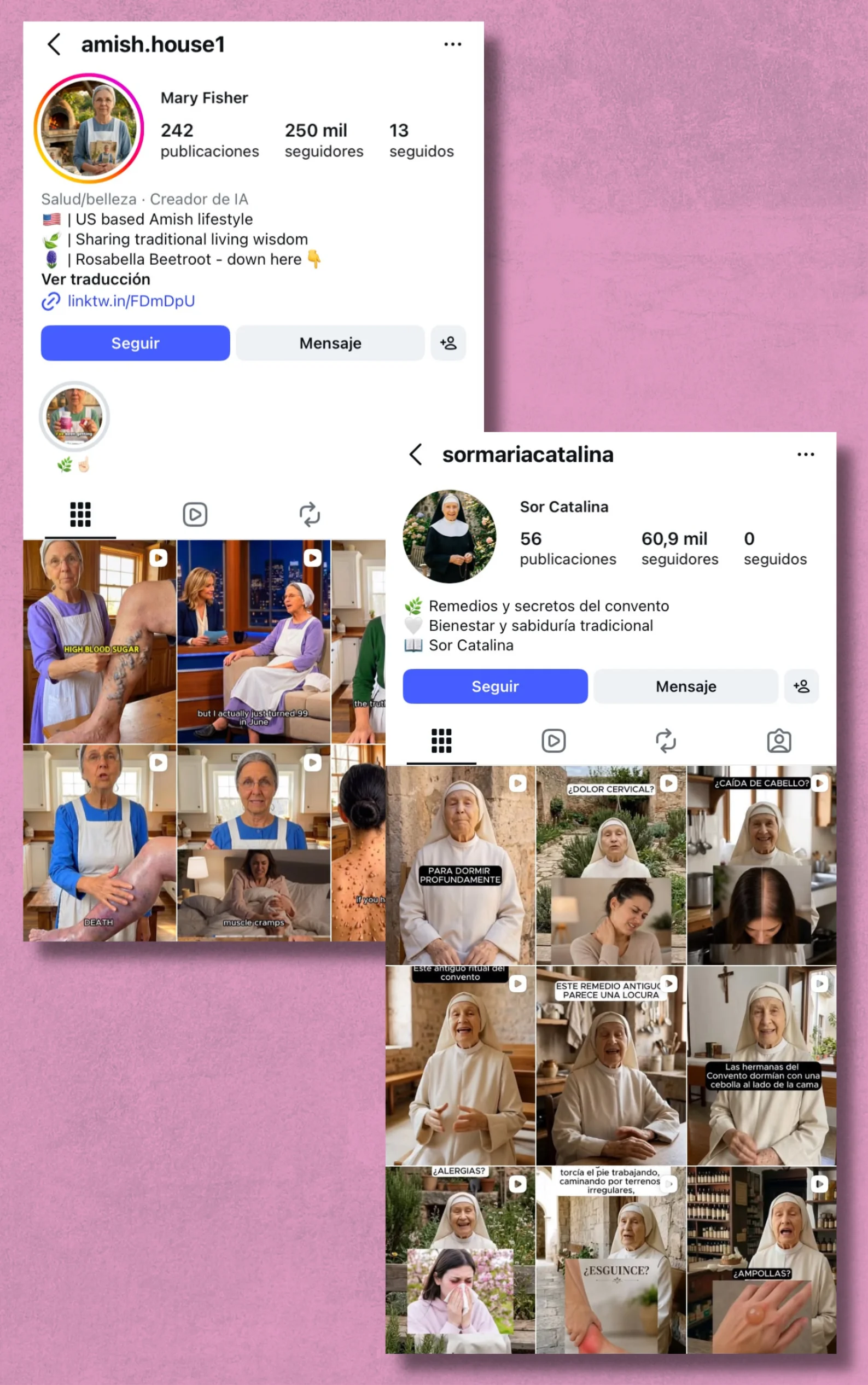
On English-language profiles (mostly from the United States), there are depictions of people from the Amish community, who are associated with growing their own food and using alternative and natural medicines. Mary Fisher (@amish.house1) is an account that supposedly represents a ‘99-year-old’ woman who posts about the ‘Amish way of life’. Although the woman does not exist (the most recent posts are labelled ‘AI-generated content’), this does not hinder her success. In her most viral video, with 3.6 million views, she claims that placing an ice cube on the arch of the foot for 3 seconds stops a migraine ‘as it is a connection point with the head’.
Meanwhile, Spanish-language accounts focus on figures linked to Catholicism, such as Sor Catalina (@sormariacatalina), a nun who supposedly shares her “remedies and secrets from the convent”, or Fray Lorenzo (@fraylorenzoreflexiones), who shares prayers and sells a “spiritual guide for the soul” promising a ‘step-by-step’ path to inner peace for just 9.95 euros.
The major danger: accounts posing as doctors, an illegal practice in Spain
Among the 250 profiles we analysed at Maldita.es, we identified 25 which, in addition to falling into the categories mentioned above, identified themselves as healthcare professionals or included indicators that could lead users to mistake them for such professionals. For example, by using the word ‘doctor’ or the abbreviation ‘dr’ in their usernames or bios.
Other profiles use elements that may be associated with medicine. One example is the Spanish-language account Felipe Nutrition (@nutritionfelipe), whose description reads: “Cardiology, 10+ years in holistic health” and which has over 714,000 followers. In several of his videos, “Felipe” is shown taking patients’ blood pressure and using a stethoscope or wearing a white coat and gloves. In one video, which has 3.1 million views, he claims that drinking a mixture of cinnamon, vinegar, lemon and turmeric on an empty stomach for three weeks means you “don’t have to spend thousands of dollars on insulin or metformin”, a medicine for type 2 diabetes. He also encourages viewers to buy a yerba mate product available on Amazon (with the warning that it has not been evaluated by the FDA) for $39.99 to boost its effects by “up to 10 times”.
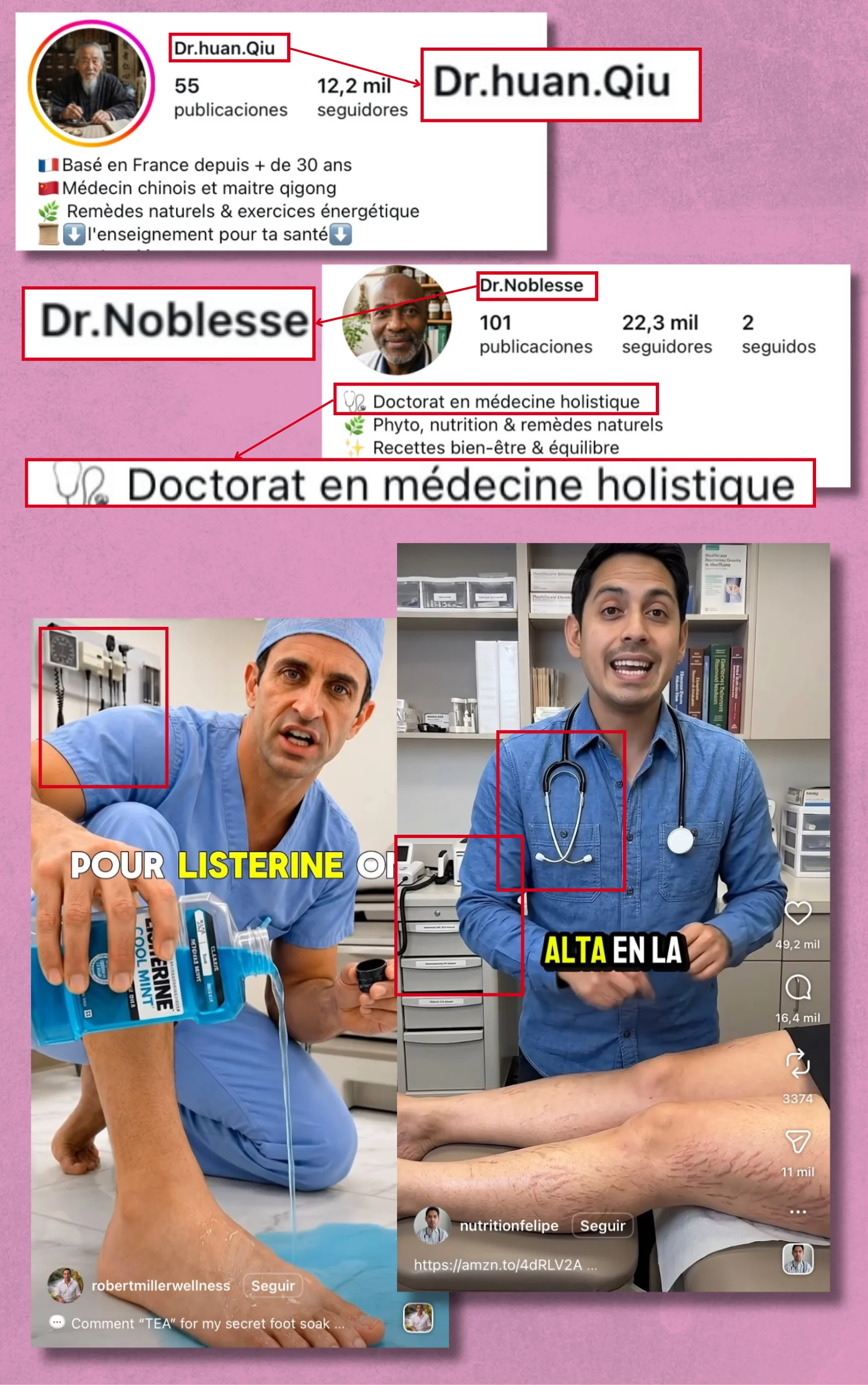
These 25 accounts have a combined total of over 3.6 million followers, and their videos have been viewed more than 397 million times. Furthermore, three of these profiles, each with over 800,000 followers, display Meta’s blue verification badge, which is supposed to guarantee that their identity is genuine.
Emilio José Molina, vice-president of the Association for the Protection of Patients from Pseudo-scientific Therapies, points out that in Spain this type of advertising is prohibited by Royal Decree 1907/1996, which does not allow “the use of testimonials from healthcare professionals, celebrities or real or alleged patients as a means of encouraging consumption”. According to the expert, this is to prevent the public from losing trust in healthcare professionals, something “essential for the proper management of public health in areas such as vaccination campaigns, product alerts, screening programmes and a long list of other initiatives that affect both individual and collective health”.
This article features the superpowers of Natalia Martín, a psychologist.
Natalia Martín is part of Superpoderosas, a project by Maldita.es that aims to increase the presence of female scientists and experts in public discourse through collaboration in the fight against disinformation.
Thanks to your superpowers, knowledge and experience, we can fight lies more effectively. The Maldita.es community is essential to stopping disinformation. Help us in this battle: send us any hoaxes you come across via our WhatsApp service, lend us your superpowers, share our fact-checks and become an Ambassador.
Methodology
For this article, Maldita.es has compiled 250 Instagram accounts that use artificial intelligence to disseminate health-related content. Some of these profiles appeared organically in the platform’s feed, whilst others were added following a search amongst the followers of the first accounts compiled. The accounts were created between December 2014 and June 2026 and, at the time of data collection (carried out between 20 and 21 July 2026), had more than 53.7 million followers and more than 45,600 posts. As of 27 July, some of the profiles had been removed from the platform.
For each of these accounts, the following information has been compiled: link (also archived or accompanied by a screenshot where this was not possible), username and profile name (which need not match the username and may be shared with other users), platform ID (extracted using a tool from My OSINT Tools), whether or not the account was verified, the number of times the name has been changed, the country recorded by the platform (which explains on its website that this is determined based on the account’s activity), the bio text, the creation date, number of posts, followers and users followed. A check was also carried out for each and every one of the 250 accounts to see whether there were other profiles with the same characteristics amongst those they followed.
To facilitate further analysis, the profiles in the database have been categorised as “Wise elders” (accounts showing older people giving health advice in different contexts), “Holistic” (those profiles that use this term or a similar one in their bio or that set their content in supposed medical consultations), “Religious/preachers” (accounts whose protagonists pretended to be nuns, priests or members of the Amish community) and “Ancestral wisdom” (depictions of communities associated with these stereotypes, such as “African”, “monk” or “Indian” people linked to supposed “ancestral knowledge”).
The links available both in the biography and in other sections of the profile, such as featured stories, have also been compiled and analysed. In total, 224 of the 250 accounts had a visible URL through which they were selling some kind of product on various external platforms. A foreign VPN (Virtual Private Network) was used to access those products not available in Spain.
To determine whether content was generated using artificial intelligence, we used Gemini, Google’s AI, which is capable of detecting the SynthID watermark – a technology imperceptible to the human eye that identifies content generated using its AI models. Furthermore, some content featured visible watermarks from various video-generation tools. We also checked for the presence of the ‘AI Information’ label that identifies synthetic content on Meta’s social media platforms, and reviewed whether the descriptions identified the creator as an ‘AI creator’ or similar terms. The posts by the users analysed displayed several of the typical tell-tale signs of AI-generated videos, such as impossible figures, blurred backgrounds and unintelligible text.
Our observations have enabled us to confirm that there are more accounts with these characteristics available on the platform, so whilst the sample included in this article does not cover all profiles, it does represent the phenomenon.
If you have any queries, please contact us at [email protected]
TRANSPARENCY: Maldita.es has participated in Meta’s external fact-checking program since 2019.