
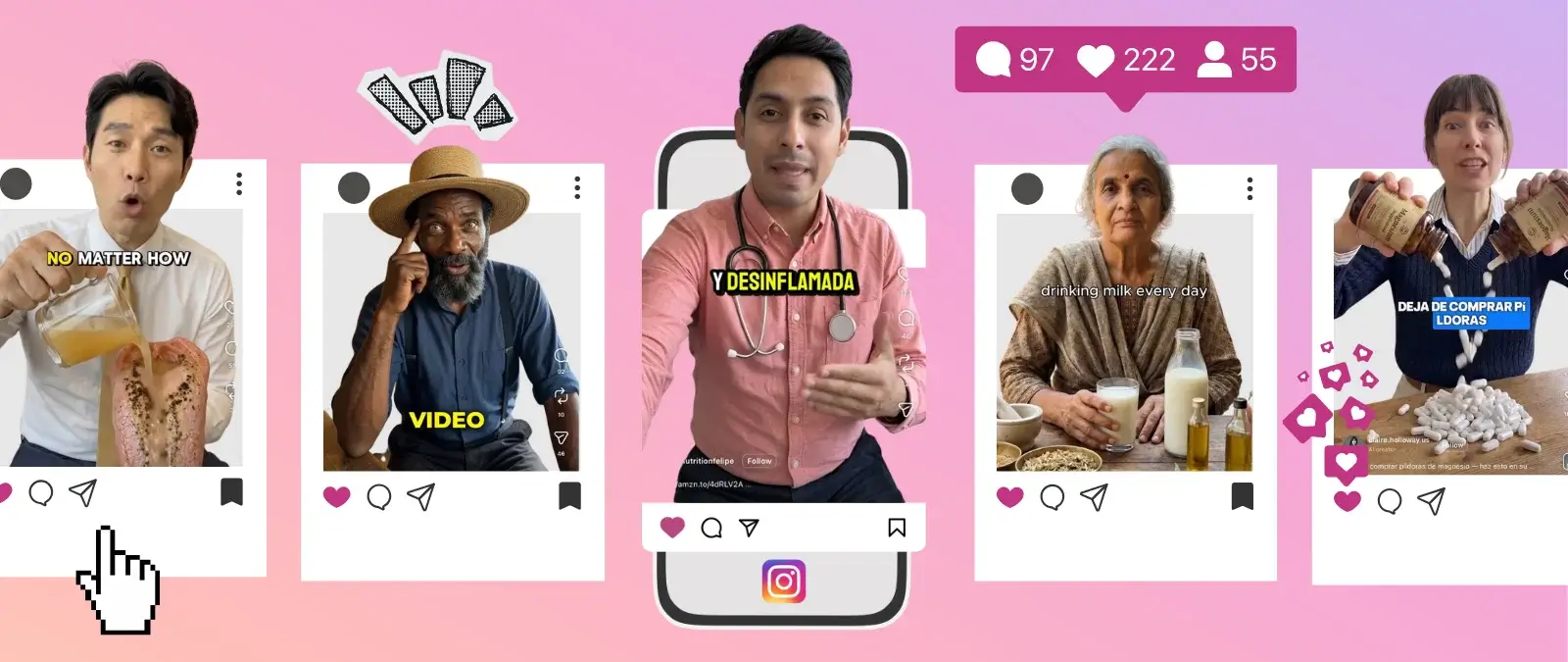
The similarities between the Instagram profile Eli Hosteler (@ eli.hosteler ), which describes itself as an "Amish herbalist" living in the United States, and that of Ernesto Salute (@ernestosalute), who claims to live in the Italian region of Trentino, or with the monk Fray Lorenzo (@fraylorenzoreflexiones), are greater than the differences. All of these profiles were generated using artificial intelligence (AI), most were created during 2026, their descriptions share the same structure, and almost all of them aim to sell you something, usually supplements or books and guides that also appear to have been written by AI.
These characteristics, among many others, are evidence of coordination and the use of similar templates, which allow them to create profiles en masse and through which 250 accounts analyzed by Maldita.es have been replicated. The objective, according to cybersecurity expert and Maldita.es contributor Daniel Fernández-Viagas, who has lent us his expertise, is to test niches and make money selling supplements and guides .
Almost 77% of accounts were created in 2026
An analysis of the 250 accounts we monitored shows that 192 were created between January and June 2026, indicating that the network began actively operating during that period. March and April saw the highest number of new Instagram accounts created, with an average of 48 new profiles each month.
Although some accounts were created in previous years, the first videos available on those profiles are recent. For example, the first posts on the five accounts created in 2022 were made between 2025 and 2026. Some of the initial videos cover topics completely unrelated to what they publish now . For instance, the first videos, published in February 2025, on the Jae Kim Skin account, created in 2022, are about parents and newborns. Now, this profile is a supposed expert in facial care and doesn't post anything about parents and babies, clear evidence that, as Daniel Fernández-Viagas explained, they are testing niches.
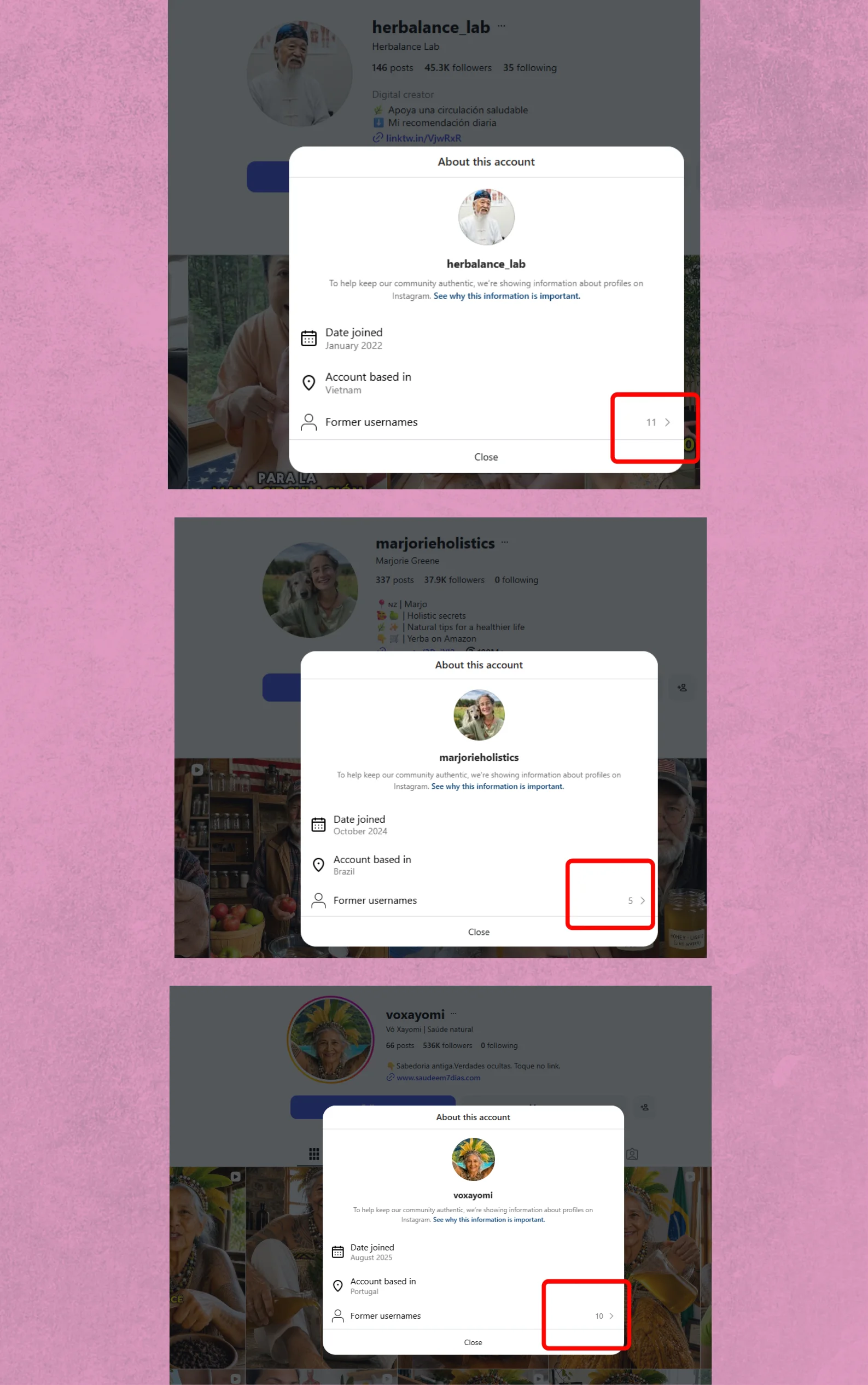
Another indication that this operation has only recently begun is that 131 of the 250 accounts analyzed by Maldita.es have undergone at least one name change. In fact, some, like Herbalance Lab, have accumulated up to 11 name changes since their creation in 2022, even though their first visible video was published on January 1, 2026.
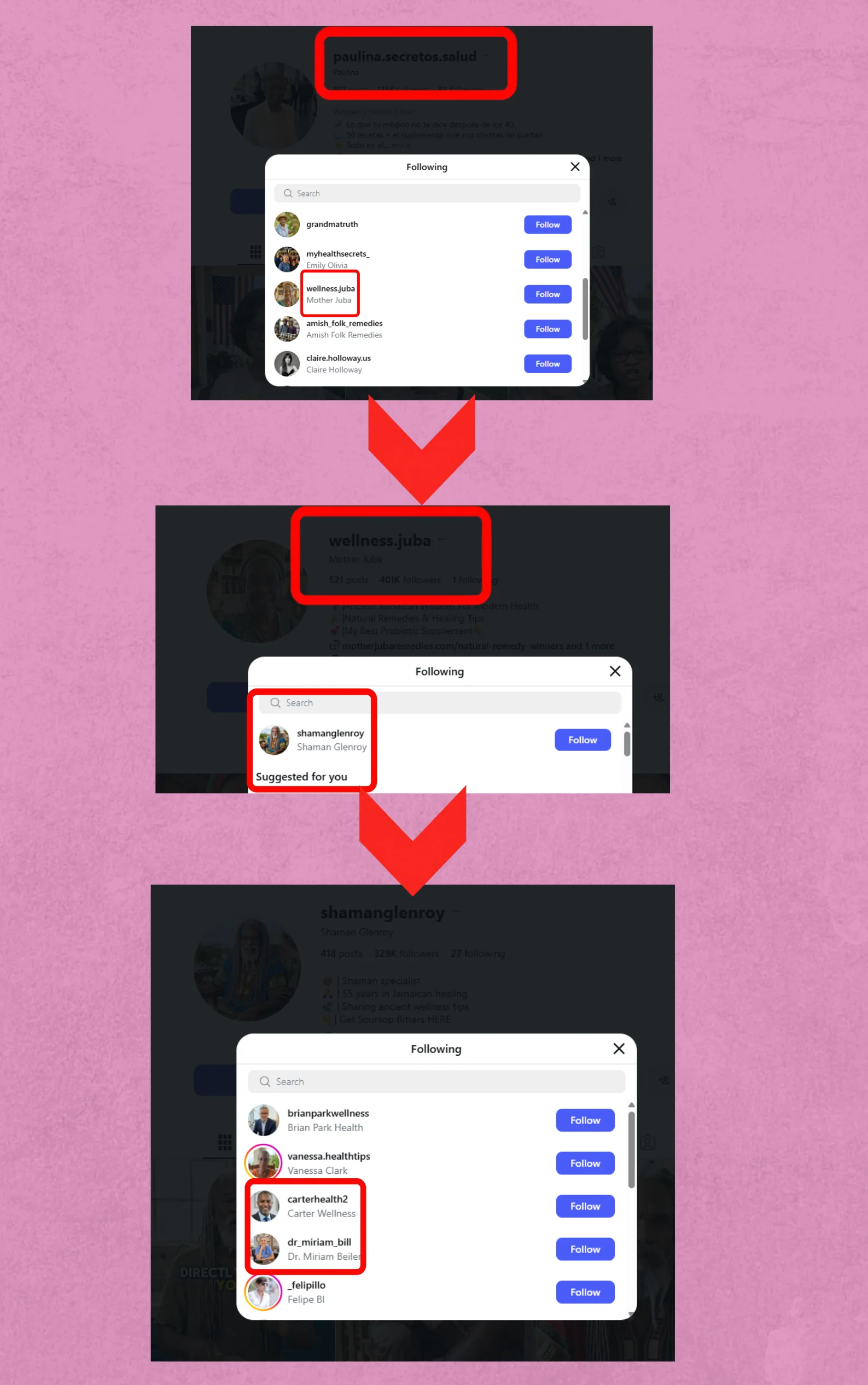
On the other hand, we found that more than half of the accounts, 57.4%, follow other accounts within the network. For example, Paulina Secretos Salud follows Amish Folk Remedies, Grandma June, Holistic Chen, and Mother Juba, among others. Mother Juba, in turn, follows Shaman Glenroy , a profile of a supposed shaman, who in turn follows Dr. Miriam Beiler , who describes herself as a "Doctor of Traditional American Medicine" and sells yerba mate energy drinks. And so on.
Chen monks and other profiles that share similar patterns
Further evidence of coordination among these accounts lies in the names they choose for these AI-generated characters, which are often very similar with only slight variations. For example, 12 accounts include the word "wellness" in their username: WellnessMaddie, wellnesswithjacob1, and Mayalin_wellness; three use the word "abuela" (grandmother) in Spanish: " abuela_lopez7," "Abuela.Remedies," and "Abuela Rosa"; and one uses the English word " grandmatruth" or the masculine form "Granddad Roy." Another 14 use "health" or "healthy"; five contain "herbal," and another five "holistic," among others.
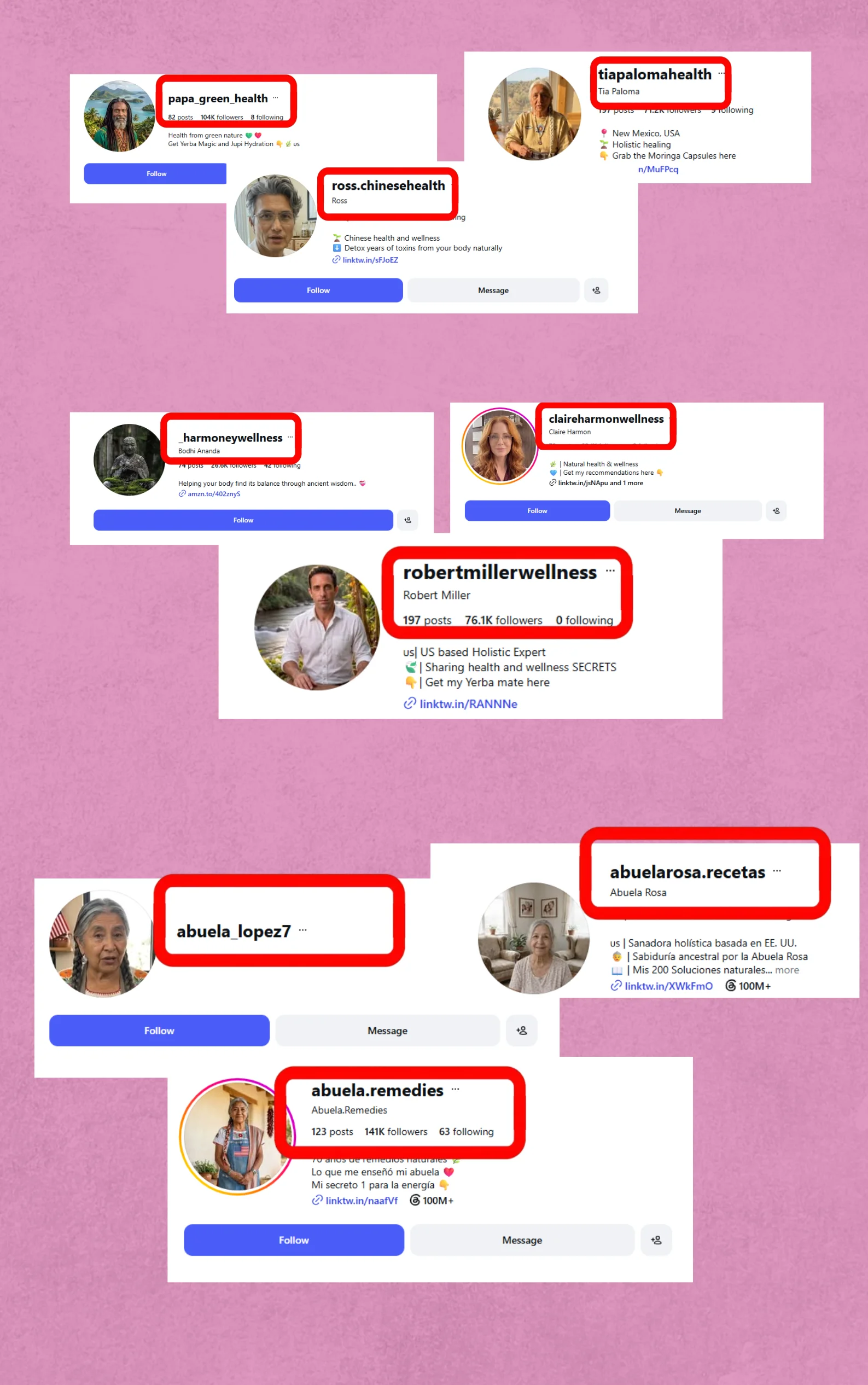
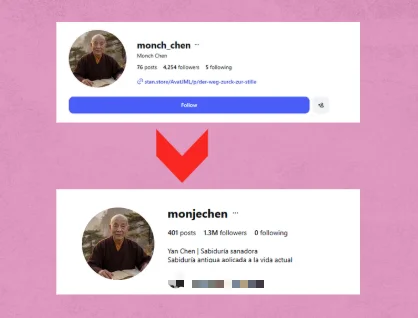
Many profiles not only have nearly identical names or characters, but they also use the same profile picture and the same names, one in Spanish and the other in English. This is the case with two accounts of monks named Chen (@monch_chen and @monjechen). It's a name they use consistently. We found six accounts with the name Chen: “@ chenwei.sante”, “Chen Lao (@chen.lao12)”, “Leo Chen (@leo.chenn_)”, “Monch chen (@monch_chen)” , “Mei Lin Chen (@vovomeii)”, and “Monaco Chen (@monacochenn)”, and three accounts using Shen: “Shen Mu (@shenmuhealer)”, “Shen Yu (@monkshen)”, and “Ravi Shen (@oravishen)”.
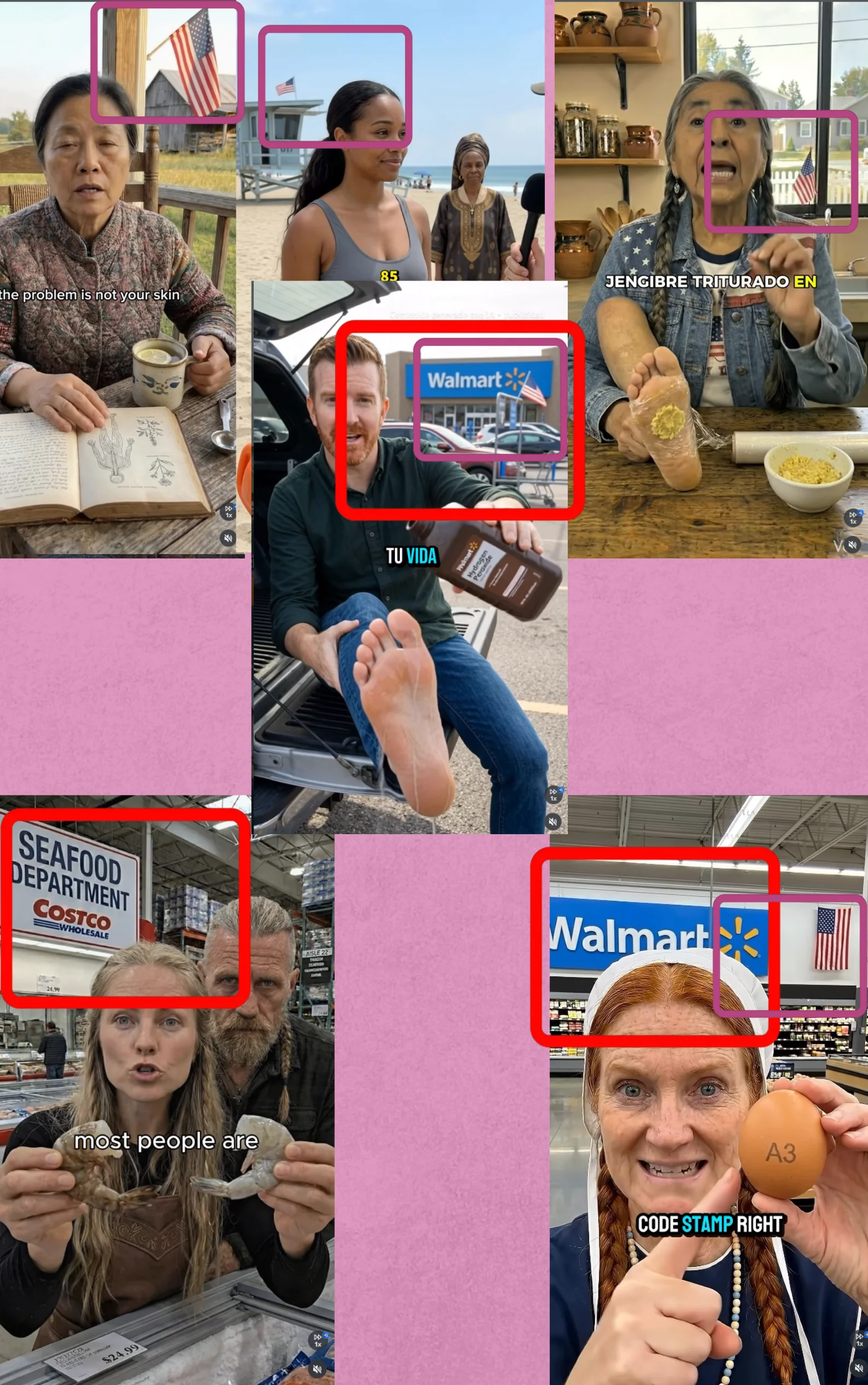
The elements that appear in the videos are also repeated in these profiles. For example, the American flag is present in many of them. We also observe that the characters regularly appear in front of or inside what appear to be large retail stores like Costco or Walmart. The cybersecurity expert emphasizes that this use of the flag and American-oriented language is due to “demographic and cultural” segmentation aimed at selling products.
Same types of profiles, locations, and account descriptions
The 250 accounts revolve around four main categories of profiles: rural elders, "holistic" practitioners, shamans or Easterners, and religious figures. Looking at their descriptions, almost all share the same structure: three lines of text and a link. "An attempt to project authority, but selling solutions that are unproven, unscientific, or unvalidated," explains Fernández-Viagas.
Among the most used words in these profile descriptions are “health”, “wellness”; “years”, “natural”, “holistic” or “wisdom”.
These words are in English, as 61.2% of these profiles are in that language. Spanish follows with 50 profiles. Regarding the country where Instagram places these accounts, more than half ( 132 out of 250) are in the United States. The rest are located in other countries such as Spain (15), France (19), Brazil (18), the United Kingdom (12), Canada (8), and Germany (8), among others.
More than half of the accounts have their Instagram location in the United States
 US |
 France |
 Spain |
 Brazil |
 United Kingdom |
 Germany |
 Canada |
 Italy |
 Australia |
— No shared |
 Sweden |
 Indonesia |
*The following countries have been removed from the visualization as they represent less than 1%: Argentina, Portugal, Vietnam, Benin, Belgium, Colombia, United Arab Emirates, Georgia, Luxembourg, Morocco, Montenegro, Myanmar, Palestine, Peru, Poland, Romania, Russia and Thailand.
Furthermore, the profile descriptions are characterised by the use of similar formulas, which consist of four parts:
Presentation of the expert or reference: holistic expert, wellness specialist, member of the Amish community, etc.
Authority: They tell you why you should trust them with phrases like "Based on ancestral wisdom," "Certified," "More than 10 years of experience," and others.
Benefit: what those who follow them would obtain: “health tips”, “wellness secrets”, “longevity”.
What you have to do, the call to action : “follow us for daily health tips”, “get my guide”, “link below” and “click here”.
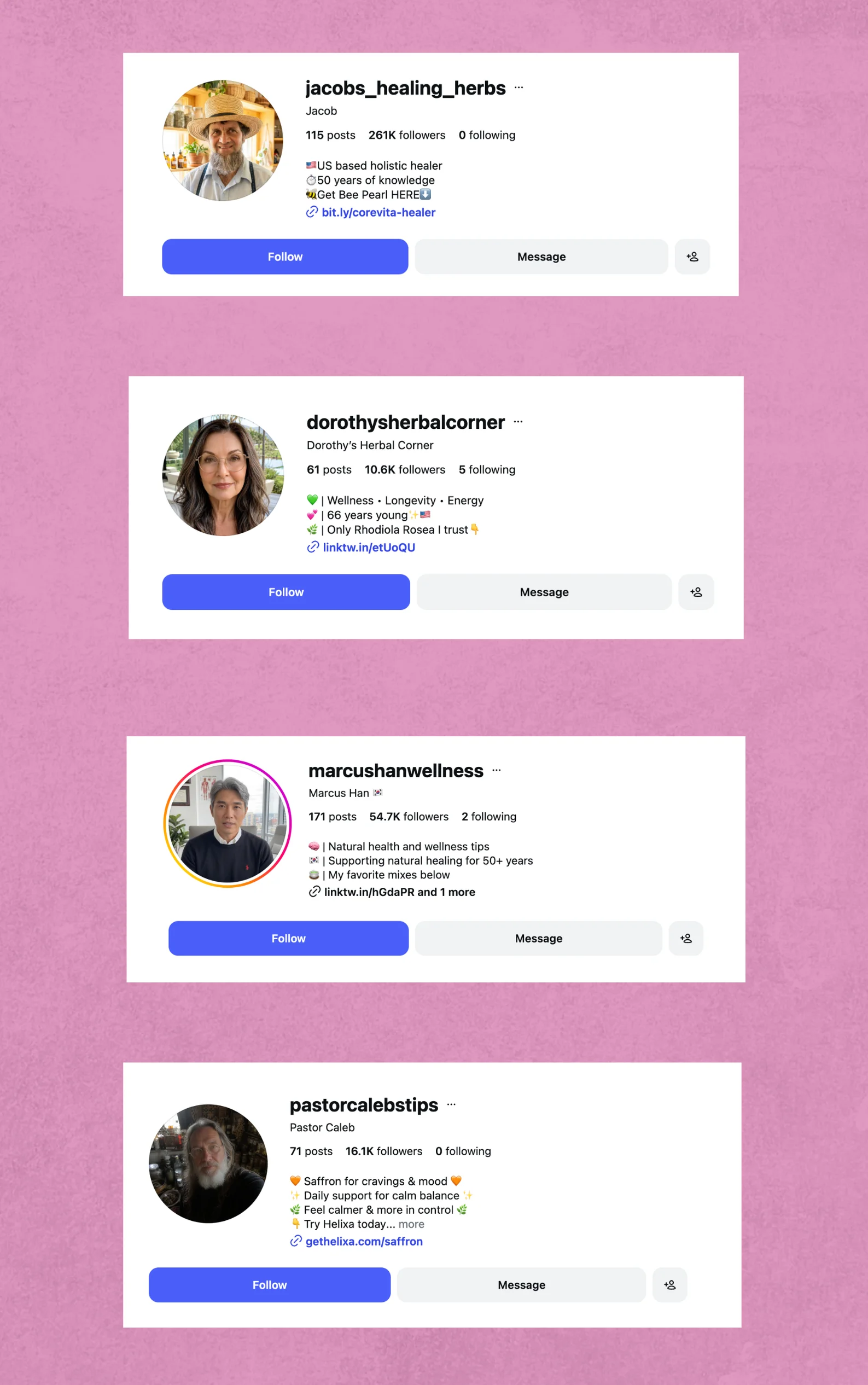
Sample of profile descriptions that, as we can see, correspond to the same type of structure. This would indicate that most of the profiles analysed use templates to create these descriptions, substituting some of the variables to avoid being identical. There are “public and commercial collections of prompts and templates optimised for generating scripts ” and short texts like these profile descriptions, as well as user-generated content “with a clear component of creating avatars that inspire credibility or approachability,” explains privacy and cybersecurity expert Daniel Fernández-Viagas. “It’s relatively cheap and quick to produce a large volume of accounts and videos, and the technical barrier is low, which is why it’s so widespread. Plus, it works for many people, and they’re making money quickly ,” he adds.
Another shared characteristic is the use of emojis ; over 95% of profiles include at least one in their profile description, with the following being the most common: 👇, 🌿, 🇺🇸, ⬇️, ✨, 🌱, 👇🏻, 📖. According to the cybersecurity expert, "the recurrence of the same set of emojis and phrases shortens creation time and maintains brand consistency."
56% of the accounts sell some type of supplement, and 32% sell books or guides with indications of having been created with AI
All these profiles share a common purpose: to gain followers and encourage them to buy the products they sell by clicking on a link visible in their profile bio or posts. While not all of them sell the same thing, most offer supplements such as beetroot root, rhodiola, or probiotics. More than half of the accounts (56%) sell some type of dietary supplement , primarily through Amazon, but also through other external websites. However, many of the products advertised for the United States are not sold on Amazon Spain.
Similarly, 32.4% of the profiles we analysed sell some type of guide or book, which are the second most offered type of product after supplements. In fact, 11 accounts , mostly targeting the Spanish-speaking audience in the United States, sell the book "200 Natural Solutions for Everyday Problems" by someone named Marina López, an author about whom no trace can be found.
We also found profiles, such as that of Fray Lorenzo Reflexiones , that sell their own guides. This AI-generated friar provides a link in his profile biography that redirects to a website with the same name, which claims to be located in Logroño (La Rioja, Spain). The website also features the supposed AI-generated friar and displays images of people with the book, which sells for €9.99, also created with this technology. Maldita.es has contacted the website and the email address listed there, asking who wrote the book and requesting any information about the person behind it, but we have not received a response as of the publication date of this article.
The website for the guide sold by Monk Chen is identical to the one promoted by Fray Lorenzo. Both are also listed at the same price, €9.99, although both claim it's a discount and that the original price is €19.99. Another detail: both sales websites feature the same review, supposedly from a user named "María R." These similarities are common on websites where these guides and books are sold online. At Maldita.es, we've already warned about the use of fake reviews to lend credibility to services.
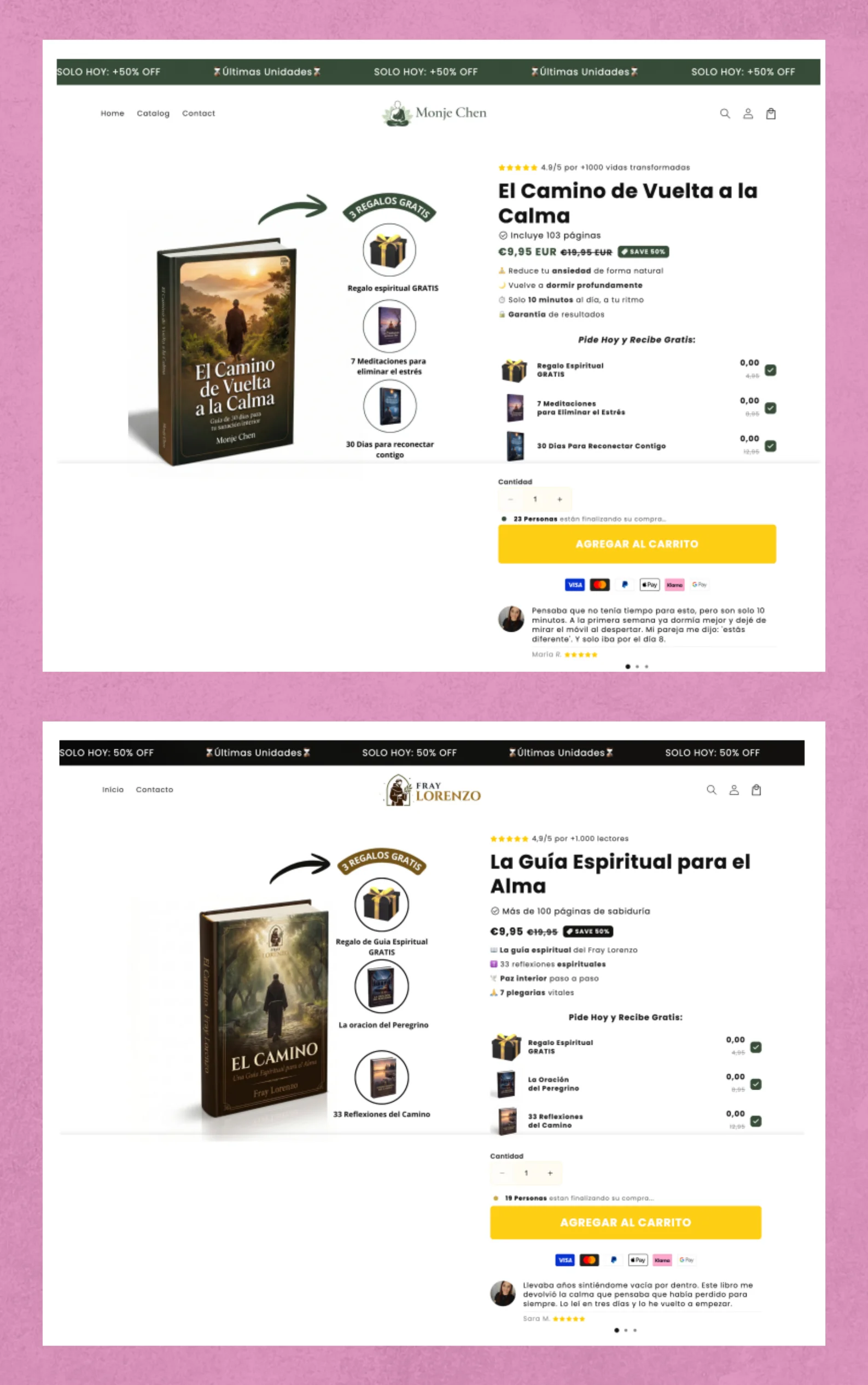
Other books claim to be related to ancestral remedies, Buddhist themes, or ancestral rituals, among other things. They all share similar characteristics and show signs of having been created with AI: for example, we found no information about the author Marina Martín, the supposed author of the book "200 Natural Solutions for Everyday Problems"; there is no trace of the supposed Fray Lorenzo or Monk Chen, since the images in which they both appear were generated with AI, and on the two identical websites, we find the same review by someone named María R. In no case do they offer any proof that a real person is writing these books or that these religious figures are real people.
This article was written with the help of the damned Daniel Fernández-Viagas, an expert in privacy and cybersecurity, who used his superpowers to contribute his expertise.
Thanks to your superpowers, knowledge, and experience, we can fight lies more effectively. The Maldita.es community is essential to stopping disinformation. Help us in this battle: send us the hoaxes you receive via our WhatsApp service, lend us your superpowers , share our fact-checks, and become an Ambassador .
TRANSPARENCY: Maldita.es has participated in Meta’s external fact-checking program since 2019.