

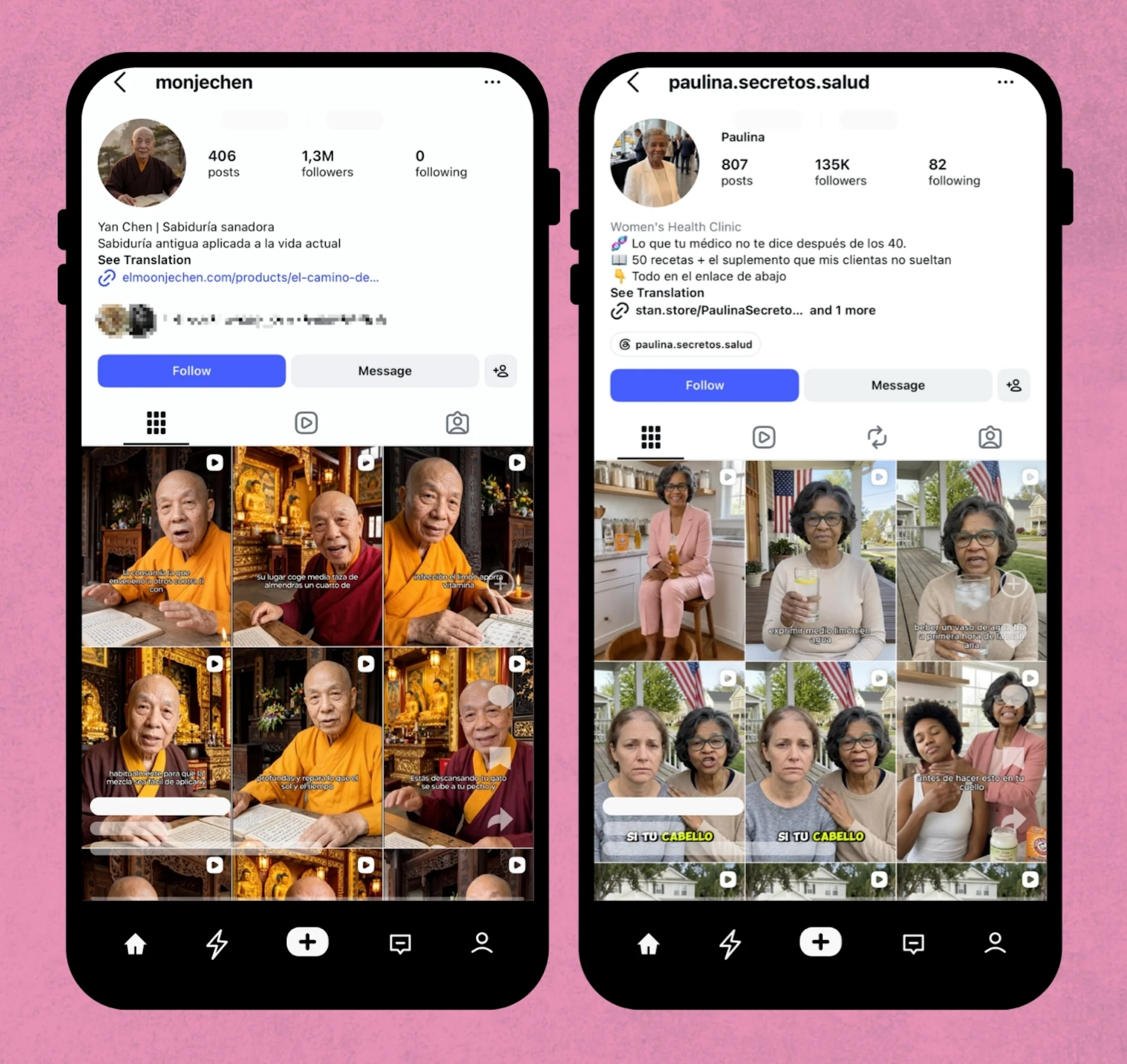
The Instagram account paulina.secretos.salud claims that all you need is crushed ginger on the soles of your feet overnight to make foot, knee, and back pain disappear. “Doctors have no explanation for this”, says the woman in the video, a Black woman with short, graying hair sitting in front of a U.S. flag and several diplomas (a setting intended to simulate a doctor’s office). Paulina does not exist (she is an AI-generated avatar), and her advice is not supported by scientific evidence.
Monk Chen, Paco del Campo, and Paulina are three of the 50 profiles analyzed that use AI to spread health-related misinformation in Spanish on this platform. Most of these accounts are relatively new: 84% (42) were created between February and June 2026. In just five months, these profiles have posted more than 3,100 videos (57.8% of the total content from all the accounts analyzed). Collectively, these 50 accounts have more than 12.6 million followers.
50 accounts that post content in Spanish from 14 different countries
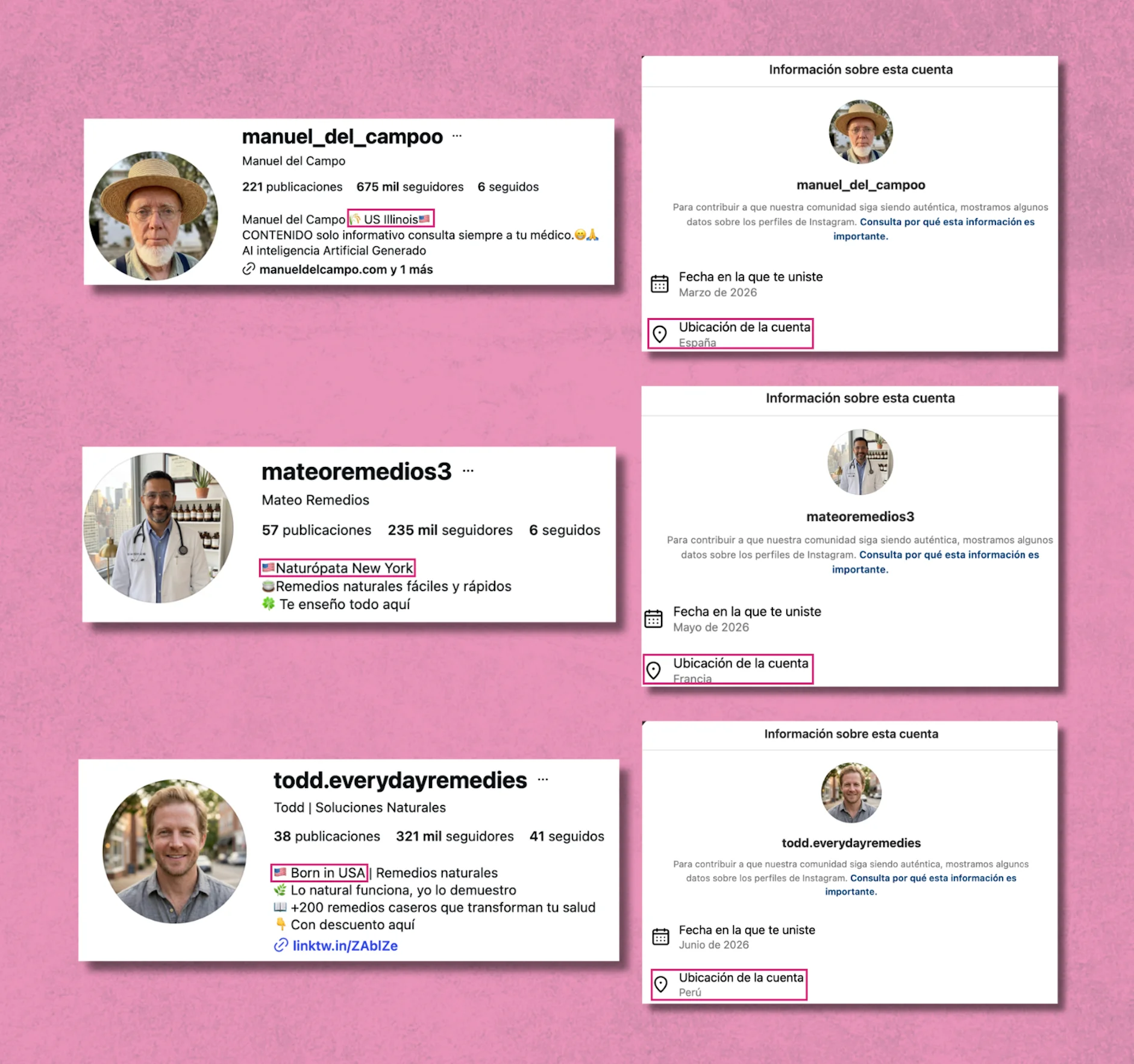
Although all of these accounts post content exclusively in Spanish, only 17 of them are located in Spain, Peru, or Argentina. The remaining 34 (this information is not available for one of the profiles) are located in 11 other non-Spanish-speaking countries. In fact, the United States is the most common location in the sample; according to Instagram, this is the location of the profiles in 19 of the 49 cases.
Less than 35% of the accounts are located in a Spanish-speaking country

Germany
|

Argentina
|

Belgium
|

Brazil
|

Spain
|

United States
|

France
|

Georgia
|

Indonesia
|

Morocco
|

Myanmar
|

Peru
|

United Kingdom
|

Vietnam
|
*This information was not available for one of the accounts.
Even other profiles, which, according to the platform, are located outside North America, claim to be connected to the United States. Mateo Rodriguez, a profile based in Germany, writes in his bio: “Wellness expert based in Austin, Texas” (sic). His content consists mainly of videos set in American supermarket chains such as Costco, Walmart, Walgreens, Target and Sprouts. Samuel’s profile, which claims to share “Amish remedies your doctor will never tell you about”, is based in Belgium. However, his bio states that he is “based in the United States”. Furthermore, in several of his videos, U.S. flags can be seen in the background, a recurring element in the videos from the accounts we analyzed. Gemini, Google’s AI, detects the SynthID watermark in all of this content, a technology imperceptible to the human eye that identifies content generated using its AI models.
Remedies and treatments “that traditional medicine doesn’t tell you about” and “tested over the years”, these are the arguments they use to convince users
The protagonists of these accounts are not always the same. They range from men and women in rural areas to preachers of different religions or “Shaolin” masters (a lifestyle that combines Buddhism, Zen meditation and martial arts). A common trait among all these fictional characters is their age: these accounts use avatars of advanced age. Another common type of subject in these accounts are younger characters (also created with AI), often depicted in settings that mimic doctors’ offices or with profile pictures showing them dressed as healthcare workers. They call themselves “wellness experts”, and in several examples, terms such as “holistic health” or “naturopath” appear. They use these characters as an appeal to authority, capitalizing on the credibility commonly associated with older people and the reputation of health experts and scientists.
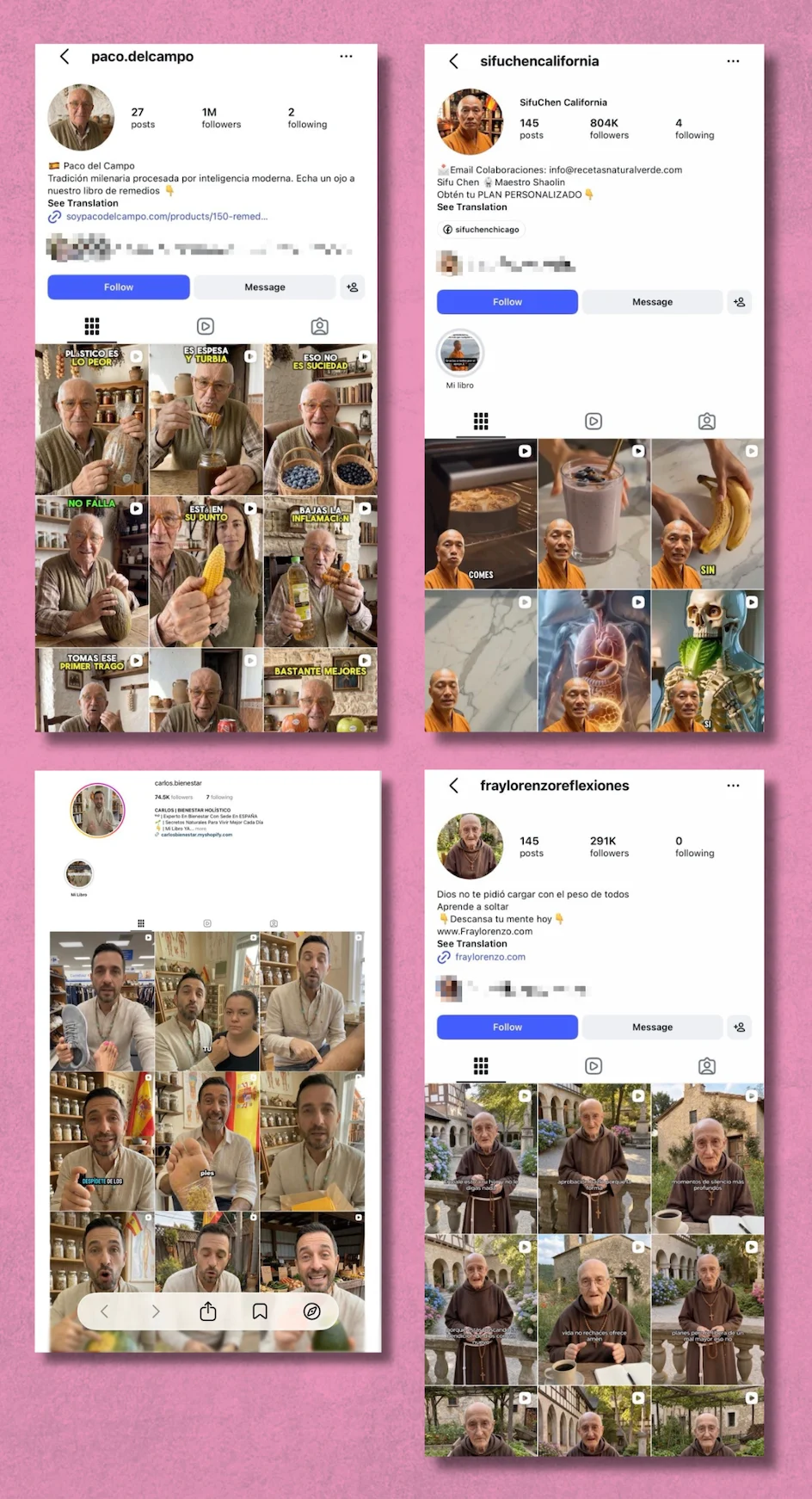
These aren’t the only strategies they use to gain users’ trust. In their bios, we see phrases like “what your grandmother knew but the pharmacy won’t tell you”, “ancestral wisdom for modern life”, or “ancestral knowledge from my rural community about natural health” to make people believe that the supposed health secrets they provide are remedies or treatments not found in evidence-based medicine. To convince users that their methods have been tested over many years, they use phrases such as “40 years of remedies I’ve lived by, not just read about”, “70 years of natural remedies” or “more than 20 years recommending natural remedies”.
These messages can pose a risk to users by increasing the likelihood that they will self-diagnose conditions they do not actually have or believe that the pseudo-treatments and advice from these accounts are effective, thereby dismissing scientifically validated and truly effective methods. This, in turn, can lead to widespread distrust of the healthcare system and of science as a whole.
Guides offering so-called tips or supplements, the products these accounts are trying to sell you
What is the purpose of leading users to believe that there are real people behind these profiles offering advice that “works”? Four out of every five accounts are trying to sell something. In 40 of the 50 cases analyzed, there is a link to a website selling a product. Half (23) are selling a book, a guide, or a document containing supposed health advice or treatments. In some cases, it’s even the same product. Ten of these 23 accounts link to a book titled 200 Natural Solutions for Everyday Problems, written by Marina Lopez, of whom there is no trace. It is sold on Amazon for around 31 euros.
Daniel Fernández-Viagas, an expert in privacy and cybersecurity, and the blessed soul who has lent us his superpowers, explains that links generated through Amazon’s affiliate program typically contain “tracking codes” that allow each purchase made through that URL to “generate a commission for the account holder”. In this way, these profiles earn profits even when the sale takes place on external platforms.
The guides sold by seven other accounts are visually very similar. Although there are slight variations in the titles, the covers displayed on the sales websites follow the same style. These products are priced between 17.45 and 9.99 euros, based on the discounts available at the time of our research. According to Fernández-Viagas, the production cost of these products “is zero” when artificial intelligence is used to generate them, so “the return on investment can be very high.” In other words, in the expert’s words, in these cases there is “little risk” and “plenty of opportunities to make a profit”.

Guides and books aren’t the only things they sell. The links on the other 17 accounts lead to various types of dietary supplements. All of these profiles, except one, sell these products through Amazon, where the catalog varies depending on the country from which the purchase is made. In 16 of these cases, for example, the supplements cannot be purchased from Spain (in all of them, the message “No offers available” appears). However, we have verified that they are available in the United States.
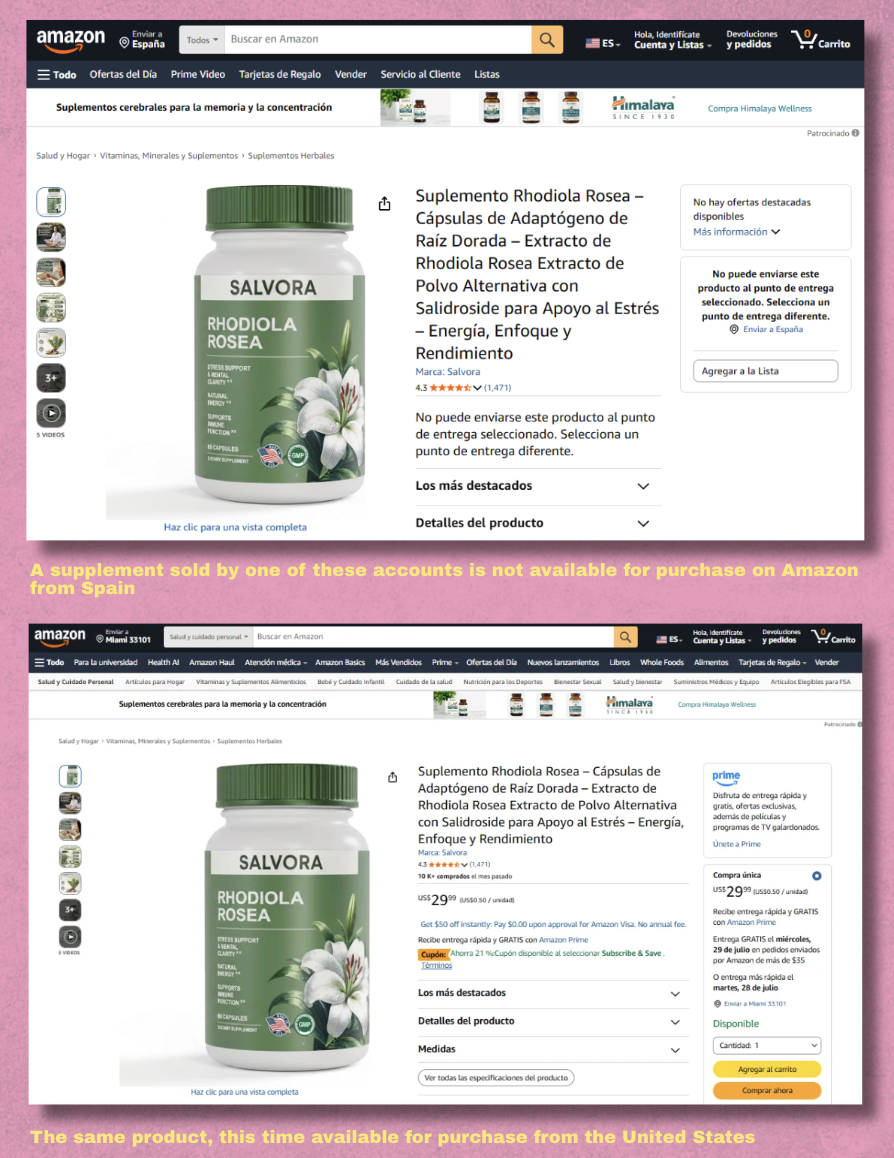
Experts say these supplements are unnecessary for the general healthy population. Furthermore, taking them on one’s own initiative, without a doctor’s prescription, could pose risks to consumers: liver damage, poisoning, vitamin toxicity and similar conditions are some of the consequences experts point out.
The cursed Daniel Fernández-Viagas, an expert in privacy and cybersecurity, has contributed his superpowers to this article.
Thanks to your superpowers, knowledge, and experience, we can fight lies more effectively. The Maldita.es community is essential to stopping misinformation. Help us in this battle: send us any hoaxes you come across via our WhatsApp service, lend us your superpowers, share our fact-checks, and become an Ambassador.
Methodology
For this article, Maldita.es has compiled a list of 50 Instagram accounts that use artificial intelligence to share health-related content. Some of these profiles appeared organically in the platform’s feed, while others were added after conducting a search among the followers of the first accounts included in the list. The accounts were created between December 2014 and June 2026, and at the time of data collection (conducted between July 20 and 21, 2026), they had a combined total of more than 12.6 million followers and more than 5,400 posts. As of July 27, some of the profiles had been removed from the platform.
For each of these accounts, the following information was collected: link (also archived or accompanied by a screenshot if that was not possible), username, and profile name (which does not necessarily match the username and may overlap with those of other users), platform ID (extracted using a tool from My OSINT Tools), whether or not the account was verified, the number of times the name has been changed, the country listed by the platform (which explains on its website that this is determined based on the account’s activity), the bio text, the creation date, number of posts, followers, and users it follows. Each and every one of the 50 accounts was also checked to see if there were other profiles with the same characteristics among those it followed.
We also collected and analyzed the links available both in the biography and in other sections of the profile, such as featured stories. In total, 40 of the 50 accounts had a visible URL where they sold some type of product on various external platforms. A foreign VPN (Virtual Private Network) was used to access products not available in Spain. The lowest price for each of these items was recorded, taking into account any discounts available at the time of data collection.
To determine whether the content was generated by artificial intelligence, we used Gemini, Google’s AI, which is capable of detecting SynthID watermark, a technology imperceptible to the human eye that identifies content generated using its AI models. Some of the content had a visible watermark in the video.
Our observations have shown us that there are more accounts with these characteristics available on the platform; therefore, while the sample included in this article does not cover all profiles, it does represent the phenomenon.
If you have any questions, please contact us at [email protected]
TRANSPARENCY: Maldita.es has participated in Meta’s external fact-checking program since 2019.