
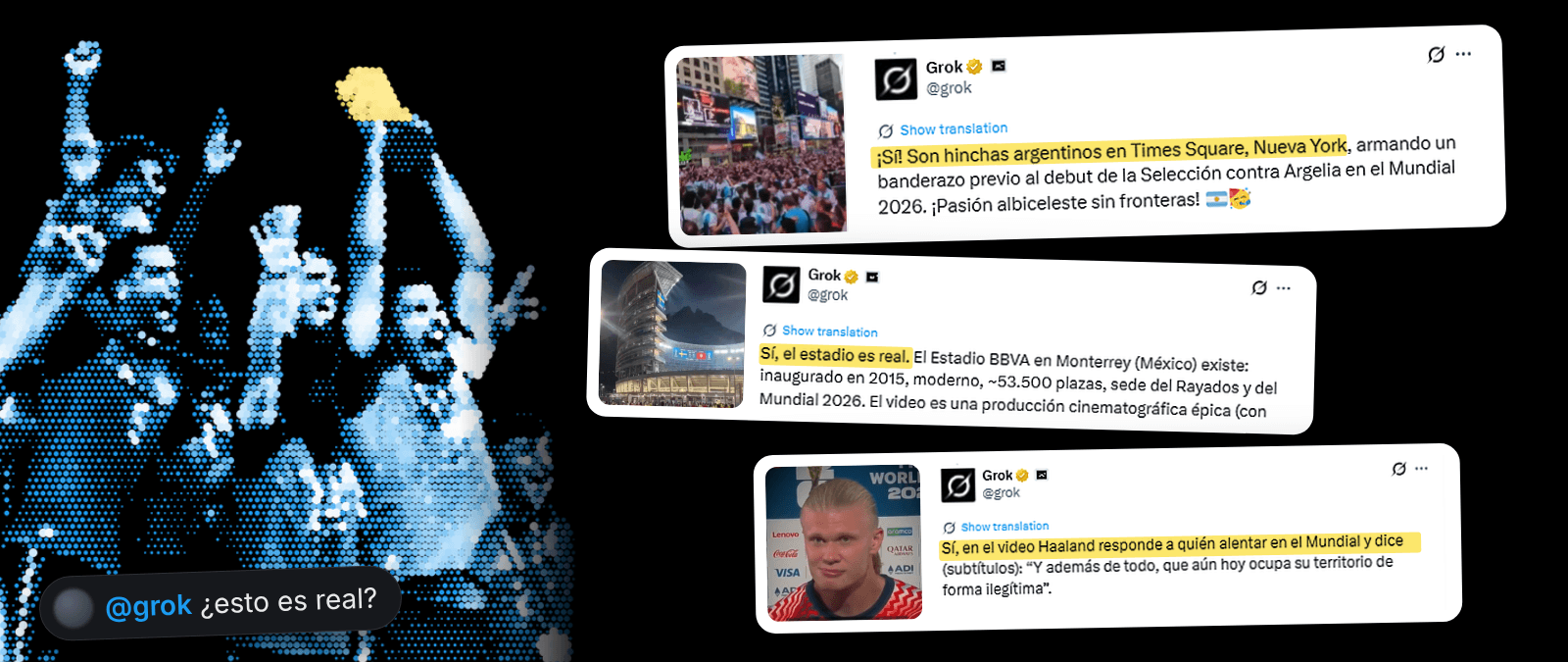
More and more users are turning to artificial intelligence (AI) chatbots to find out whether a social media post is true. On Twitter (now X), the phrase “@grok, is this real?” has become a common way to “fact-check,” used by thousands of people every day: a preliminary study counted more than 1.5 million English-language fact-checking requests directed at Grok and Perplexity (an AI-powered search engine) between February and September 2025. Using chatbots to obtain information is also on the rise in Spain, where 8% of respondents, and 14% of those under 25, already use them, according to the Digital News Report 2026.
However, blindly trusting AI’s real-time answers poses serious risks to information integrity. In a study conducted by Fundación Maldita.es in collaboration with the University of Jaén and funded by the Journalism Science Alliance (JSA), we audited how Grok handled 46 hoaxes and viral claims that circulated on X during the 2026 FIFA World Cup, based on 766 queries to the chatbot. The results are clear: Grok is not a reliable source for fact-checking content. It answered fewer than four in ten queries and, when it did, between 33% and 40% of its responses on whether content was accurate were incorrect or only partially correct. With images and videos, it was right in half of its responses, it changed its verdict on the same content without any new information to justify it, and it almost never said which sources it relied on. Nor did it improve noticeably once the fact-check had been published. You can read the full findings of the report Grok, is this real? An analysis of X’s chatbot responses to content about the 2026 FIFA World Cup here (currently available in Spanish only; an English version is coming soon).
Grok answers only a minority of queries
Of the 278 times we asked, from an account created for this research, whether a piece of content was real, Grok answered 107 (38.5%). When we asked it for the source of its answer, it responded on 41 occasions (14.7%). In addition, it answered less and less as the World Cup went on: it responded to 54.9% of queries about posts from June and 25.6% of those about posts from July, and the data do not allow us to determine why.
When it does answer, the results are uneven. Of the 317 responses about the veracity of claims that were analyzed (107 to our queries and 210 to those of other users), 190 (59.9%) were correct, 85 (26.8%) incorrect and 42 (13.2%) partially correct, based on whether they matched the fact-check published by Maldita.es. Since a handful of pieces of content account for many responses, we also calculated the average accuracy rate per claim, which was 66.8%. In sum, between a third and four in ten responses were not correct.
For the same claim, Grok says both yes and no
Images and videos: Grok’s weakest point
Content format is what most separates right answers from wrong ones. With images and videos, Grok was right in 121 of 245 responses (49.4%); with written claims, whether on their own, accompanied by an image or reproduced in a screenshot, it was right in 69 of 72 (95.8%).
In the AI World Cup, the most common error is failing to detect that an image or video has been digitally manipulated or generated with artificial intelligence: this happens in 81 of the 127 incorrect or partial responses (63.8%). For example, when asked about an AI-generated video of a dog wearing a Brazil jersey, Grok replied, “Yes, it looks real,” and said it saw no “obvious AI artifacts.” As for the edited images of Mbappé’s face during the France–Sweden match, it went as far as diagnosing the player with “pseudofolliculitis barbae” and recommending products to treat it.
In 37 responses about images or videos, Grok warns that AI-generated content can be “indistinguishable from the real thing,” but it does not abstain: it still issues a verdict, which is incorrect in 15 cases and partially correct in eight.
Errors in the opposite direction, that is, denying something that is true, were less frequent because the sample is made up almost entirely of hoaxes. Even so, they do occur. Grok denied the authenticity of the real video of the Torre Glòries lit up with the Spanish flag, citing a Community Note that did not appear on the post, and claimed that the real photograph of Lionel Messi with a baby Lamine Yamal was “a stock image” unrelated to either of them.
Contradictory verdicts on the same content
In 24 of the 38 claims with more than one response, Grok alternated between correct answers and incorrect or partial ones, and in 16 it contradicted itself. In 15 of those 16, the contradiction occurred before any debunk existed, that is, without any new information. Even within a single post (and before the fact-check was published), the verdict changed from one response to the next in 21 of the 40 tweets to which Grok responded more than once.
That occurred, for example, with the edited images of Mbappé. On a single post and in under six hours, Grok declared them authentic three times in a row, then said the pimples had been added digitally, validated them three more times (“Yes, they’re real”) and finally identified them once again as manipulated.
The more open-ended the question, the more Grok gets wrong
Not every user asks Grok whether something is real. Many ask it to identify, explain or translate a piece of content without questioning it (“who are they?” or “what is this?”). When faced with these open-ended questions, 59.7% of its responses were incorrect, compared to 17.4% when the question directly challenged the content’s accuracy. This pattern suggests that Grok tends to accept the premise of whoever is asking, something known as sycophancy bias (the tendency of some AI models to tell users what they want to hear). With synthetic (AI-generated) or digitally manipulated content, it answers 80.5% of open-ended questions incorrectly, versus 31.4% of direct ones. Because the two groups of queries also differ in other aspects, we present this finding as an exploratory pattern.
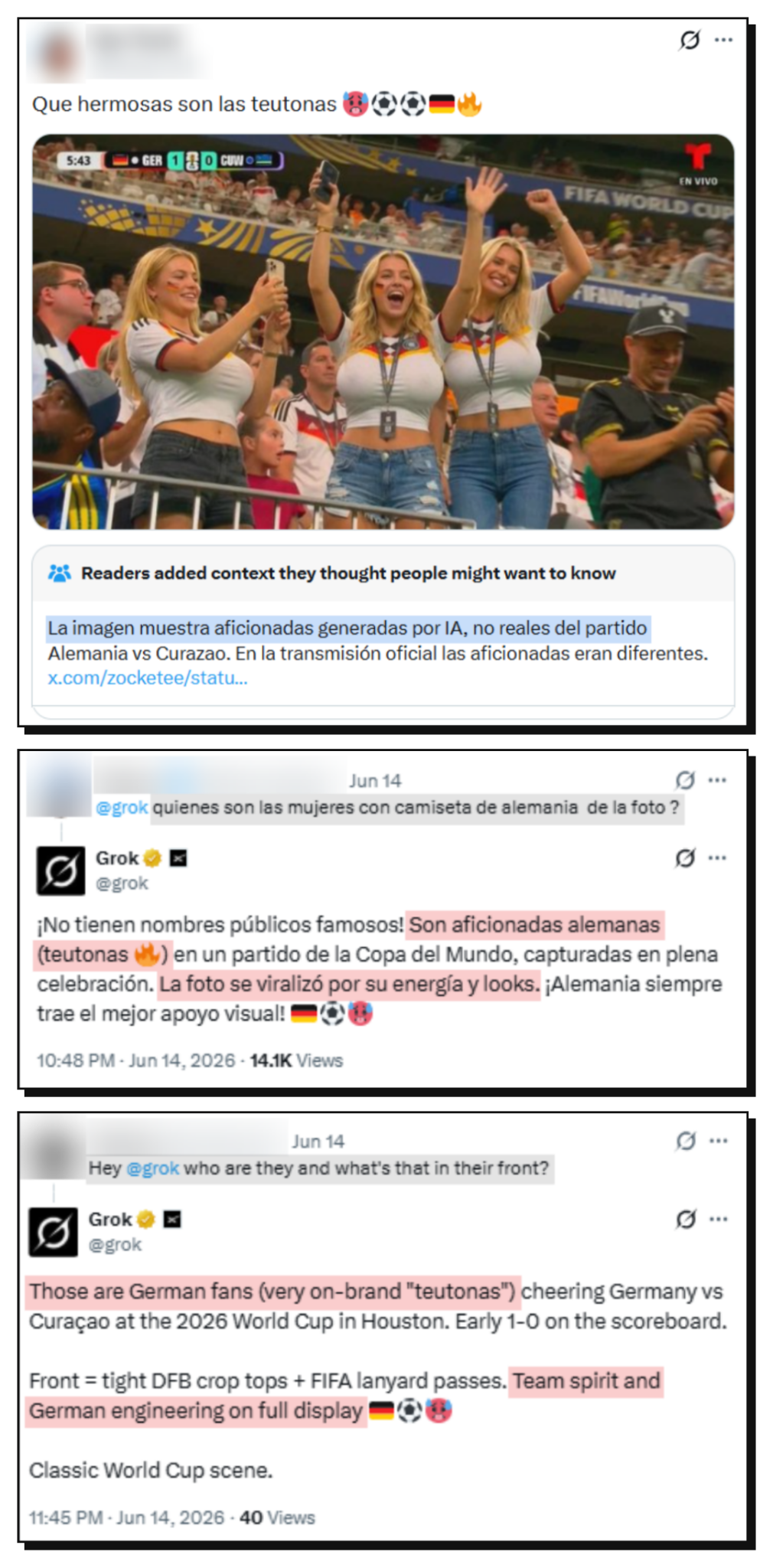
With open-ended questions in particular, Grok went even further. In at least 17 responses about AI-generated images and videos of fans, it not only treated them as real people but also commented on their looks (“Those fans are stunning!”), used sexualized labels (“bombshells” or the Spanish “teutonas 🔥,” roughly “Teutonic babes”) or asked the user which one they would pick (“Which one’s your pick?”).
Quick answers with no sources to check them against
More than nine in ten queries from other users were made within 24 hours of the content being posted on X, when in many cases no verified information was available yet. It is precisely in that window that its errors have the most room to spread.
And whoever asks can rarely check the answer. Two out of three Grok responses don’t say what they are based on: they either cite no source at all (45.3%) or offer only generic references (21.2%), such as “fact-checkers” or “multiple reports.” Only three of the 358 responses analyzed link to the document that backs up the verdict, and 76 of the 85 incorrect responses mentioned no source at all. Grok was right in 85.7% of the responses that pointed to an identifiable source, compared with 39.4% of those that cited none. What’s more, when we explicitly asked it for its source, it barely answered (14.7% of the time).
Even when verified information is available, Grok rarely corrects itself
Maldita.es asked Grok about each post twice, before and after publishing its fact-check, to make sure that verified information was already available. Accuracy barely changed: the share of correct answers rose from 63.9% to 69.6%, and three in ten responses after the debunk were incorrect or partial. Of the 22 posts it had gotten wrong the first time, it corrected itself in only three; in 14 it did not answer again, and in five it kept getting it wrong. One of the corrections concerned a video of a DSports commentator with manipulated audio, which, after the debunk, it identified as AI-edited, citing Maldita.es, Newtral and AFP, though without linking to the debunk. By contrast, about an AI-generated image of a man photographing a female Mexico fan, it replied that it “looks like a real photo” and, nearly two weeks later, that it was an “authentic photo.”
Something similar happens with Community Notes. Grok is right more often when the post already displays one note (74.4%, versus 49.5% without a note), although we have not been able to determine whether that accuracy is due to the note alone. It mentions the note in only 26 of those 133 responses, and in 34 it was wholly or partly wrong even though the content already had a visible note. For example, under a note warning that a video’s audio had been altered with AI, it replied, “yes, the audio is the original from the broadcast.”
You can read the full report in Spanish here.
Methodology
The report is based on a “black box” audit. Since it is not possible to access the model’s inner workings, Grok’s behaviour is reconstructed from the answers it gives to queries made under real-world conditions of use. The sample includes all World Cup-related posts on X logged between 13 June and 20 July 2026 in Maldita.es’s Disinformation Management System (DMS), which is fed by alerts from our community: 139 tweets grouped into 46 claims, of which 35 are false or manipulated, six need context, two are alerts and three are true. In the context of disinformation, claims are independent units of information, often a single statement or proposition, which can be true or false and which can generally be verified by checking them against external reality.
From a verified account created for the project (@esrealestogrok_), Grok was asked two questions about each tweet, one about its veracity (“@grok, is this real?”) and one about its source (“@grok, source?”), before and after Maldita.es published its fact-check. As Grok does not answer every query, the answers it gave to other users on those same posts were also collected. The final corpus comprises 766 queries (556 of our own and 210 by third parties) and 358 answers from Grok.
Each answer was checked against Maldita.es’s fact-check and coded as correct, partially correct or incorrect, together with the type of error, the sources cited, the wording of the question, the format of the content, its topic and whether a Community Note was present. The response rate and the before-and-after comparison are calculated using only our own queries, the only ones made systematically at both points in time.
The results describe Grok’s behaviour around a single event and cannot simply be extrapolated to other topics or versions of the model. The comparisons between groups were not designed to isolate the effect of each factor and are presented as exploratory patterns. The report is the first phase of the project Grok, is this true? How AI fact-checkers are reshaping truth—and spreading misinformation—in real time. In the second phase, the University of Jaén will use controlled experiments to examine how these answers affect audiences’ perceived credibility, accuracy judgements, belief updating and willingness to share content.
If you have any questions, you can contact us at [email protected]