
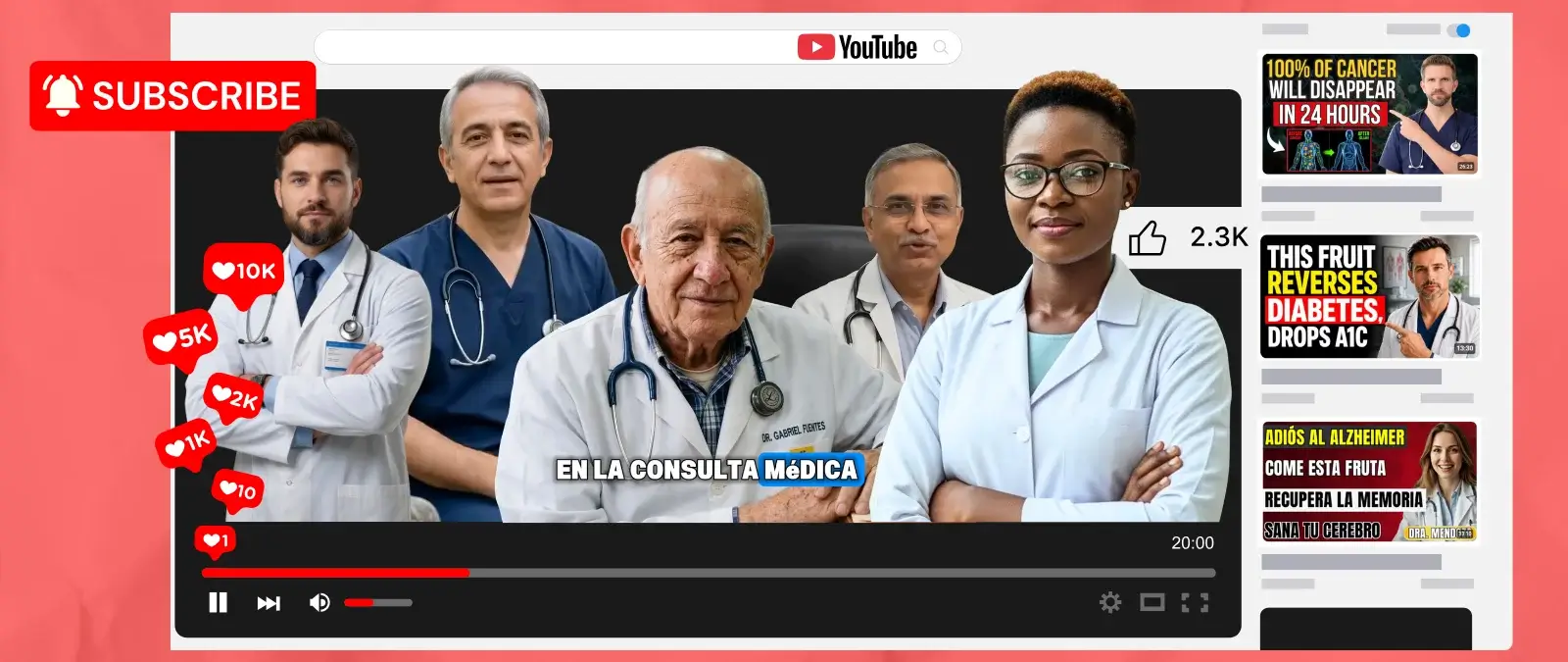
1,046 AI-generated ‘medical’ channels: the network of fake experts flooding YouTube with disinformation
Richard Ben, Laura Mendoza and John Meyers are three of the 1,046 YouTube channels that use artificial intelligence to spread health disinformation. The oldest account among those analysed was created 20 years ago, specifically on 6 July 2006. It belongs to ‘Dr’ Nieves Martínez, whose videos on ‘health for older adults’ are labelled ‘AI-generated content’. However, the most (over 77 per cent) appeared on the platform between January 2025 and July 2026.
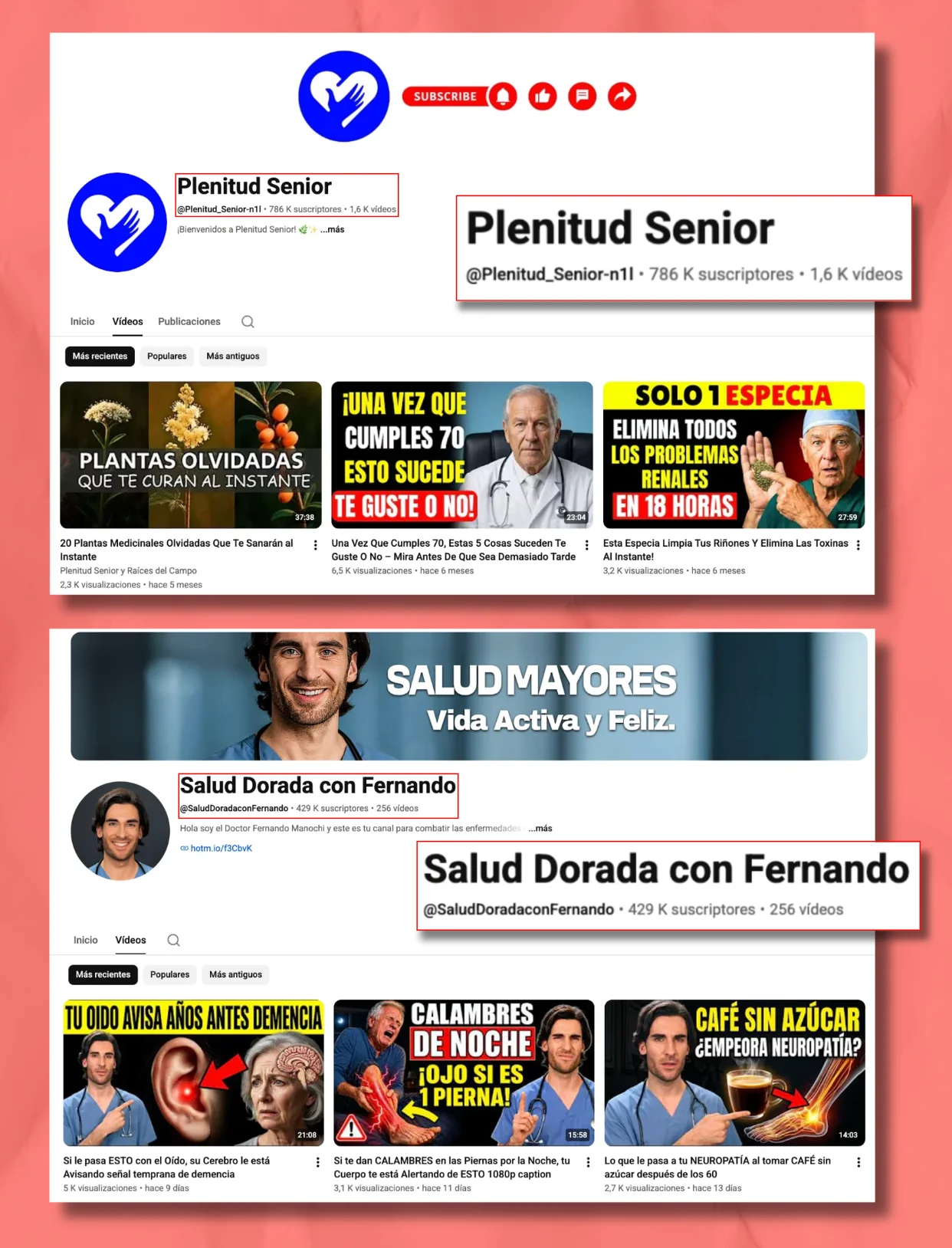
In just a year and a half, these 809 fake health channels created over the last 18 months have managed to amass more than 13 million subscribers and have published more than 62,000 videos offering alleged health advice and treatments. Among them is misleading content such as this example (marked with a YouTube label warning that it is ‘AI-generated content’) from ‘Dr’ Castillo (a channel with over 120,000 subscribers) in which she claims that there are seven fruits (pomegranate, blueberries, lemon, kiwi, orange, apples and purple grapes) that “prevent and kill cancer cells”. “There is no such thing as a magic diet” or any specific food that can cure cancer on its own, just as there are no superfoods with miraculous anti-cancer properties, Marta Villarino, a dietitian and nutritionist specialising in cancer patients, explained to Maldita.es.
77% of Channels Were Created in 2025 and 2026
Number of channels created each year, broken down by month. Click on a square to view the data
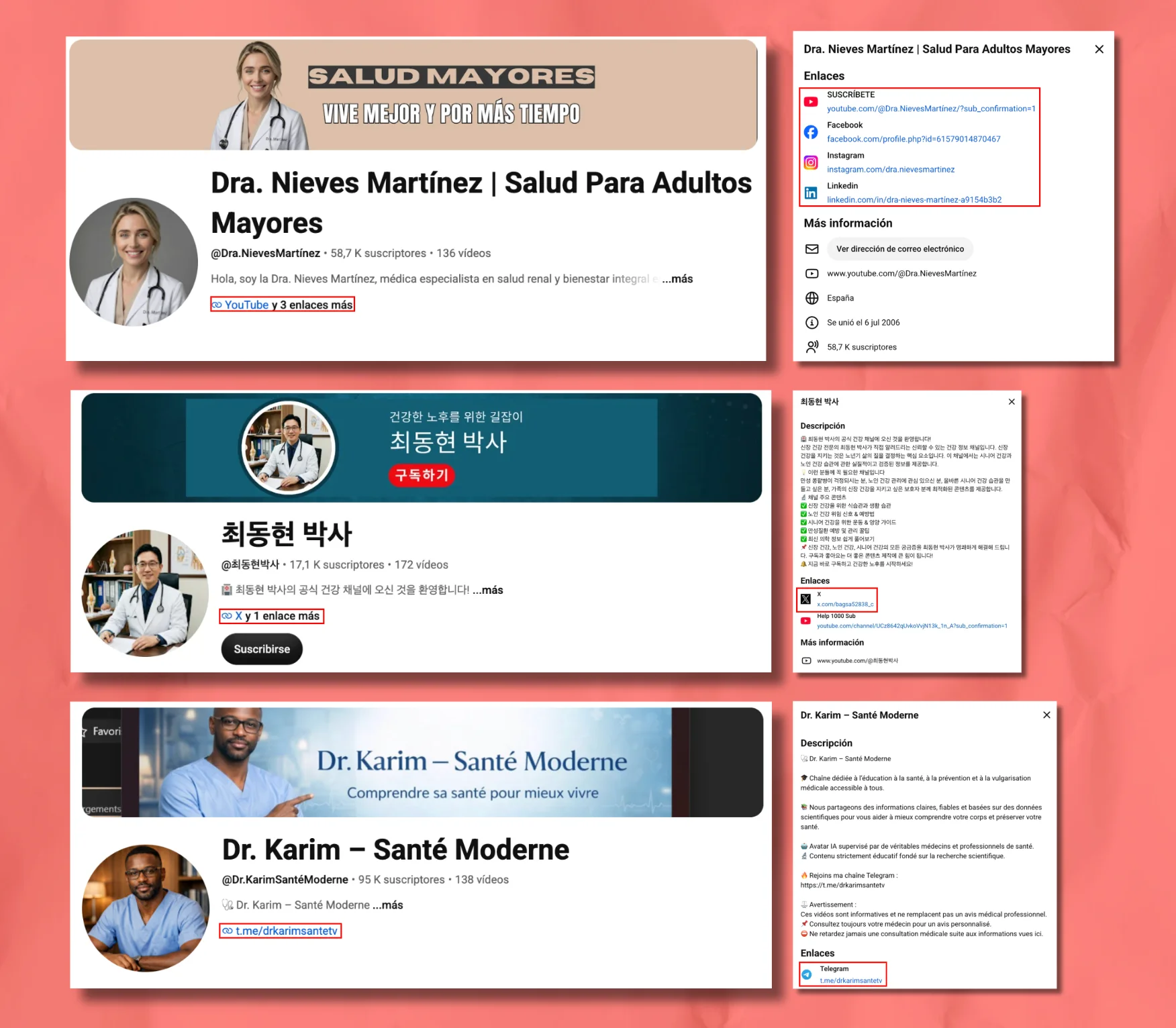
Some of these channels have accounts on other social media platforms where they post the same type of content. For example, ‘Dr’ Camille Reyes (a channel created on 23 June 2026 that already has over 6,200 subscribers) provides a link on her profile to a Facebook account of the same name, where she also posts videos offering supposed health advice, pretending to be a doctor in her office. Unlike the content she shares on YouTube, this content is not labelled in any way to indicate that it is AI-generated. For her part, ‘Dr’ Nieves Martínez redirects users to, amongst other platforms, an Instagram profile, a platform where we have also detected a coordinated network comprising hundreds of AI-generated accounts that seek to sell dietary supplements (some without health authorisation) and guides containing purported health advice. Other channels redirect to profiles on Twitter (now X) and Telegram, amongst others.
Almost 100,000 videos in 33 languages posted from at least 54 different countries
The 1,046 YouTube channels have published, in total, more than 96,400 videos that have reached audiences from all over the world (accumulating almost 1,840 million views on the platform). This content includes posts in 33 different languages, with Spanish, English and Portuguese being the most common. These three languages feature in 45.7 per cent of the channels analysed.
The number of countries in which these channels are based is even higher. According to the information available on the platform, the 717 accounts for which this information is available post videos from 54 different countries. Among these, Mexico, the United States, Brazil and Spain stand out: a total of 303 channels (95 in Spain) are based in one of these four countries (42.3 per cent).
They look like doctors, but they aren’t: this is how they try to convince people that their advice and treatments are ‘reliable’
The main characters in these channels and their videos are, almost without exception, ‘doctors’ generated by artificial intelligence. These avatars appear, both in the videos they post and in the channel’s profile picture, dressed in medical uniforms and carrying tools associated with the profession, such as a stethoscope. The (fictional) scenarios in which they are shown are intended to recreate medical offices. Furthermore, most of the channels use terms such as ‘Dr’, ‘doctor’, ‘health’ or ‘remedies’, amongst others, both in their usernames and in their channel descriptions. In this way, they attempt to exploit the reputation of health experts and scientists to increase their credibility.
“With over 25 years’ medical experience, Dr António offers reliable advice on prostate health, including prevention, symptoms, tests and treatments.” “I am Dr Vega, an A&E doctor with over 10 years’ frontline experience.” “Welcome to Dr Revela, the channel where the truth about health comes to light.” Statements of this kind, which are common on the channels analysed, imply that these accounts provide advice “that nobody else tells you” or highlight their supposed years of experience; these are further strategies they use to gain users’ trust.
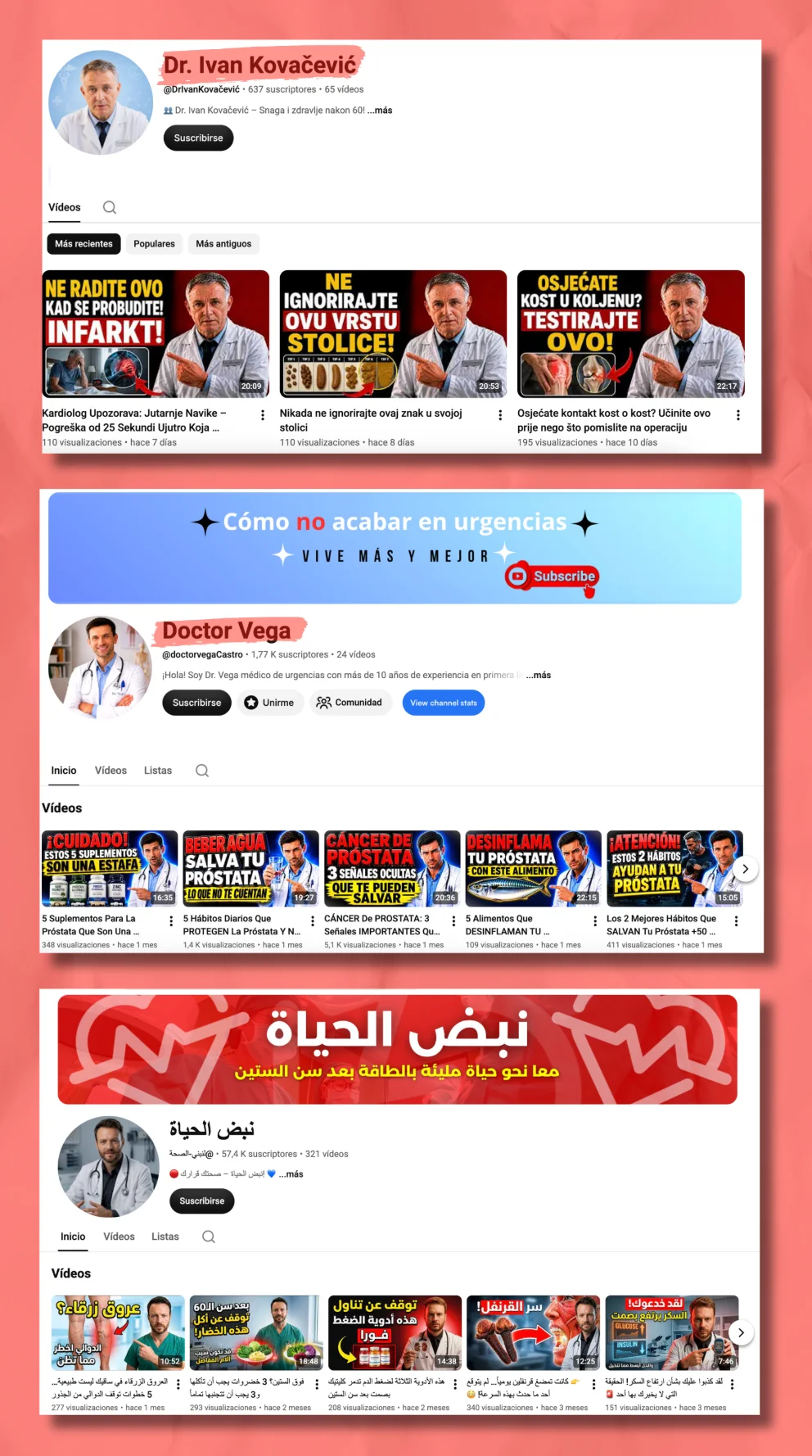
“Cancer will disappear within 24 hours”: the (medically impossible) promises of a cure made by these channels
The fact that it is a so-called doctor with ‘years of experience’ who is making these supposed recommendations makes it easier for users to fall for tricks and accept certain pieces of disinformation at face value. This is why they may come to believe claims made by these fake experts, such as, for example, that it is possible to make “100 per cent of cancer” “disappear” within 24 hours. This is what can be read in the miniature of a video published on 4 May 2026 on the YouTube channel of “Dr” Richard Ben, who describes himself as “the number one oncologist”. There are a number of factors (such as maintaining a healthy weight, taking exercise or reducing consumption of foods such as ultra-processed products or red meat) which, according to scientific evidence, can reduce the risk of developing such diseases, but they are not effective in combating or treating the disease (let alone within 24 hours, as the video claims).
In fact, the video by ‘Dr’ Richard Ben, which has achieved more than 430,000 views in just under three months, refers to daily habits to ‘prevent cancer after the age of 50’. However, if a user does not watch the video and relies only on the message in the miniature, they will be falling victim to disinformation that could put their health at risk, as relying on these pseudo-treatments and advice may lead them to disregard prescribed, scientifically backed and genuinely effective treatments.
Like this one, there are other examples where misleading phrases are used in miniature images, which are then not repeated in the title, description or content of the video. The miniature image for one of the videos on the channel run by the so-called ‘Dr’ Laura Mendoza claims that it is possible to ‘say goodbye to Alzheimer’s’ by eating certain fruits. In fact, it is a disease for which, as things stand, there is no cure, either through medication or lifestyle changes (including diet).
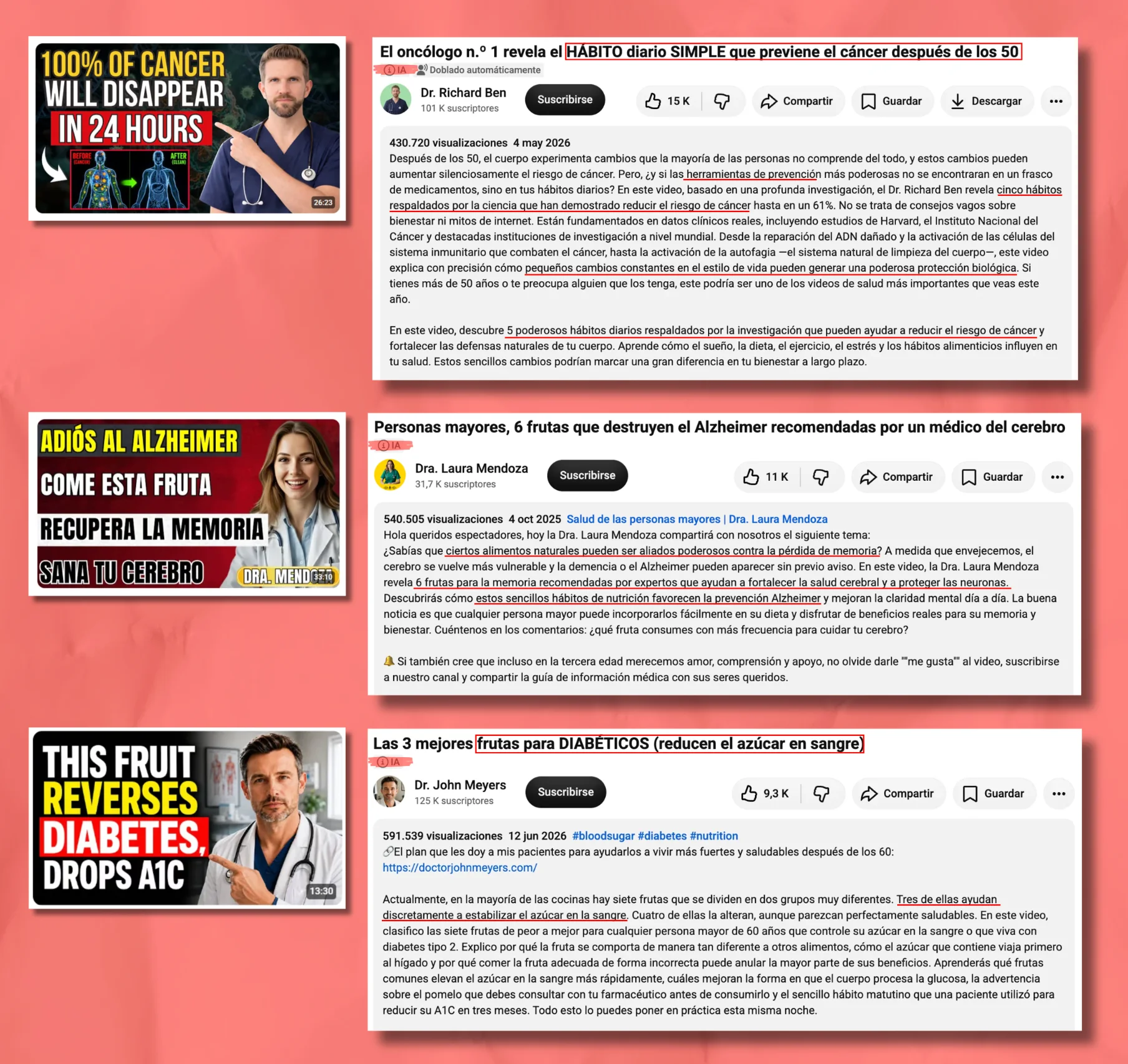
Although it is not common, some channels, such as that of ‘Dr’ Richard Ben, do include a disclaimer. Generally, either in the profile or in the video descriptions, we see messages such as this: ‘This channel is for educational purposes only and is not a substitute for professional medical advice, diagnosis or treatment. Consult a registered doctor for personalised advice”. This same text (or a similar version) is repeated in several languages, including Korean, Spanish, Filipino, Dutch, Indonesian and English, amongst others.
From paid content to direct donations or product sales: how these channels benefit financially
As well as spreading disinformation on health-related issues, some of these channels seek to make a profit either on or off YouTube. However, in Spain, posing as a doctor can be a criminal charge, and it is forbidden to advertise products “with purported health benefits (...)” that seek to “provide testimonials from healthcare professionals”, according to the regulations on the advertising and commercial promotion of products, activities or services with purported health benefits.
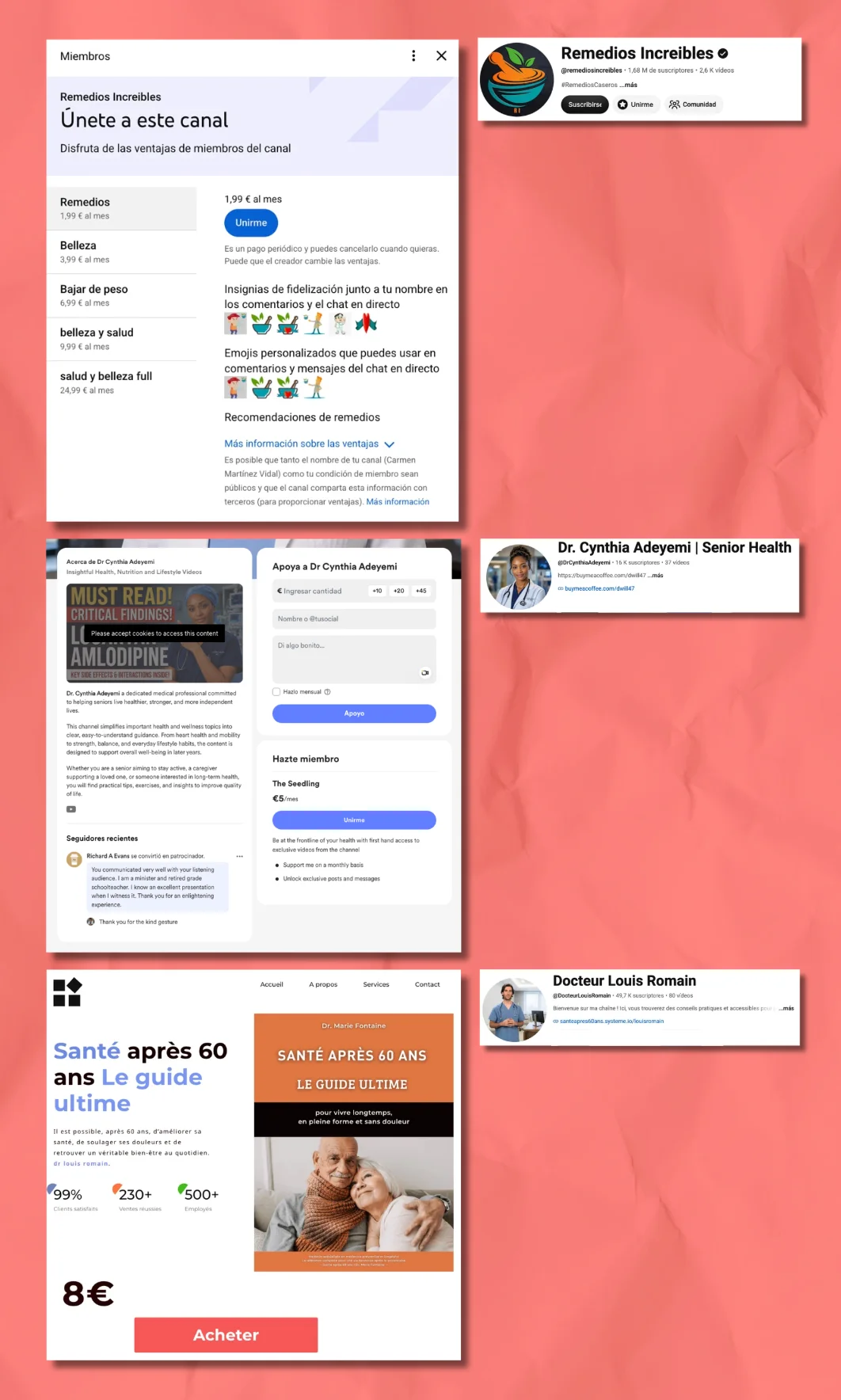
On the one hand, there are those who seek to profit from the platform itself by encouraging users to become channel members, a system through which viewers pay a monthly fee to financially support a creator in exchange for exclusive benefits, loyalty badges and special emojis. For example, the channel ‘remediosincreibles’ (which has over 1.6 million subscribers and publishes content in Spanish from the Dominican Republic) uses this method, with prices ranging from €1.99 to €24.99.
Then there are the channels that receive money from other users on platforms outside YouTube. Some, such as the DrCynthiaAdeyemi channel, ask for donations via sites like Buy Me a Coffee, a website that allows them to receive donations, tips or recurring payments from their followers. Others sell books and guides containing supposed health advice. The French-language channel called DocteurLouisRomain, with nearly 50,000 subscribers, links to a guide offering supposed advice on “improving health, relieving pain and regaining true wellbeing in daily life” after the age of 60. It sells this product for around 8 euros. This pattern is repeated on Instagram profiles, which also sell dietary supplements.
Metodología
For this article, Maldita.es has compiled a list of 1,046 YouTube channels that use artificial intelligence to disseminate health-related content. The channels were created between 6 July 2006 and 14 July 2026; at the time of data collection, they had a combined total of over 1,800,000,000 subscribers and had published more than 96,000 videos. As of 31 July, some of the channels had been removed from the platform.
The following information has been compiled for each of these accounts: link, username and profile name (which does not necessarily match the username and may be shared with other users), platform identification number, the country recorded by the platform (which explains on its website that this is determined based on various variables such as IP address, saved home or work addresses, and the device’s GPS location), the description text, the creation date, the number of posts (and their language) and the number of subscribers.
To streamline the data collection process, a tool was used to scrape the channels. This website was used to generate 33 different documents in .csv format (one for each language), which were then merged into a single database to facilitate their analysis. In the final database, only those variables that were relevant to the study were included.
Our observations have shown that there are more accounts with these characteristics available on the platform; therefore, whilst the sample included in this article does not cover all profiles, it does represent the phenomenon.
If you have any queries, please contact us at [email protected]