
This article was published in partnership with Indicator. You can read their article here.
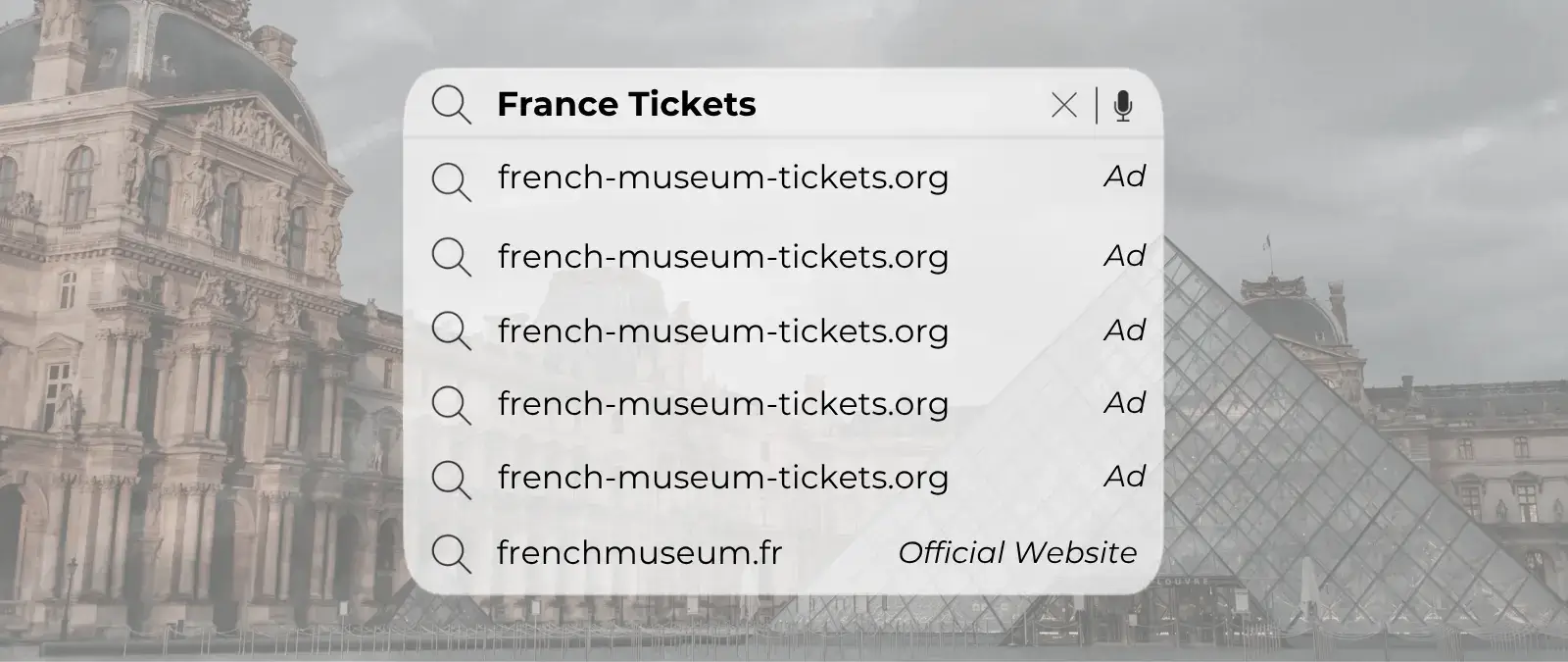
Their websites can easily be confused with the official ones, and their domains are unlikely to raise suspicions in most tourists either: museedulouvre-tickets[.]org, museeorsay-tickets[.]org, versallespalace-tickets[.]org or louvre-museum-tickets[.]org. However there is one big difference: price. These sites are reselling the official tickets to France’s most popular national monuments and museums and charging 260% the official price on average, sometimes more, as a joint investigation by Fundación Maldita.es and Indicator on global networks of ticket reselling has shown.
These sites have built a thriving business that essentially relies on overcharging visitors for a service those public institutions provide. The key to their success seems to be the purchase of ads in Google that ensure their websites appear in search results above the legitimate web pages of the Louvre, Musee D’Orsay, or Palais de Versailles. Just four of those unofficial sites had almost 300,000 visits in May 2026 alone and 87% of their traffic came from paid search ads, according to data collected by SimilarWeb. Google’s own records show the same websites have run 67 ad campaigns targeted to appear in France during the same period, with some ads appearing 700.000 times to users in the country.
Withholding judgement of how ethical such a scheme is, this kind of ticket resale could be illegal in France. According to experts consulted by the legal-checking organization Les Surligneurs, the activity is against article 313-6-2 of the LOI n° 2012-348 du 12 mars 2012 that prohibits “the act of selling, offering for sale, or displaying for sale or transfer, or providing the means for the sale or transfer of tickets to a sporting, cultural, or commercial event”.
Tracking and reporting these potentially illegal ads on Google
Cultural sites around the world have repeatedly denounced this practice that experts consider illegal in countries such as France and Greece, and against the rules of the most popular international museums and monuments. Google has specific rules for ticket-reselling ads, but it is unclear whether those cover these particular activities; regardless, the company’s safeguards are clearly failing at preventing the phenomenon even when the ads are purchased specifically to target countries that prohibit it.
The French monuments’ unofficial sites alone have repeatedly run ads offering overcharged tickets in several languages, but targeted to appear to users in France. We reported five particularly relevant examples to Google using the online form it provides for users to flag potentially illegal content, but the process is particularly complicated when compared with other major digital platforms in which Fundación Maldita.es has conducted similar research.
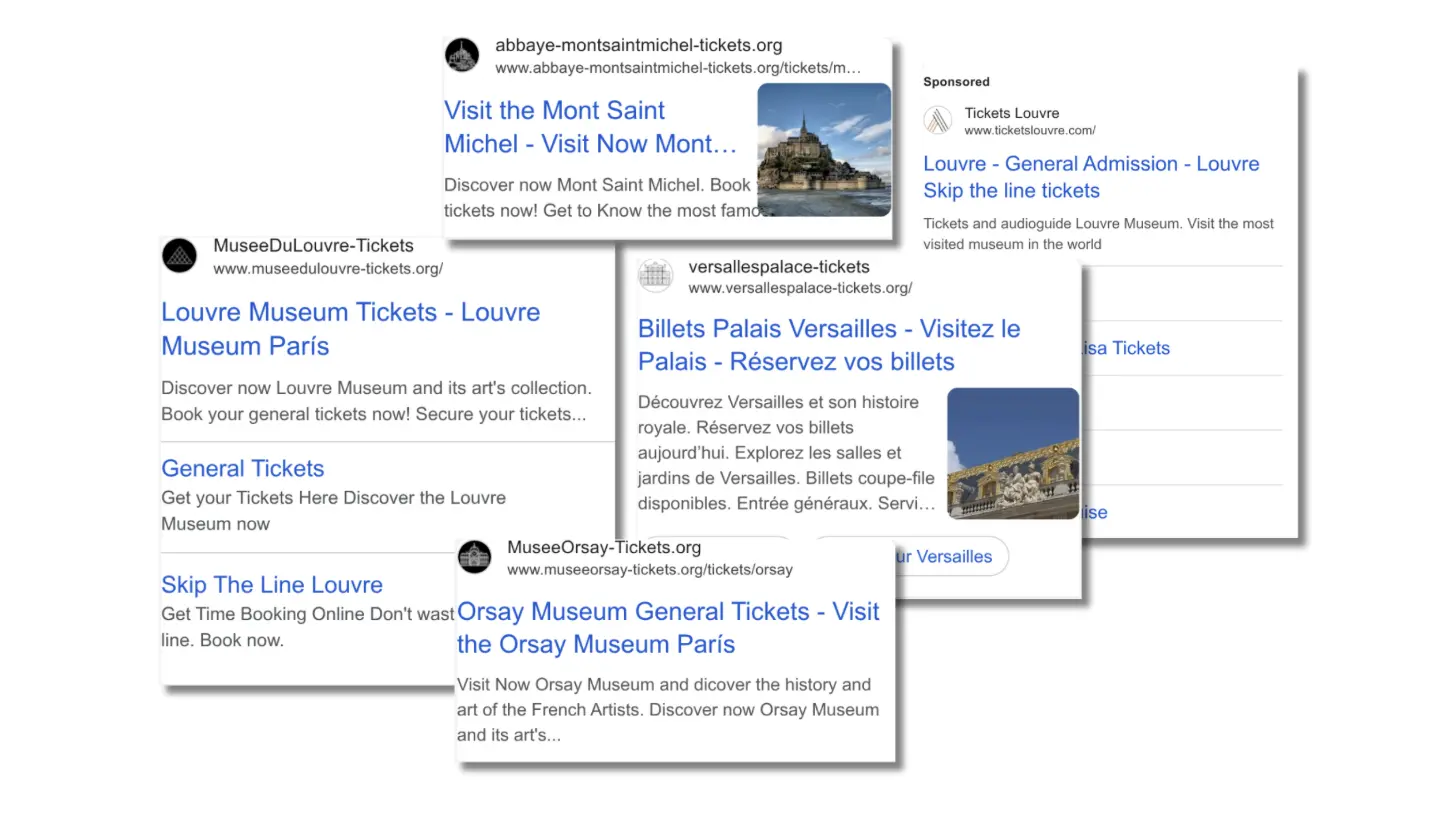
The reported ads, that had accumulated from 50,000 to 700,000 impressions at the time of reporting, were all removed by Google after our reasoned request, but the amount of time and complexity the process requires might disencourage some users. After clicking on the option to report the ad, users who want to flag content for removal because they consider it illegal have to access a separate form, in which they have to navigate drop-down menus and open questions, going through at least 11 different steps to send the report.
We find this process not only considerably more confusing than the ones in other popular online services, but also inconsistent with the “user-friendly” nature these potentially illegal content-reporting systems must have in accordance with article 16 of the European Union Digital Services Act. Additionally, the volume and circulation of this kind of content raises doubt about Google’s Search fulfilment of its responsibilities as a designated “very large online search engines” in Europe, more concretely its duty to put in place effective mitigation measures against “the dissemination of illegal content through their services”.
It is hard not to see the problems described above as systemic, since the capacity of those “unofficial” websites to breach French laws on this particular issue seems to depend entirely on their use of Google’s ad infrastructure. According to data from SimilarWeb, only 2.7% of those websites traffic comes from organic search (i.e. users clicking on links from regular search results) while 87% comes from paid search (i.e. users clicking on ads purchased, that normally appear above organic search results).
Harming Users and Taxpayers
The most affected by this practice, as detailed in the investigation by Fundación Maldita.es and Indicator, are the Google users who, for example, could have paid 22 euros to enter the Louvre Museum in Paris and ended up spending 76 because they thought they were in the official site. However the cultural institutions themselves, that are public sites administered by the French government and sustained by French taxpayers, are also victims.
As a user explained to us (and as many reviews online argue), these “unofficial” sites have often cancelled tickets at the last minute. Beyond the reputational damage suffered, as many users confirm that they always thought they were dealing with the actual cultural institution, those are visitors that finally could not access the site and pay their ticket.
CORRECTION: an earlier version of this article said that the four domains had had traffic over 4 million in May, according to SimilarWeb, when the real figure is 299.382. The article has been modified to reflect it.
Methodology
You can consult the methodology for the full investigation here. For this particular section, Fundación Maldita.es selected four domains that included the word ‘tickets’ and the name of one of the three cultural French sites that appear in a list of 74 popular museums and cultural attractions maintained by Wikipedia and the TEA/AECOM Museum Index 2023. In early June 2026, Fundación Maldita.es consulted all ads linking to those domains in Google’s publicly available Ad Transparency Centre and annotated available data from the ads that had been purchased specifically to appear in France and on Google Search. From 121 ads we selected 67 that had been active during May 2026 and then selected one ad per domain according to the higher number of impressions in France to be reported using the following route on Google’s website:
- Report this ad
- Select the Google product where the content you are reporting appears: A Google Ad
- What type of Ad do you want to report?: Search Ad (Ad found on Google search result page)
- Select the reason you wish to report content: Legal Reasons to Report Content
- Select the reason you wish to report content: Other: Report content for a legal reason not listed above (for example, content violating local anti-terrorism or hate speech laws)
- Thanks for describing the issue. Click Create request to submit a request to our team: Create Request
- Please select the format of the content you're reporting: Ad Transparency report URL
- Explain in detail why you believe the content on the above URL(s) is unlawful, citing specific provisions of law wherever possible: This is an ad appearing in France for reselling tickets to a French cultural site, which is against LOI n° 2012-348 du 12 mars 2012 tendant à faciliter l'organisation des manifestations sportives et culturelles.
- In order to ensure specificity, please quote the exact text from each URL above that you believe infringes on your rights: The ad in itself is illegal in France.
The prices of tickets offered on the analyzed domains were also compared with those available through the corresponding official channels, taking into account the services included in each product (such as audio guides or guided tours) and calculating both the absolute and percentage differences between the two prices. In addition, the terms of sale and ticket resale policies of each tourist attraction were reviewed, along with technical data relating to the domains, including associated IP addresses. The web traffic data used in the analysis were obtained from Similarweb and correspond to the estimated total number of visits during May 2026. Based on this information, both traffic volume and the proportion of visits generated through organic search and paid advertising were analyzed.