

Spanish law prohibits their sale and advertising, but it seems that major digital platforms operate outside the rules: of all the medications declared illegal in Spain during the last two years, 45% advertised on Facebook, Instagram, Google, or TikTok after they had been banned. These were ads specifically paid for to appear in Spain, totaling at least 380,000 visualizations.
The Spanish Agency for Medicines and Health Products (AEMPS) issues a public statement each time it orders the banning of a medicine and its recall, a communication that includes photos and detailed descriptions of the product. Despite this, a simple search of the ad repositories of major digital platforms reveals that Google, Facebook, Instagram, and TikTok do not comply with the prohibition despite having all the necessary information at hand.
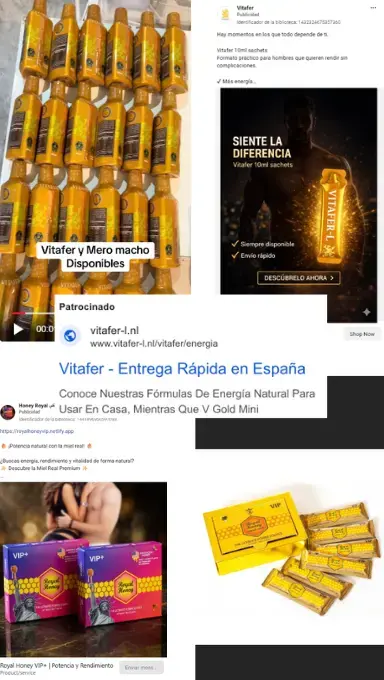
Products such as ‘Royal Honey VIP’ o ‘Vitafer-L’, which are presented as “food supplements” but are actually never-authorized medications, were advertised on all three platforms after they were officially banned. Vitafer-L alone published more than 80 targeted ads to appear in Spain, some of them reaching 110,000 impressions.
20 illegal medicines since July 2024
In the last two years, the AEMPS has declared 20 products as illegal “medicines for human use”, ordering the prohibition of their marketing and their recall.In most cases, these are products that, due to their composition, are medicines but have not been "authorized or tested" by the health authorities as required by law. They often also hide their true composition from consumers.
Almost all of the medicines recently banned in Spain contain undeclared amounts of sildenafil, sibutramine or tadalafil. These are drugs administered under medical supervision to treat erectile dysfunction and obesity. The Spanish Agency for Medicines and Health Products (AEMPS) considers that their uncontrolled use can lead to "serious health risks" as they are contraindicated for various types of patients and have not undergone regulatory controls.
A systemic failure
Spanish law penalizes the “promotion, information or advertising of unauthorized medicines” and, therefore, these advertisements may be illegal content for the purposes of the European Union Digital Services Act (DSA). The regulation requires all platforms mentioned in the study to implement “effective risk mitigation measures” specifically to prevent “the dissemination of illegal content through their services.”
In this case, we are talking about a risk mitigation strategy that would be quite simple to design, since the Spanish Agency for Medicines and Health Products (AEMPS) provides the necessary data to prevent the dissemination of this type of illegal content in real time and in a volume that is more than manageable for a large platform: an average of 10 products per year.
Furthermore, in this case, the promotion of illegal content does not only occur within the platform but actually empowered by its advertising system: commercial communications are subject to more regulation and should undergo greater quality control than other messages, also taking into account that they represent an economic benefit for the platform itself, which is the one that charges money for ad placement.
Not only in Spain
Facebook, Instagram, Google and TikTok not only ignore the law and the warnings of health authorities in Spain. A recent investigation from Reset.tech (an organization from which Fundación Maldita.es receives support) found ads on Facebook and Google that they were promoting potentially dangerous dietary supplements. Health authorities in various European Union member states have already declared one in five of these products illegal or dangerous.
Nor is the volume a minor issue. Reset.tech's research found more than 350,000 ads on Facebook and 2,000 on Google between 2023 and 2026. On the search engine alone, the ads appeared up to 8 million times.