In the weeks between Black Friday and Christmas, millions of people shop online. Scammers know this and increase their activity during this time. In recent weeks, 37 TikTok and Instagram advertisers ran at least 18,000 fraudulent ads. Alarmingly, 78% of these advertisers are still active on both platforms, despite TikTok and Instagram having previously taken action against them for breaking the law, selling counterfeit goods, or other “unacceptable commercial practices in advertisement”. Both Meta and TikTok continue to earn revenue from the ads placed by these fraudulent advertisers.
The advertisers pose as well-known brands such as Pandora, Carhartt, LEGO, Jack & Jones, and Lacoste, offering low prices to attract users. They then redirect consumers to websites that are not the brands’ official pages and show several signs of being unreliable. As one victim told Maldita.es, products bought through these sites, if they arrive, are either counterfeit or completely different from what was advertised.
Despite the ads being visible in Spain, 75% of the advertisers claim to be based in Asia. On TikTok, 53% have a registered address in China and 26% in Hong Kong. On Instagram, 41% of profiles that disclosed information had at least one administrator from Vietnam.
Repeat offenders: beyond a Christmas scam
Although the advertisers were identified through scams linked to the Black Friday and Christmas period, their advertising volume shows a much wider operation. They have placed at least 18,000 ads since the days leading up to Black Friday but the 37 advertisers account for over 1.2 million advertisements in total.
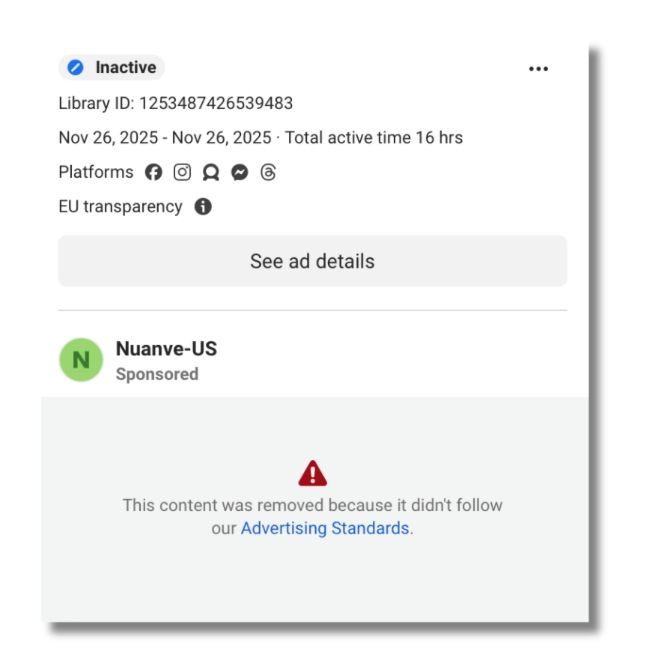
All the Meta accounts identified in this investigation had at least one advert restricted for “failing to comply with rules on unacceptable business practices in advertisement.” Meta's policies stipulate that advertisements must not be deceptive or misleading, terms used to describe content intended to scam users or steal personal data.
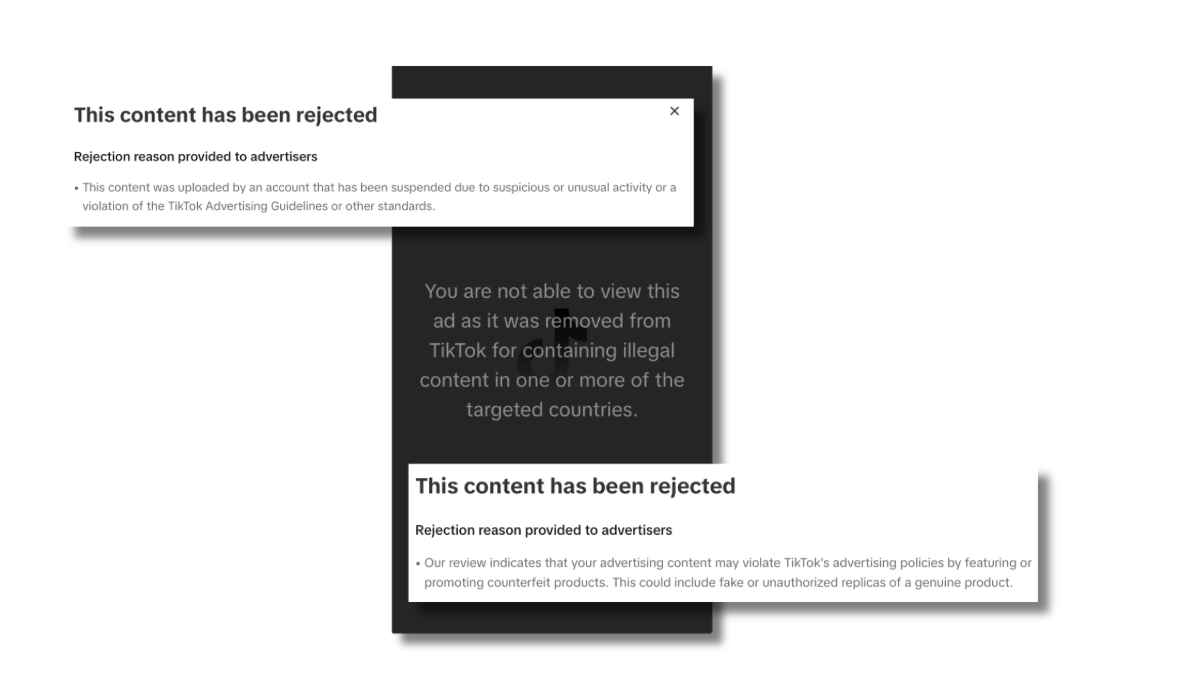
At the time of analysis, 86% of the advertisers reviewed on TikTok had at least one advert moderated for breaching the terms on illegal content in at least one country where it was shown. In several cases, TikTok explicitly stated that the adverts promoted counterfeit products. The remaining advertisers were suspended for distributing illegal content. Despite these actions, 7 of the 15 accounts examined were still active on the platform at the time this report was published. Overall, 78% of advertisers remained active on both platforms at the time of publication.
These fraudulent ads generate direct revenue for Meta and Tiktok since they are shared through paid advertising programs, which are both platforms' primary source of revenue. According to figures submitted to the US Securities and Exchange Commission (SEC), ads account for 98% of Meta's revenue, which amounted to $41.392 million in the first trimester of 2025. Similarly, Tiktok’s advertising revenue reached $17.000 million in 2024, according to a Business of Apps report. Neither platform discloses how much revenue a single ad generates, making it impossible to determine how much profit was earned from this campaign.
Adverts and scams under European and Spanish law
In the European Union, TikTok and Instagram are designated as “Very Large Online Platforms (VLOPs)” and are therefore subject to specific obligations under the Digital Services Act (DSA). These include putting effective measures in place to reduce systemic risks linked to the spread of illegal content and to ensure a “high level of consumer protection” under Article 34. Article 35 adds that these measures may include “adapting their advertising systems.”
María Teresa Martínez, a lawyer specialising in digital law, points out that these obligations include those relating to transparency in online advertising, which require proactive identification and mitigation of risks, rather than action based solely on notifications (article 39).
Samuel Parra, a lawyer specialising in data protection, told Maldita.es that platforms are required to gather specific details about advertisers, including their name, address, phone number, identification documents, and business registration information. He says this should make it possible to take action against fraudulent advertisers. In theory, he adds, platforms should not allow people using random names and addresses to advertise branded products, as allowing such adverts would be in breach of the Digital Services Act.
Platforms are required to remove illegal content but only once they become aware of the illegal nature of the content, Rahul Uttamchandani, a lawyer specialising in technology and privacy, told Maldita.es. Where the content is published is irrelevant, he adds, what matters is whether it is accessible in the European Union. Kenia Mestre, a data protection lawyer at Legal Box Plus, says these adverts are legally considered illegal content because they breach Regulation (EU) 2017/1001 on the European Union trade mark and Spain’s Trademark Law.
Mestre adds that these adverts may constitute a serious unfair commercial practice under Spain’s advertising and unfair competition laws, as they mislead consumers about both the identity of the seller and the authenticity of the product. Some of the adverts removed by TikTok carried a notice stating they were taken down for containing illegal content in one or more target countries.
Mestre says advertisers may face criminal liability for fraud, particularly where there is repeated posting of fraudulent adverts and multiple victims. Even if they are not located in Spain, they are liable under Spanish law if the harm happens there.
In other investigations, such as one into a network of more than a thousand Facebook pages across 60 countries posing as local public transport systems, Maldita.es has already reported the use of platform advertising to promote scams. In that case, the scammers appeared to have links to Russia and Vietnam.
Kenia Mestre, lawyer specialised in data protection and María Teresa Martínez, lawyer specialised in digital law, collaborated on this article with their superpowers.
Kenia Mestre and María Teresa Martínez are part of Superpoderosas, a project launched by Maldita.es that aims to strengthen the presence of scientists and experts in public debate through collaboration in the fight against disinformation.
Thanks to your superpowers, knowledge, and experience, we can fight lies more effectively. The Maldita.es community is essential to stopping misinformation. Help us in this battle: send us the hoaxes you receive to our WhatsApp service, lend us your superpowers, spread our fact-checking, and become an Ambassador.
TRANSPARENCY: Maldita.es is, from 2019, part of Meta’s Third Party Fact-Checking Program.
Methodology
For this investigation, we compiled and analysed advertisements published on TikTok and Instagram between November 28th and December 23rd, 2025 that posed as well-known brands or used their name and picture without permission. The sample selection process began with a manual identification of suspicious TikTok advertisements, which allowed us to identify recurring patterns and keywords in the advertising texts (e.g., 'up to 80%,' 'Black Friday,' 'Christmas Sale'), as well as references to well-known brands (Lacoste, Pandora, Bimba y Lola, Ralph Lauren, among others). We widened our search in the TikTok and Meta ad libraries, resulting in a total of 18,088 ads.
Given that many of these campaigns operated in a coordinated manner, once an account with fraudulent advertisements was identified, we used its name in the library search engine to locate other accounts with similar names. This is how we found cases in Meta such as ‘Pandora.Online.Shop’, ‘Pandora Online Shop’ and ‘Pandora Shop’, all with the same profile image and virtually identical advertisements. For Meta, we also entered the website domains to which the fraudulent adverts redirected users in the ad library search bar. This allowed us to identify adverts from multiple accounts that led to the same fraudulent or suspicious websites and that used the same advertising style.
The adverts identified were grouped by advertiser and, where available, by payer. We also recorded details such as the period of activity, the countries targeted, the number of adverts posted, and whether any had been moderated or removed by the platforms. To identify where the advertisers were operating from, we collected information disclosed by advertisers and payers, including the registered office listed on the platforms and in public business records. Where an advertiser listed more than one country as its registered office, each location was taken into account. Five advertisers failed to disclose a registered office and could not be classified by region.