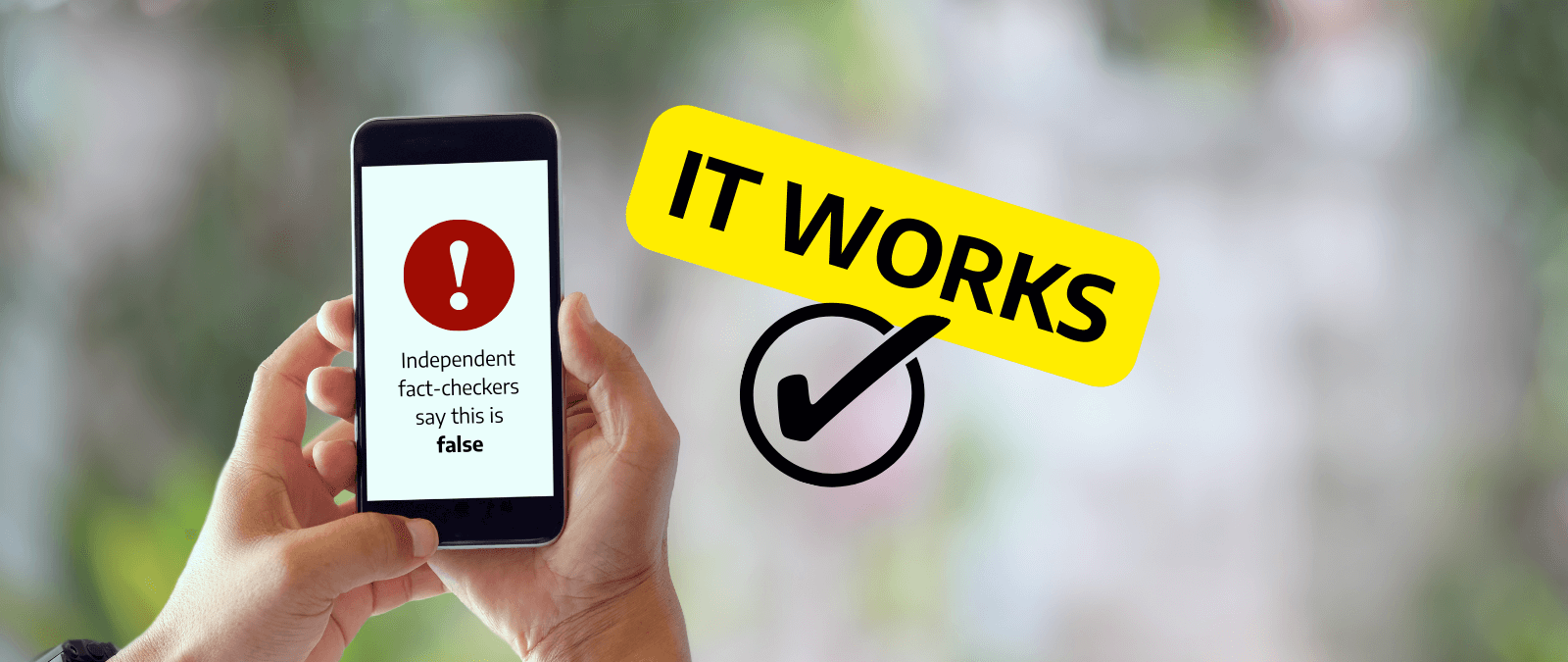
Although there are very powerful individuals and companies interested in proclaiming that fact-checking “doesn’t work” against disinformation, dozens of top-tier scientific studies say exactly the opposite.
Recent evidence shows that fact-checking not only reduces the circulation of disinformation online, but does so regardless of the partisan preferences of those who consume it (2023). This is shown, among others, by research published in December 2025 led by Julia Cagé (Sciences Po, Paris), which demonstrates that when content shared on social media is verified as “false,” the users who shared it are twice as likely to delete their post and are also less likely to spread disinformation in the future.
In 2024, researchers from the Massachusetts Institute of Technology (MIT) also demonstrated that warning labels used by fact-checkers on platforms like Facebook, Instagram, and Twitter (now X) significantly reduce the belief in and intention to share false information among users who see them. On average, belief in disinformation decreased by 27.6% and the intention to share it by 24.7%. Even those with low trust in fact-checkers showed a 12.9% reduction in belief in false content and a 16.7% reduction in intention to share it. Although fact-checking labels are more effective for those who trust fact-checkers, they still work for those who distrust them.
These results are consistent with some data that the digital platforms themselves have made public about their fact-checking programs. According to the latest Meta reports, at least 53% of European Facebook and Instagram users who are about to share disinformation voluntarily decide not to when they see a warning that a fact-checker has stated it is not true. In Spain, this percentage stands at 59%. In the case of TikTok, the January-June 2025 report indicates that the average rate of users who choose not to share a video after seeing the “unverified content” warning is 30.95% across the EU and the European Economic Area. This intervention respects freedom of expression but has a much greater impact than other, more invasive measures such as content deletion or blocking, which TikTok typically uses as a moderation policy (Maldita.es participates in Meta's third-party verification program but not in TikTok's.)
Even in interventions against disinformation where fact-checkers are not direct partners, their content has a positive impact: Fundación Maldita.es studied all Community Notes on X in 2024 and found that fact-checkers' articles were the third most cited source and that notes that used links to our work generated more credibility and were more likely to build consensus among users.
The global impact of fact-checking: proven and lasting effectiveness in diverse countries
Studies show that fact-checking is not only effective in correcting false beliefs, but its impact is also long-lasting. In 28 simultaneous experiments conducted in four countries (Argentina, Nigeria, South Africa, and the United Kingdom), a team of researchers found that fact-checking significantly reduced false beliefs and that these effects persisted for more than two weeks after the initial intervention (2021). This finding reinforces the importance of well-designed corrections (2021), which can maintain their effectiveness even in diverse cultural contexts, where no group became more inaccurate after the correction.
According to the researchers, fact-checking has also proven effective in correcting false beliefs about COVID-19 (2022), working even when it debunked a political leader in front of their own supporters (2020). Furthermore, politicians tend to lie less after being corrected by a fact-checker (2024). Its effectiveness has been demonstrated in different countries (2021) and situations, while the arguments commonly used against it, such as that it could be “counterproductive”, have been discredited (2019) in various studies (2020).
Another study (2021) shows that fact-checking can negate the effect of social media metrics on content sharing intentions. Without fact-checking information, posts with more likes or comments tend to be shared more. However, when a fact-checker debunks a story, this effect disappears, regardless of those metrics.
Fact-checking on health and politics in different countries
Fact-checking has proven effective against different types of disinformation. In an experiment with COVID-19-related hoaxes on social media (2023), researchers found that the accuracy of users who had seen corrections to the false information improved by 0.62 out of 5, while the accuracy of those who had only seen the disinformation decreased by 0.13. This study replicated real-world internet user conditions, where different types of content compete for attention.
Regarding political fact-checking, whose impact is sometimes believed to be limited due to social polarization, four researchers reached the opposite conclusion (2019): among the citizens who participated in the experiment, those who had read an article refuting a statement by a political leader had greater knowledge of the facts than those who had not. Furthermore, this improvement persisted among those who identified as supporters of that politician. Even among their loyal followers, fact-checking had an effect.
The effect of political fact-checking is not limited to citizens; it also affects politicians themselves. Professors from three Italian universities found that politicians who had been debunked by fact-checkers lied less afterward: of the 55 members of parliament studied, those who were publicly corrected reduced their false claims (2022).
Although many studies on the effects of fact-checking focus on the United States and Europe, there are studies that use evidence from countries in Latin America and Africa. In a simultaneous experiment in Argentina, Nigeria, South Africa, and the United Kingdom (2021), researchers found similar effects across all contexts, leading them to conclude that fact-checking “can be a central tool in the fight against disinformation”. Exposure to a debunking reduced belief in disinformation by 0.59 points on a scale of 5.
The adverse effects of fact-checking are very limited: backfire, implied truth, and alarmism
Some of the arguments used to attack fact-checking, sometimes even from within academia, lack a solid scientific basis. This is the case with the “backfire effect”, the counterproductive effect whereby a rebuttal could increase belief in disinformation. That was the result of a 2010 experiment that used a politically controversial example (the existence of weapons of mass destruction in Iraq). However, subsequent research (2019) showed that this effect was not replicated. A study in 16 European countries confirmed that the rebuttal effect is consistent across all political and media systems. Despite this, it is common to use an already refuted idea from an article published more than a decade ago to continue sowing doubt about whether fact-checking worsens the effects of disinformation rather than reducing them.
Another line of attack is to claim that the problem of disinformation is being exaggerated and amplified. According to this theory, the amount of disinformation is very small, and disproportionate concern is being generated around it. However, the academic articles (2022) used to justify these claims have a basic problem: they offer an extremely limited definition of disinformation and, therefore, only measure a small fraction of the total disinformation to which citizens are exposed.
For example, one of the academic articles commonly used to accuse those fighting disinformation of alarmism is this one published in Nature (2020). Its calculation is that “'fake news' represents only 0.15% of Americans’ daily media diet”. But it only considers as disinformation what is published by websites labeled as disinformation outlets; everything else is considered reliable information. Researchers track the impact of articles from these websites across all types of media, but they overlook a vast number of formats in which disinformation is spread. Although these formats are more difficult to define precisely, they are real and affect citizens every day. The fact that not all disinformation beyond this extremely narrow definition can be measured does not mean it isn't real.
The so-called "implicit truth effect" is also often taken for granted. This effect states that when some social media content is labeled as false, the public interprets the rest of the content as true. However, studies, such as the one published in the journal Political Behavior (2020), reach very different conclusions, stating that “exposure to the labels 'Disputed' or 'Rated as false' did not affect the perceived accuracy of headlines not labeled as false or true”.
What fact-checkers really do
Sometimes, many of those who argue that fact-checking “doesn’t work” against disinformation do not fully understand the work of fact-checkers today. As this article by Peter Cunliffe-Jones and Lucas Graves (2024) stated, in addition to monitoring disinformation and producing fact-checks in different formats, fact-checking organizations like Maldita.es do much more: educational campaigns, early detection of disinformation, technological and AI tools, public policy initiatives, community building, collaboration with academics… And beyond all that, their monitoring and debunking work remains not only relevant but also the essential foundation for many other anti-disinformation activities: artificial intelligence systems that identify the language of disinformation spreaders are trained on databases that fact-checkers have certified as false content, and pre-bunking campaigns or the most successful media literacy initiatives are prepared by paying attention to the lies previously identified by fact-checkers. Saying that fact-checking “does not work” against disinformation, as is still heard from time to time, is simply inaccurate. Some of those who defend it simply lack the proper information or hold a decade-old view of what fact-checkers do. Others, of course, have a vested interest in maintaining this narrative for business reasons.
At Maldita.es, we believe that fact-checking will not end disinformation on its own because 1) nothing can eliminate disinformation, there is no magic method, because it has always existed, but we can help people; and 2) because many different and effective interventions are needed to fight it. Those who accuse small fact-checking organizations (many non-profit, like Fundación Maldita.es) of not having enough impact should, firstly, learn more about our work and, secondly, acknowledge our contributions to solving the problem.
*This article was updated on March 13, 2026 to update the scientific evidence on the effectiveness of fact-checking with the most recent findings from the academic literature in the field.