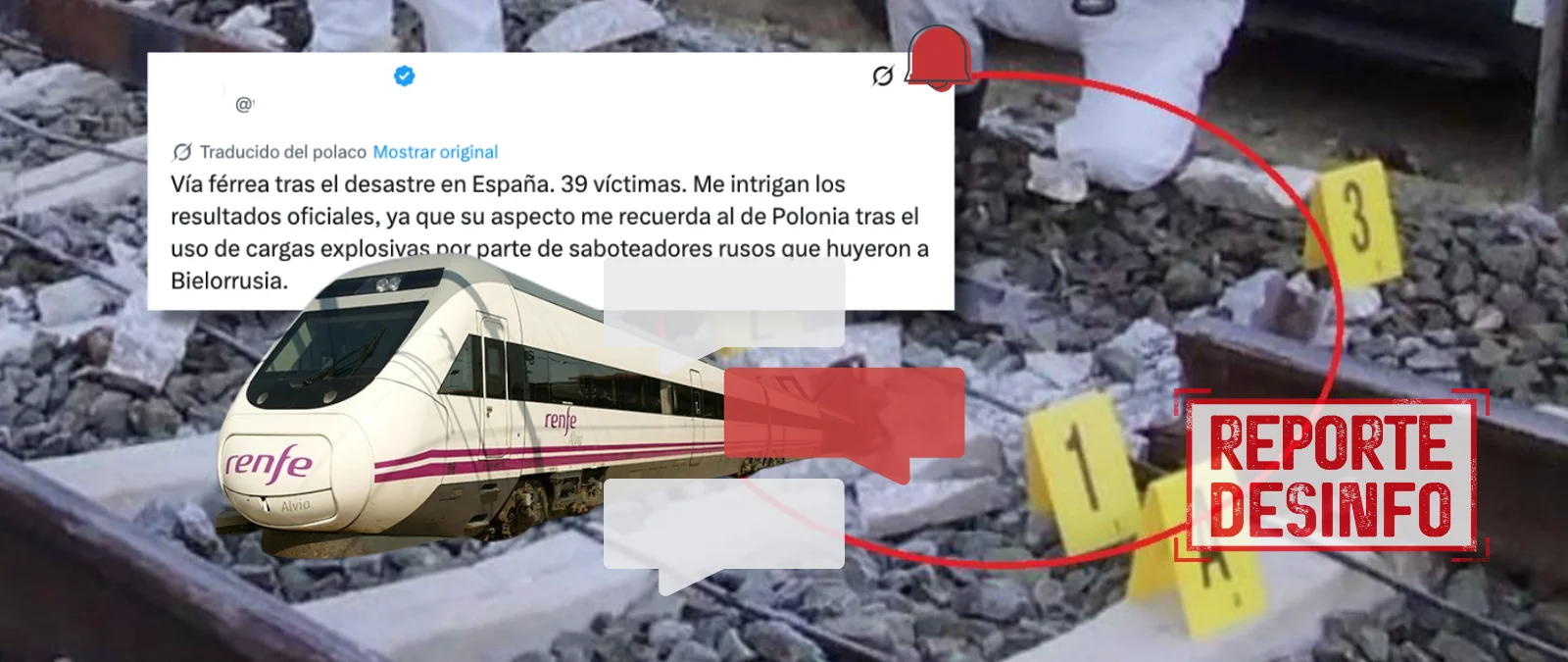
The alleged sabotage of the tracks is one of the theories (without evidence) circulating on social media to explain the supposed reasons for the crash of the high-speed train near Adamuz (Córdoba) on Sunday, January 18, 2026. By 21 January, the causes of the accident were still unknown, but many users have speculated about who might be responsible for the alleged sabotage.
At Maldita.es, we have collected more than 50 posts from X (previously Twitter)accusing Russia (most of them), Israel, or even the “far right” of manipulating the tracks to cause the accident, which left 43 people dead and at least 150 injured. This theory gained strength after a tweet posted by a Polish user on January 19, which was later quoted or reproduced exactly by many other users. This theory is circulating in at least eleven different languages and has accumulated more than 2.4 million views.
An international campaign: from a tweet by a Polish user to the reposting of the same text in multiple languages
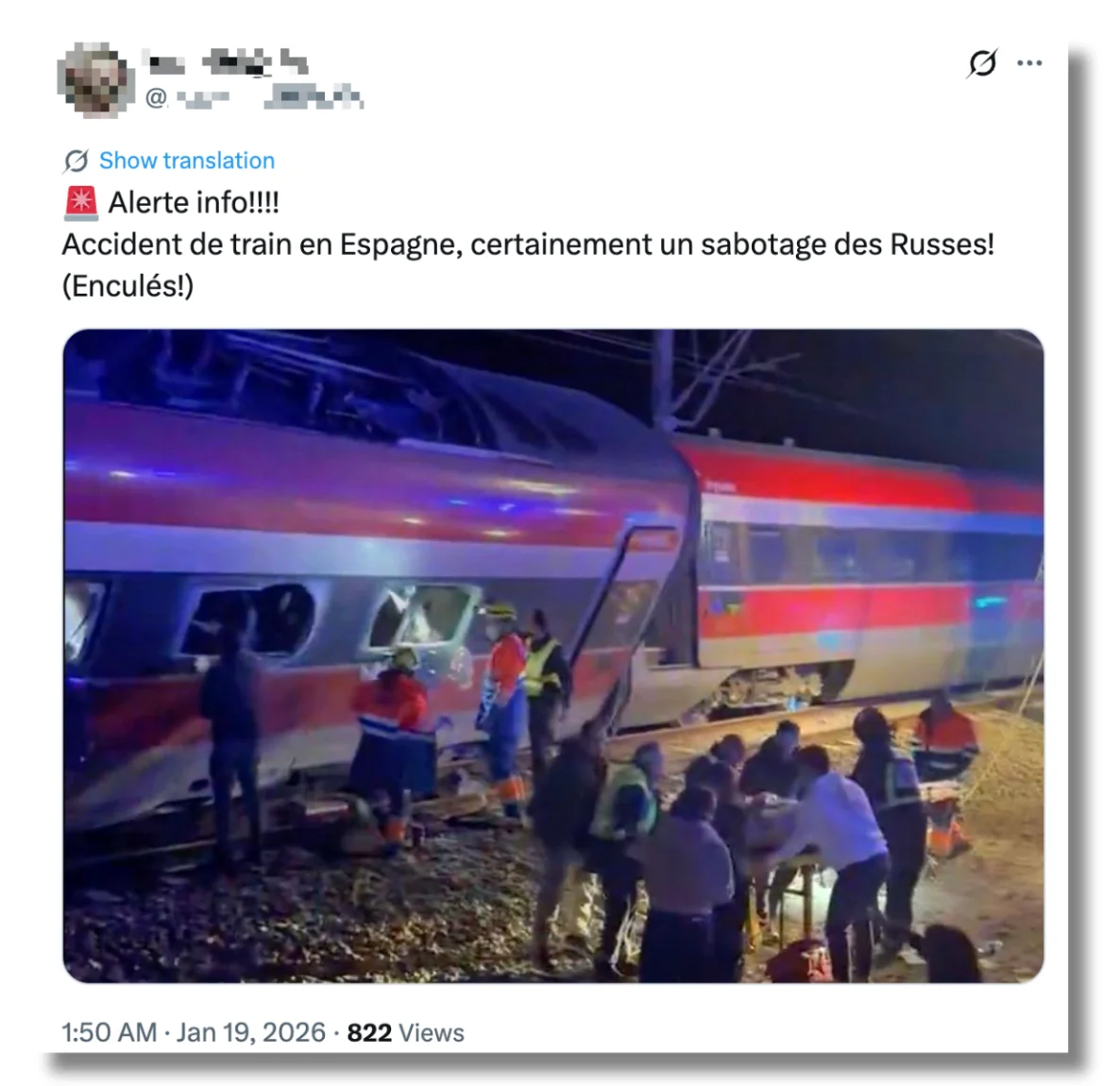
At around 2 a.m. on Monday, January 19, just a few hours after the accident in Adamuz, the first of more than 50 tweets analyzed was posted, supporting the theory of alleged sabotage. It is in French and claims that the accident was caused by “the Russians”.
Shortly after 11:30 a.m. that same day, a Polish user with over 300,000 followers on X posted the following tweet: “Railway tracks after the disaster in Spain. 39 victims. I am curious about the official findings because it looks similar to Poland after Russian saboteurs used explosives and then fled to Belarus”. The tweet in question, written in Polish and with more than 1.4 million views at the time of publication of this article, makes reference to the incident that occurred on the railway line between Warsaw and Lublin last November. Polish Prime Minister Donald Tusk described the incident as “unprecedented sabotage,” although he did not name any suspects. Other members of his government, however, attributed it to Russia and “hybrid warfare”.
The Polish user's tweet is, in fact, the most viral of all those collected by Maldita.es. In addition, we see how other users have posted tweets with the same text and even translated it into other languages such as Russian, Spanish, or English, which suggests that this is a coordinated disinformation campaign, as most of the tweets were posted within a few hours of each other. Some of the tweets with the same text directly cite the Polish user's tweet as the “source”. Others spread variations of the text or their own version.
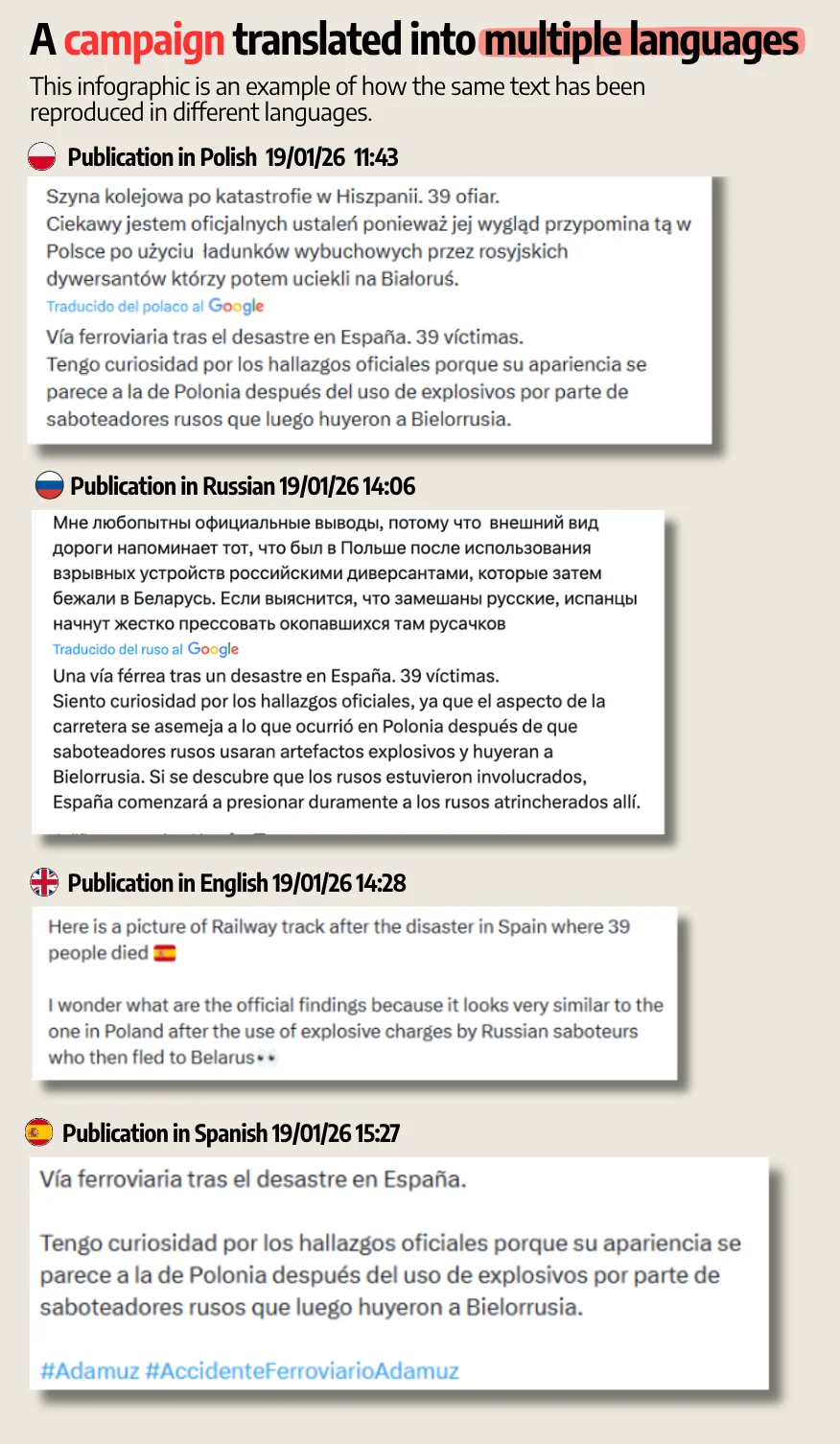
In our analysis, we have seen posts on X with this theory in at least eleven languages: Czech, Spanish, Finnish, French, Russian, English, Italian, Japanese, Latvian, Polish, and Ukrainian. Most also share the photo of the Spanish Civil Guard analyzing the area, the same one shared by the Polish user.
On January 21 at 10 a.m., the exact causes of the train derailment in Adamuz were still unknown. Interior Minister Fernando Grande-Marlaska explained after the Council of Ministers meeting on January 20 that the investigation into the causes of the accident had just begun and that it was too early to know whether there had been a fault in the train or on the track. Marlaska said that “all hypotheses regarding the possible causes of the accident are open” [minute 11:25], but recognised that “the possibility of sabotage has never been considered” [minute 18:57].
72% of the publications analyzed that share the conspiracy theory of sabotage attribute it to Russia or link it to Poland
Of the more than 50 posts analyzed by Maldita.es, made between the early hours of January 19 and January 20, 39 explicitly mention Russia or refer to the incident that occurred in Poland last November. This represents 72% of the total. The mention of the incident in Poland is mainly due to reposts or quotes from the Polish user who spoke about it on X.
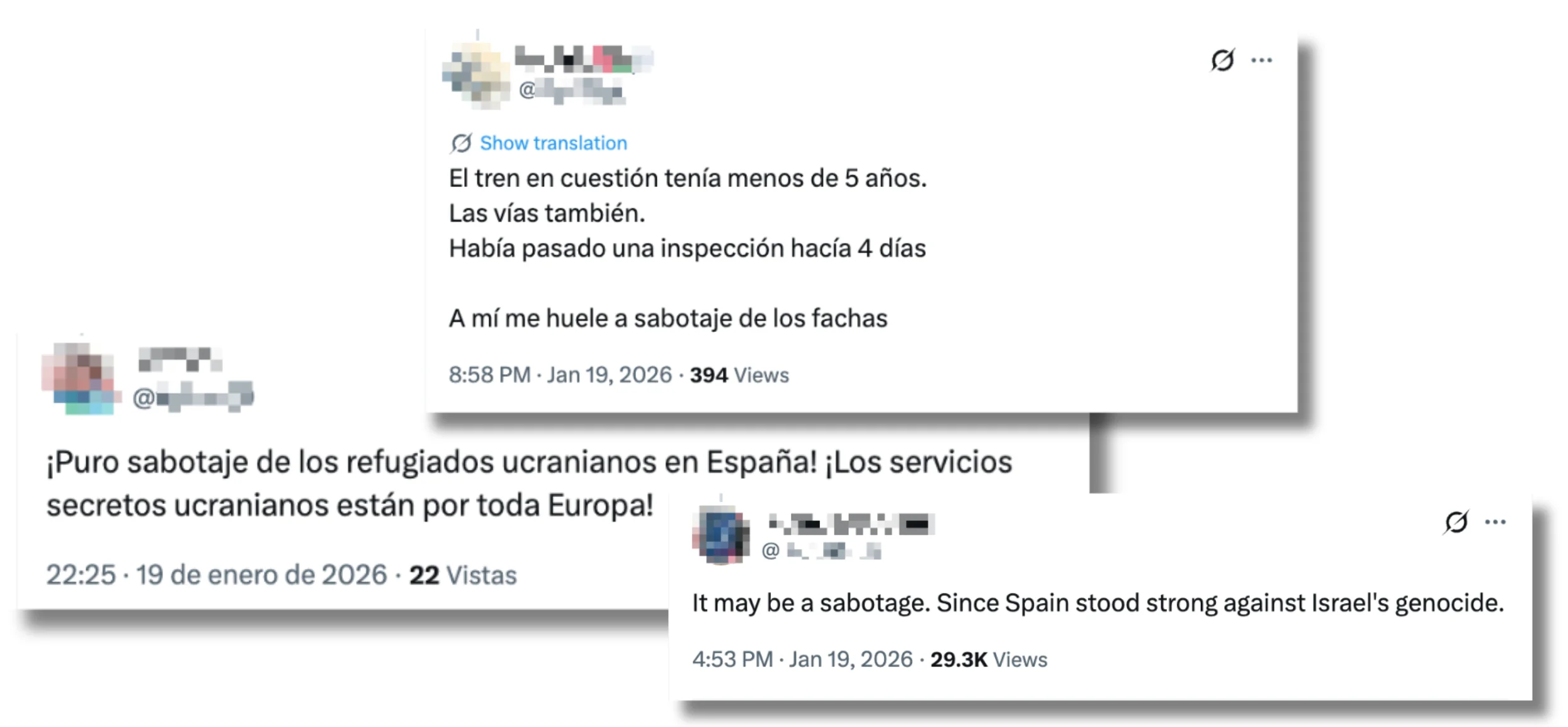
15% of the tweets analyzed share the unproven theory of sabotage without blaming anyone, and a minority point to “the far right,” “Israel,” or even “Ukrainian refugees.” The latter content is part of a disinformation narrative that blames refugees from Ukraine for alleged criminal acts.
X's response: no visible Community Notes, but Grok points out that there is no evidence
At the time of publication of this article, none of the 54 publications collected have visible Community Notes, a system that allows users to add “context” to tweets they consider misleading. In order for this warning to appear below the tweet, it must have the consensus of the users who vote on these notes. Until this consensus is reached, they remain hidden. As of January 21, these proposed notes, although still hidden, exist in only three of the messages analyzed; for the rest, no notes have been proposed (at this time).
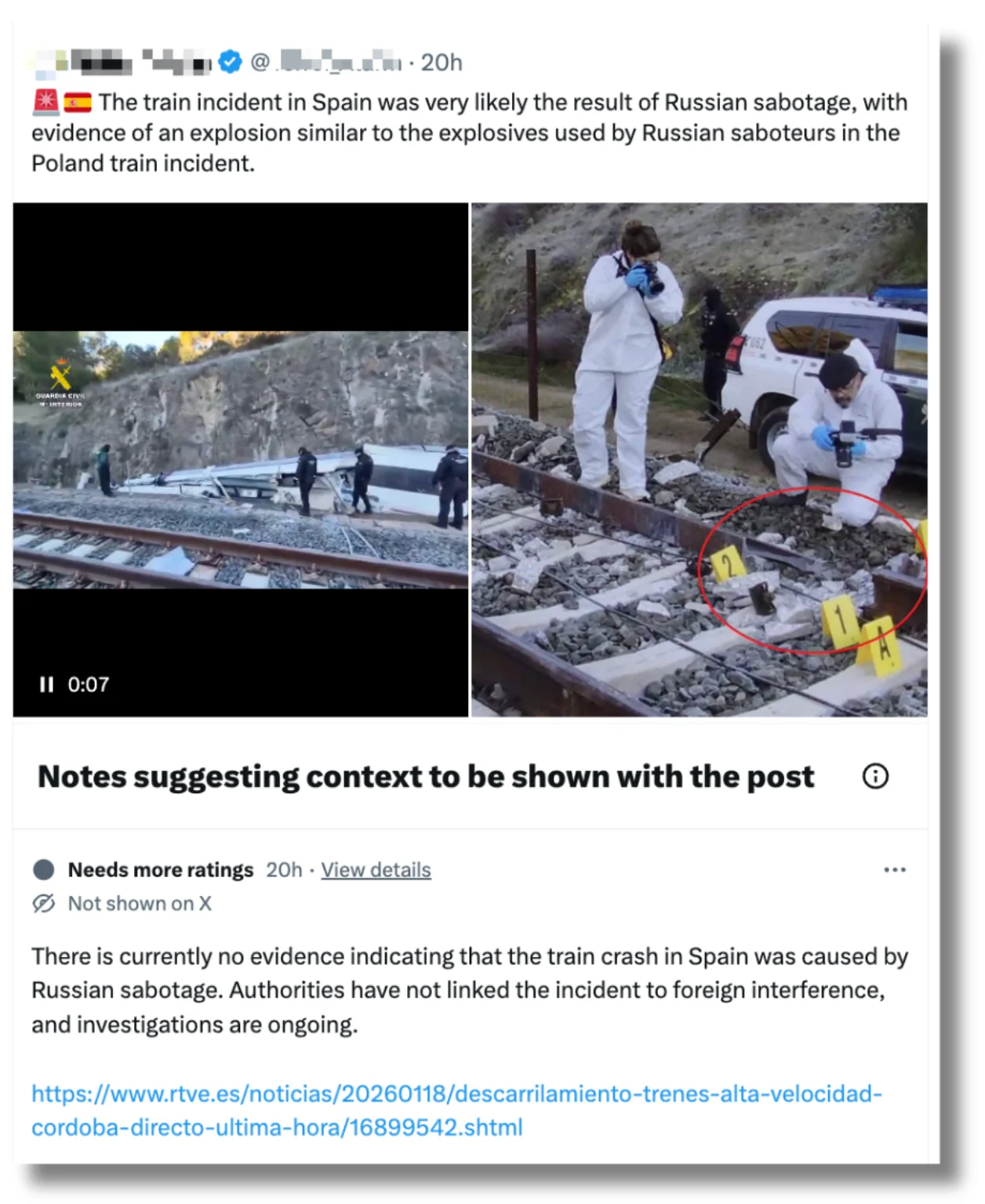
For its part, Grok, X's artificial intelligence, has replied to various users that this theory is not supported by official sources. "Spain, a member of NATO, has provided military aid to Ukraine during the Russian invasion. Some reports speculate that the train incident could be sabotage by Russia's hybrid warfare, similar to the 2025 railway attack in Poland, attributed to Russia. However, official investigations cite faulty welding on the railroad, with no foreign involvement yet confirmed. Investigations are ongoing”, it told a user on January 20.
Metodología
For this analysis, we searched social network X (formerly Twitter) for posts containing words such as “sabotage,” “Spain,” “accident,” “trains,” or “Russia” in Spanish, English, French, and other languages. We also did a reverse image search of
the image shared by the Civil Guard showing officers inspecting the track where the Iryo train was traveling, which appears to be missing a section and has been widely shared. We compiled and analyzed only those posts that spread the sabotage theory and discarded those that were skeptical or rejected any acceptance of it.
We collected the selected tweets in a database where we compiled information such as: date and time of publication, content of the publication, language, actor to whom the theory is attributed without evidence, views, etc. We then carried out the analysis. The data collection period ran from the first tweet we found spreading the sabotage theory on January 19 at 1:50 a.m. to 11:00 a.m. on January 20.