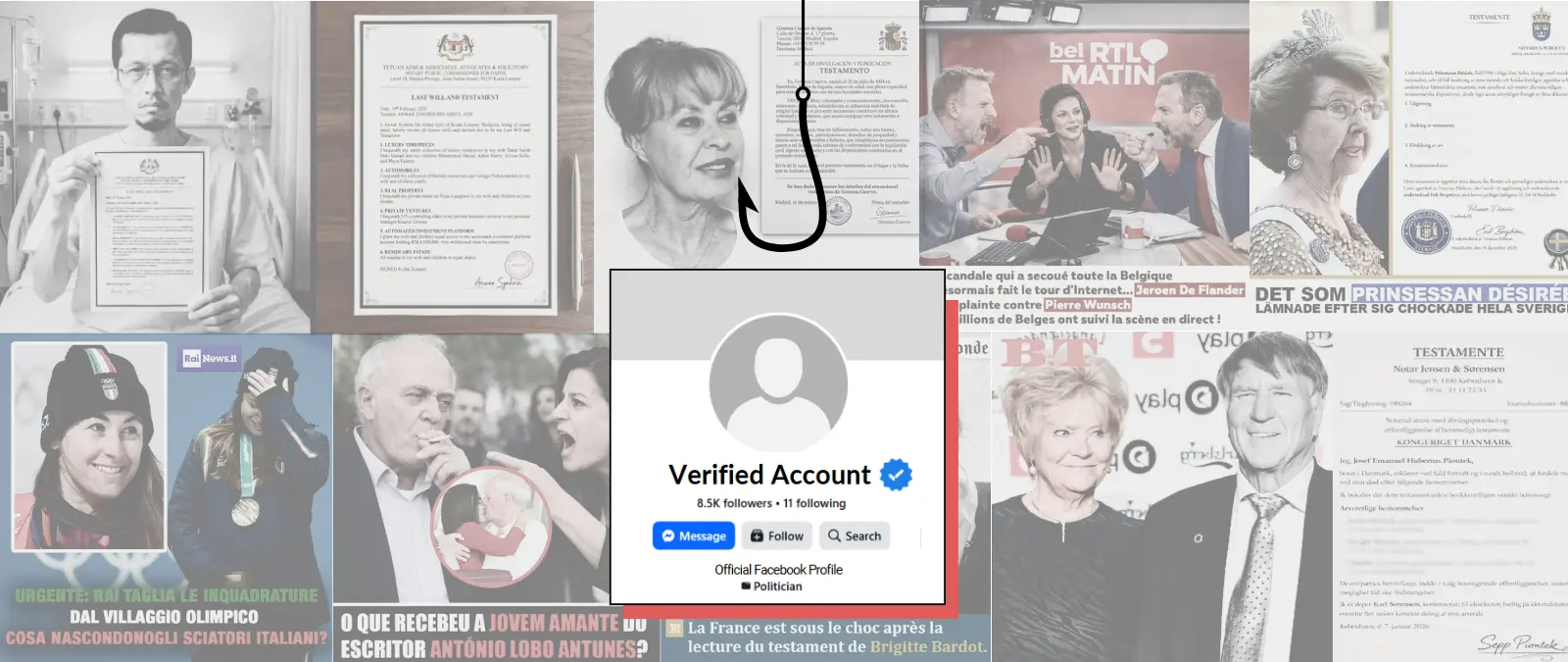
In the first quarter of 2026, 170 profiles with a blue checkmark have published 67,000 fraudulent ads on Facebook and Instagram to promote unauthorized investment platforms where personal data or even an initial deposit is requested. Although these are accounts that Meta claims to have verified, in reality they have been stolen from their legitimate owners or are profiles impersonating athletes, politicians, or actors.
The blue check that appears next to the name of a Facebook profile is supposed to indicate authenticity. It should help other users know that the person is who they claim to be and that Meta has verified this. However, in practice, this badge adds extra credibility and visibility to ads that promote scams. Meta makes money from advertising and from the subscription fee required to obtain the blue checkmark, but it does not adequately prevent impersonation and verifies profiles that do not belong to the people they claim to be.
At the same time, Meta also lacks effective mechanisms to resolve cases where real accounts are hacked and used to run fraudulent ads. Although those affected repeatedly request help to recover their accounts, many never succeed. Their profiles are exploited to promote scams without being able to put an end to the situation.
Verified profiles that publish fraudulent ads on Facebook and Instagram
We have detected 170 Facebook accounts with the blue verification badge that, in the first three months of 2026 and only in Europe, published more than 67,000 fraudulent ads according to data from Meta’s repository. Throughout their entire period of activity, these accounts have published more than 110,000 ads only in the continent. Although we have detected that they have also published ads outside Europe, Meta does not include it in its repository once they become inactive.
Scroll to see how it works

Verified profile on Facebook
A Facebook profile with a blue tick impersonating footballer Lewis Miley.
Verified account
Fraudulent ads published
From the verified profile, ads are published using the likeness of various celebrities targeting different countries.
Deceptive advertising
Fake interviews in media outlets
These ads lead to fake interviews impersonating news outlets, promoting unauthorised investment platforms.
Spoofed media
Personal data harvested
Inside these fake platforms, users are asked to submit their personal details.
Data captureThese accounts published ads targeting at least 33 different countries, for example Chile or Malaysia, or EU member states such as Portugal, Romania, or Sweden, using the image of more than 150 famous people in those places (many of them recently deceased) and of various national media outlets. Normally, the same account shares ads for several countries, while Meta’s transparency information indicates that the pages have administrators in countries such as Vietnam, Ukraine, or Estonia.
Unlike other accounts involved in this type of scam that use invented names of people or media outlets, these verified accounts use the names of real people or groups. Through hacking or impersonation, scammers increase credibility by taking advantage of accounts with authentic names accompanied by the verification badge. According to Meta, this checkmark can only be obtained by paying for a subscription to ‘Meta Verified’ or through the former free and more exclusive process reserved for outstanding individuals, brands, or entities.
In addition to the blue checkmark, other elements that make the ads from these accounts appear more legitimate are their high number of followers (they have an average of more than 57,000) and their creation date: 88% were created over a year ago.
Accounts that impersonate famous people and are verified by Meta
‘Meta Verified’ is a paid subscription for Facebook and Instagram which, according to Meta, “helps you build more trust” and “protect your brand”, and even gives you "prioritization and greater visibility in some areas”. All the available options include the verification badge to “convey trust” and a supposed proactive monitoring service for accounts that might be impersonating you.
‘Meta Verified’ accounts using the names of footballers Pedro Neto or Arthur Theate have published hundreds of these fraudulent ads. However, representatives of both have confirmed to Fundación Maldita.es that these profiles are fake and that neither of the two players has a Facebook account.
Other well-known figures such as elite athletes Jobe Bellingham, Fabián Ruiz or Jacob Toppin, or actress Geraldine Viswanathan are among the verified profiles detected publishing ads. All share common characteristics with confirmed impersonated accounts, such as similar profile biographies.
Meta’s inaction regarding account hacking
Among the verified accounts analyzed, there are also cases of real profiles belonging to individuals and institutions that have been accessed by unauthorized people. Once they obtain the necessary permissions, they use these accounts with public relevance to spread fraudulent ads. This has been explained to Fundación Maldita.es by people from fields such as music, television, and the third sector who have suffered account hacking.
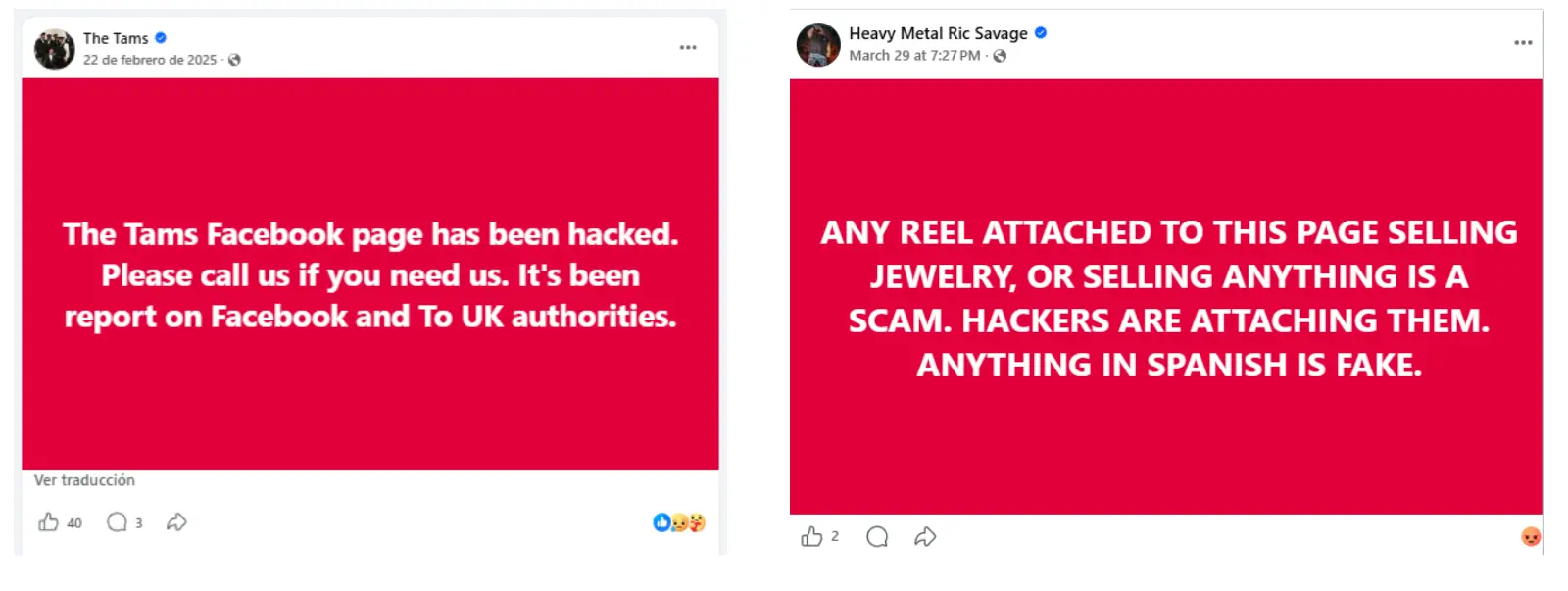
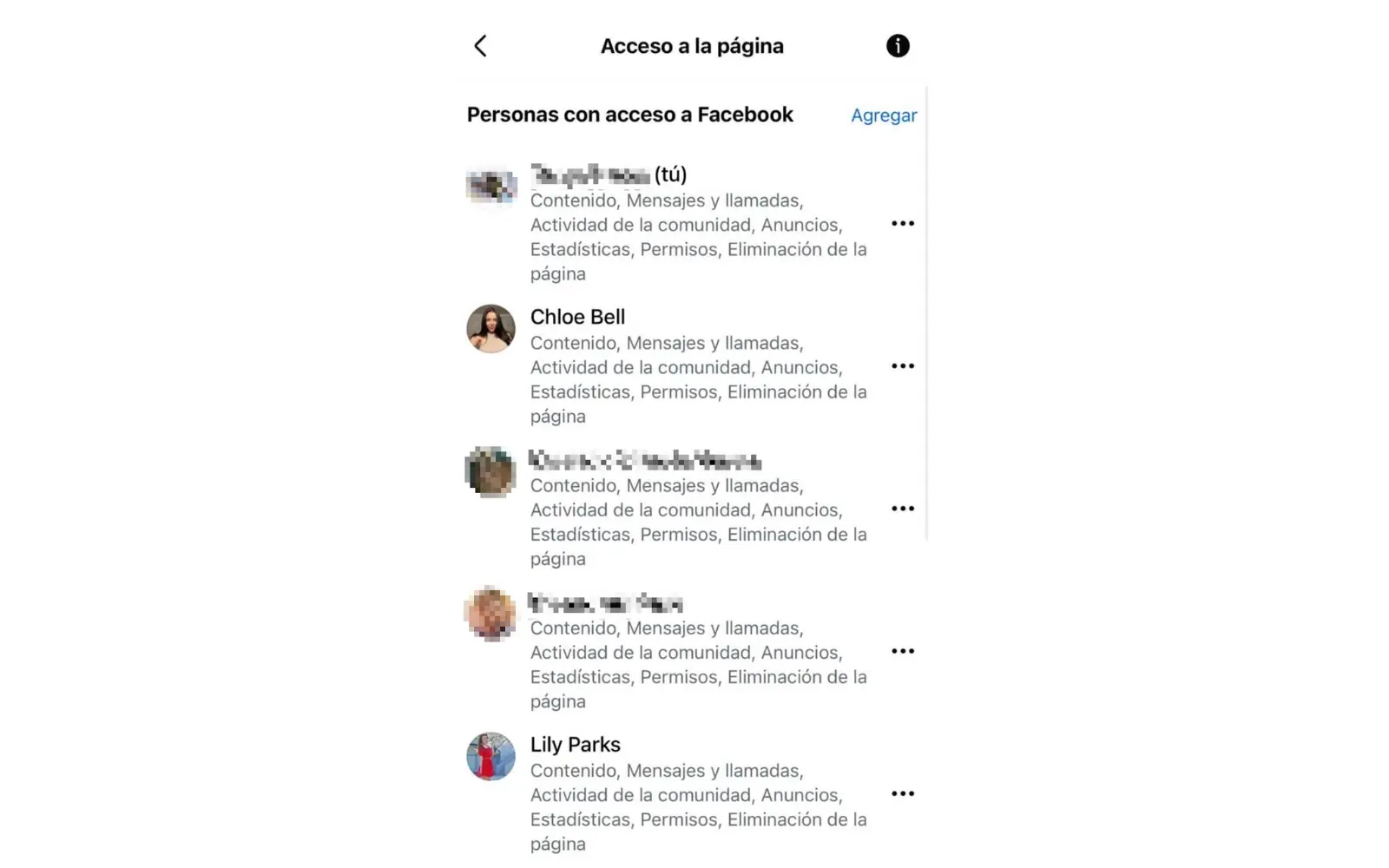
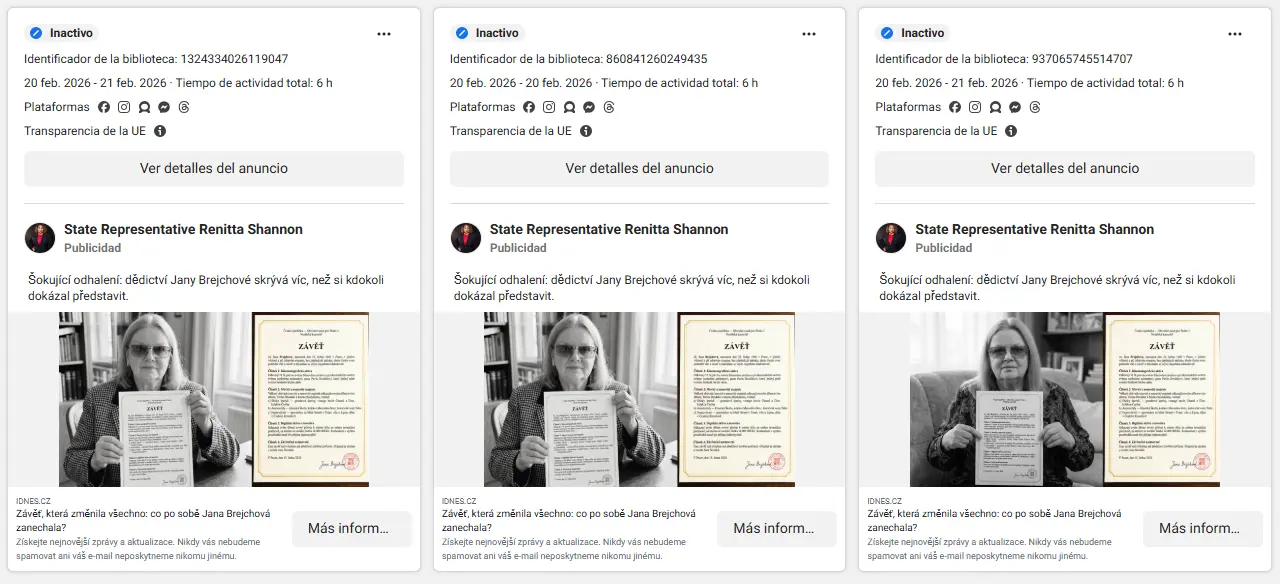
Renitta Shannon, former member of the Georgia House of Representatives (USA), has seen her profile hacked. She explains to Fundación Maldita.es that she has repeatedly reported the incident to Facebook “to prove that someone has taken over” her account and is impersonating her “by posting ads that usually go against the values” she defends. However, she adds that “Facebook has refused to do anything about this” and that she cannot “post or shut down the page because the scammers have taken over.”
A deceptive design and revenue for Meta from ads and subscriptions
At the end of 2025, the European Commission imposed a €120 million fine on X for failing to comply with obligations under the Digital Services Act. Specifically, for the deceptive design of the “blue verification badge.” The investigation concluded that X does not meaningfully verify who is behind each account that obtains this checkmark, also through a paid subscription.
The same practice seen on X, which exposes users to scams, also takes place on Facebook and Instagram. Here, verification systems are also not working properly with accounts that, while impersonating celebrities, manage to access ‘Meta Verified’, even though one of the requirements is to submit an official photo ID.
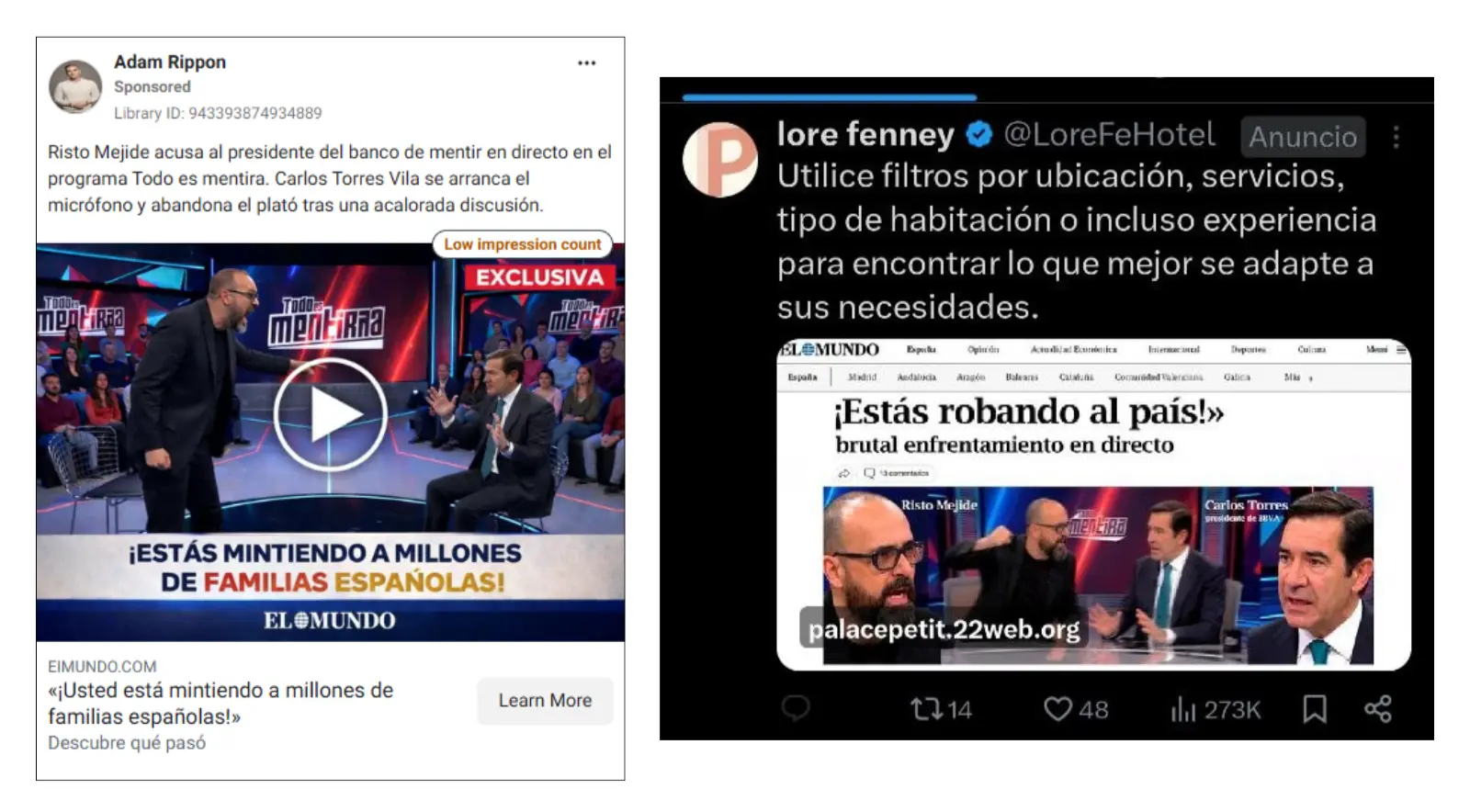
The ‘Meta Verified’ subscription also claims to provide “uninterrupted access to support from its agents”, but testimonies from people who have suffered hacks and whose accounts are being used to spread frauds report passivity from Meta in resolving the situation.
While these individuals’ reputations are affected, Meta generates revenue twice from these scams. On one hand, through the more than 67,000 ads published in just three months by these 170 verified accounts. On the other, through Meta Verified subscriptions paid to obtain the blue checkmark, with plans ranging from the standard €13.99 per month per profile to the Max plan at €349.99.